- Home
- Insights & Immigration News Alerts
- Insights
- Envoy Global's U.S. Corporate Immigration Trends 2026 Report
GUIDE | Updated June 2026
U.S. Corporate Immigration Trends
2026 Report
Contents


As the Trump administration continues to advance one of the most consequential overhauls of the U.S. immigration system in years, Envoy Global’s U.S. Corporate Immigration Trends Report provides an exclusive, data-driven look at how more than 500 HR and global mobility professionals are navigating these changes while maintaining compliant programs that enable organizations to secure the talent they need.
The 2026 U.S. Corporate Immigration Landscape
Employers entered 2026 facing an immigration landscape defined by rising unpredictability and increasing resource demands.
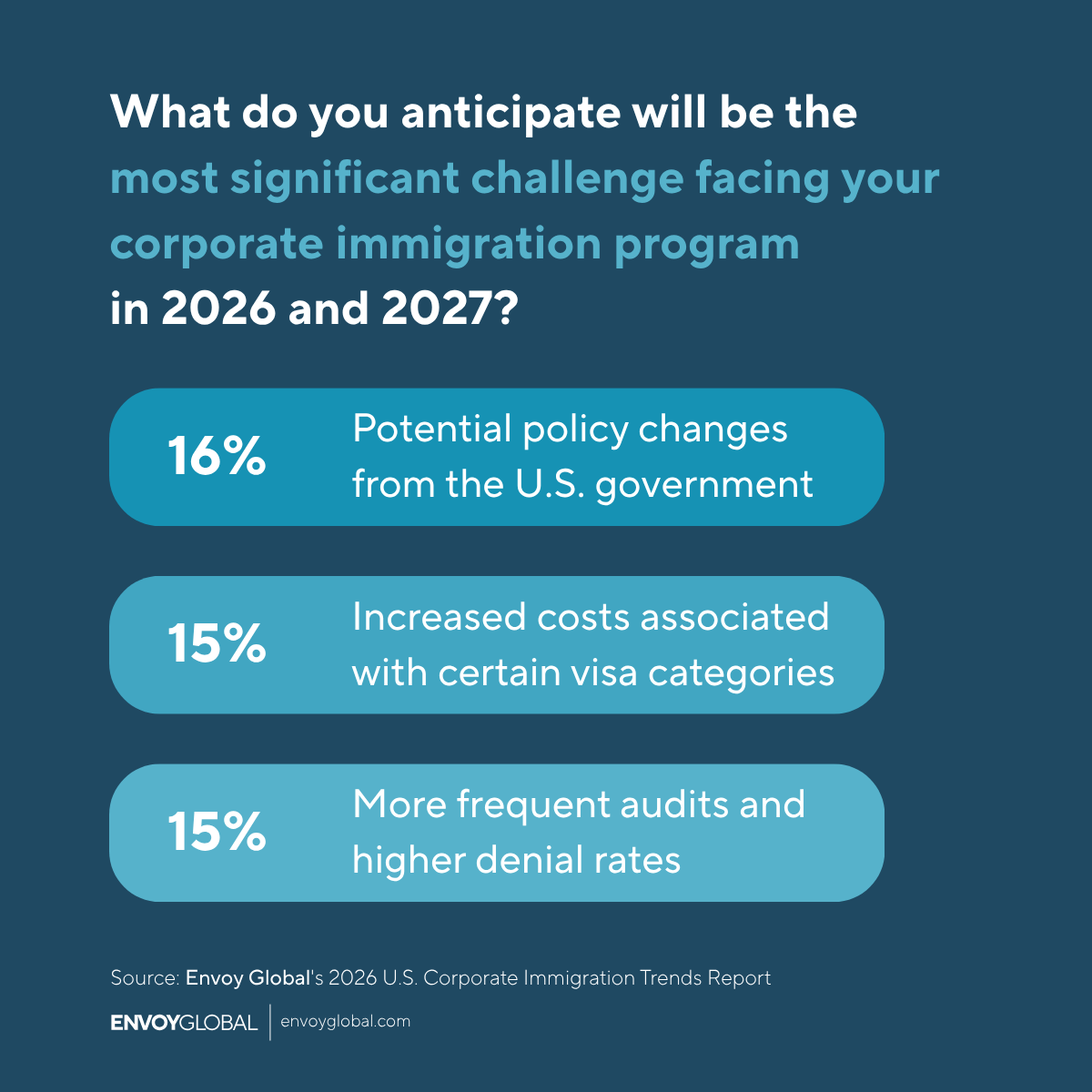
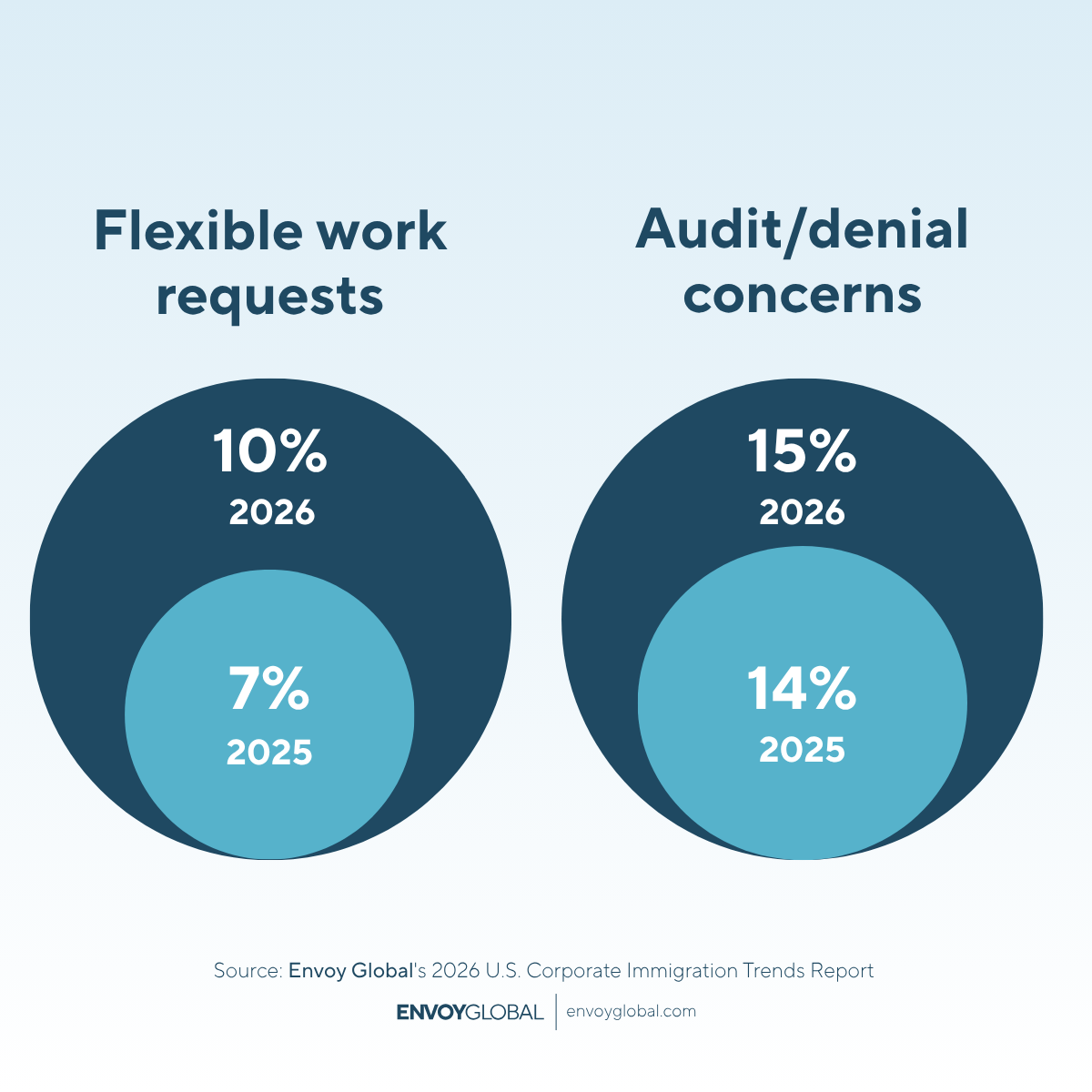
In 2025, employers identified potential U.S. government policy changes (21%) and more frequent audits and visa denials (14%) as their biggest anticipated challenges for 2025–2026. The second Trump administration’s actions during its first 18 months have reinforced those concerns.
HR and mobility teams spent much of the past year responding in real time as the system became harder to predict and more expensive to navigate.
Across the board, employers now report that their immigration programs are being shaped within an increasingly complex and interconnected landscape in 2026.
These forces set the tone for the year and influence every aspect of strategy, from H‑1B planning to global workforce decisions.

2025: A Year of Rapid Regulatory Change
The major changes in legal immigration during the last half of 2025 – particularly the $100K fee for H-1B consular processing, which practically eliminated offshore hiring, the travel and entry restrictions for nationals of dozens of countries, the indefinite pause on immigrant visa options at U.S. consulates abroad for nationals of 75 countries and the new wage-weighted H-1B cap selection system – will continue to have a ripple effect throughout 2026.
For a deeper look at the immigration policy changes defining 2025 and 2026, read the full analysis with Sherry Neal.
Top Anticipated Challenges in 2026–2027
Looking ahead in 2026 and into 2027, employers expect a more complex and demanding environment to shape how their immigration programs operate.

Managing Risk in a Period of Heightened Scrutiny
Even without any statutory reform over the past 30 years, changes in agency interpretation, enforcement priorities, processing standards and adjudication guidance continue to materially affect eligibility, timelines and program planning.
Employers have also seen that policy changes can be implemented rapidly and with no-to-limited transition periods, making long-term workforce planning difficult—particularly for critical-skill roles.
Growing concern around audits and denials reflects employers’ experience with a more assertive enforcement posture and heightened adjudicatory scrutiny across multiple agencies.
Organizations are encountering more frequent Request for Evidence (RFEs), narrower eligibility interpretations, denials and increased workplace audits affecting I‑9, H‑1B, PERM and wage compliance.
While employers cannot control enforcement trends, they can control their level of audit readiness, documentation discipline and response planning. Denials or delays can disrupt operations, delay critical projects and elevate reputational risk, making proactive compliance infrastructure and denial contingency planning essential.
The Fastest‑Growing Employer Concerns
Flexible work requests and audit/denial activity show the sharpest year-over-year increases, reinforcing the sense that the system is becoming harder to navigate.
Federal Enforcement Concerns
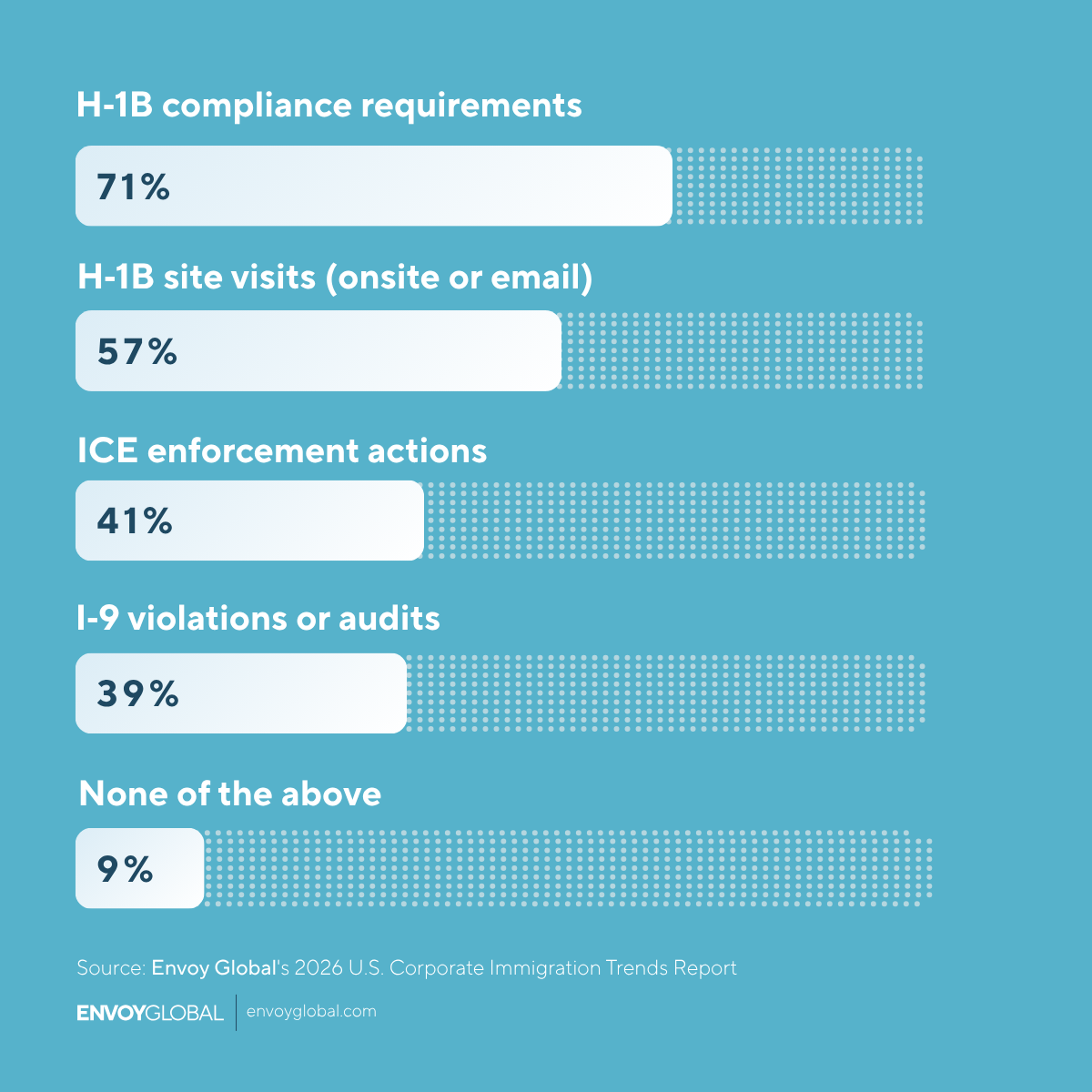
Federal enforcement remains a central concern for employers in 2026, with H‑1B scrutiny shaping much of how organizations are thinking about compliance.
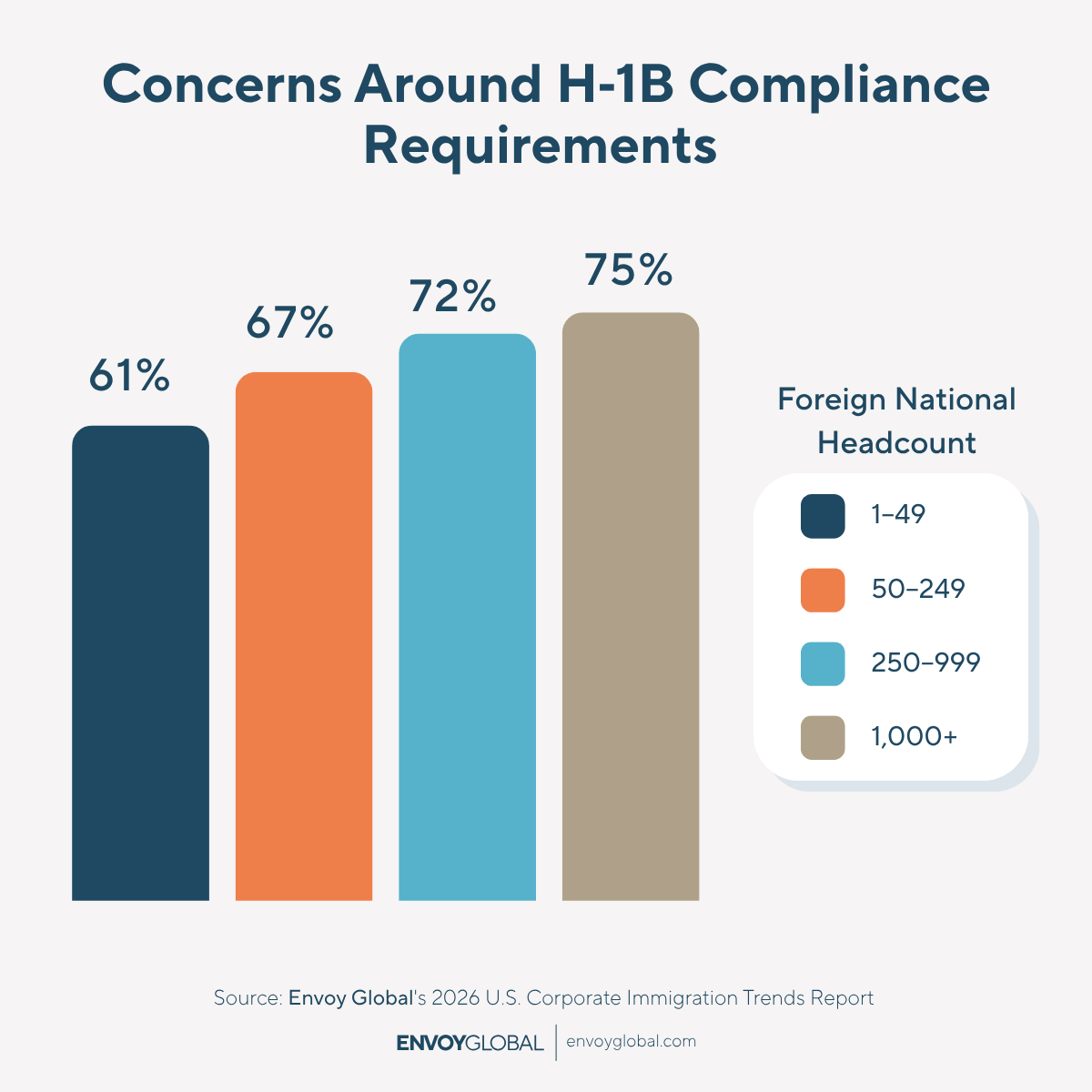
H‑1B Compliance Concerns by Program Size
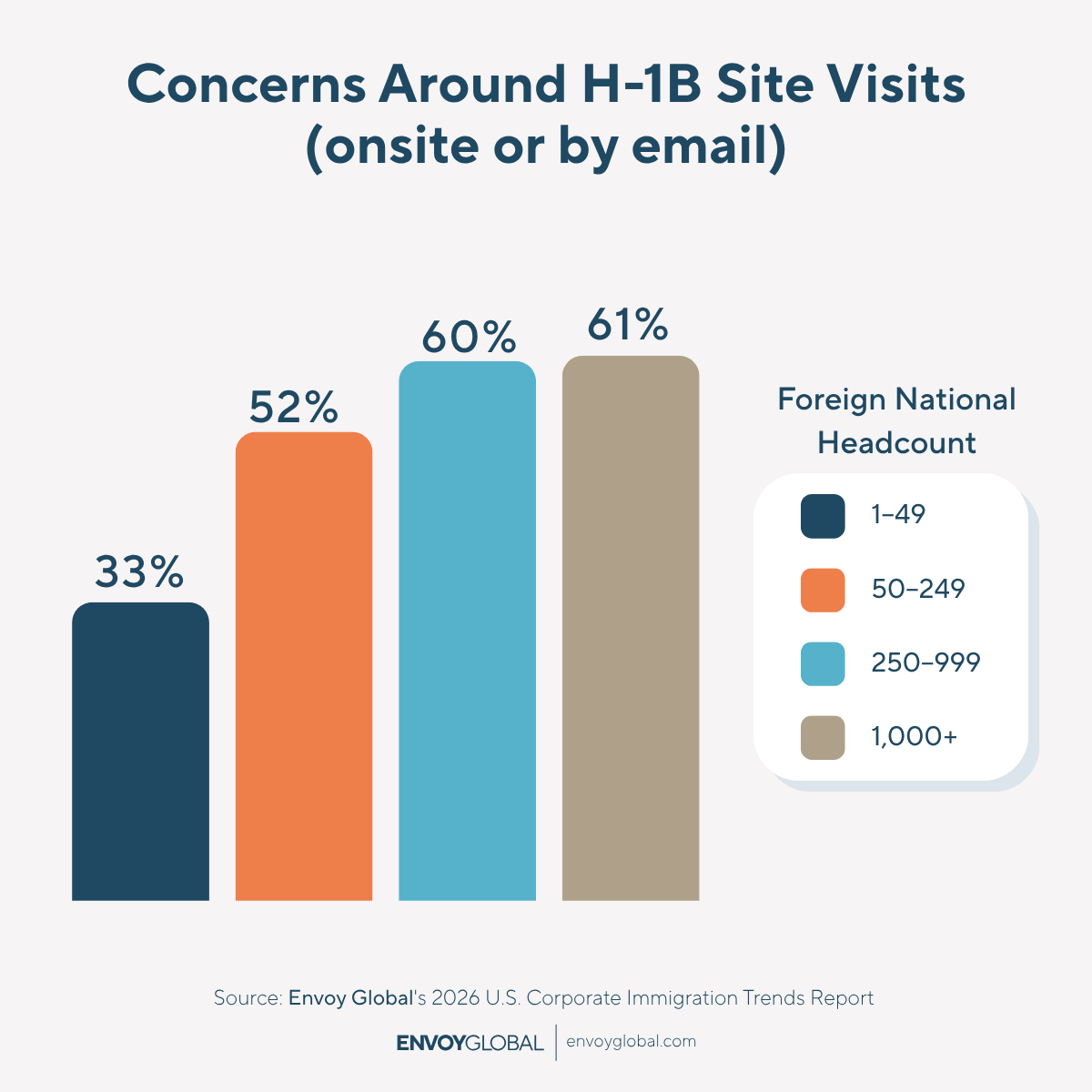
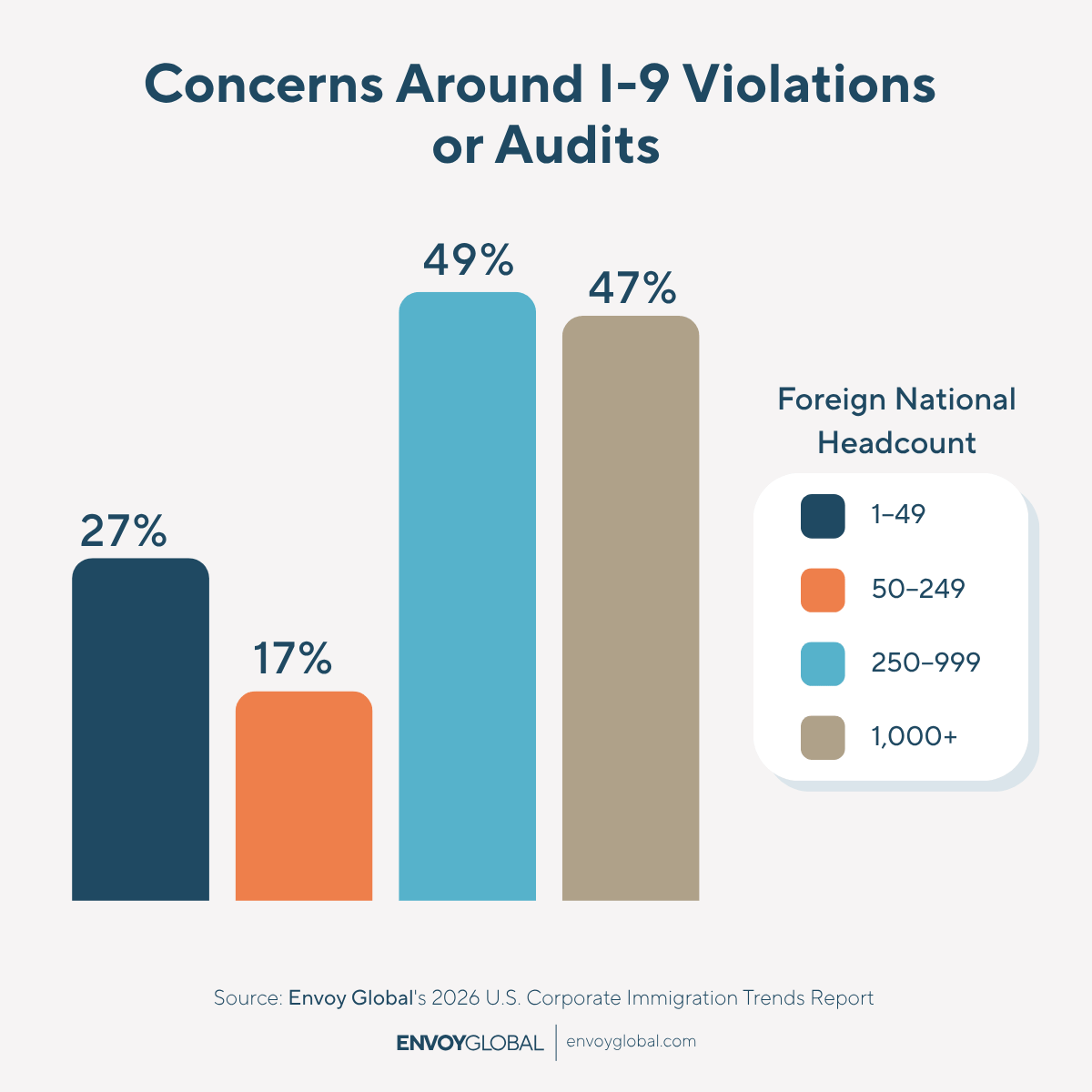
Employers with sizable foreign national populations express the greatest compliance concerns, particularly across core federal immigration enforcement activities.
H‑1B Site Visit Concerns by Program Size
I-9 Related Concerns by Program Size
Compliance Concerns
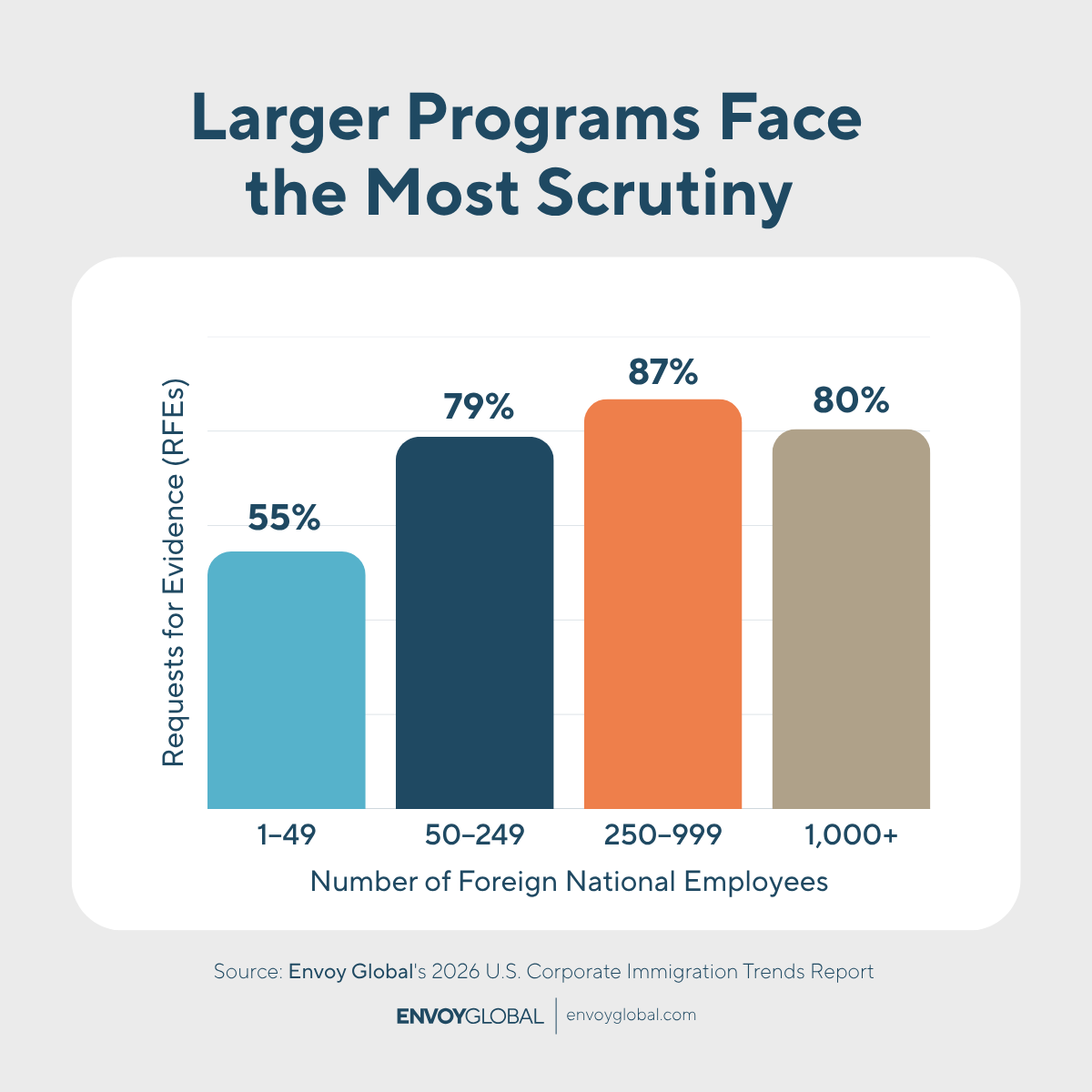
Although RFE rates have not returned to the elevated levels seen during the first Trump administration, employer sentiment suggests that scrutiny is intensifying.
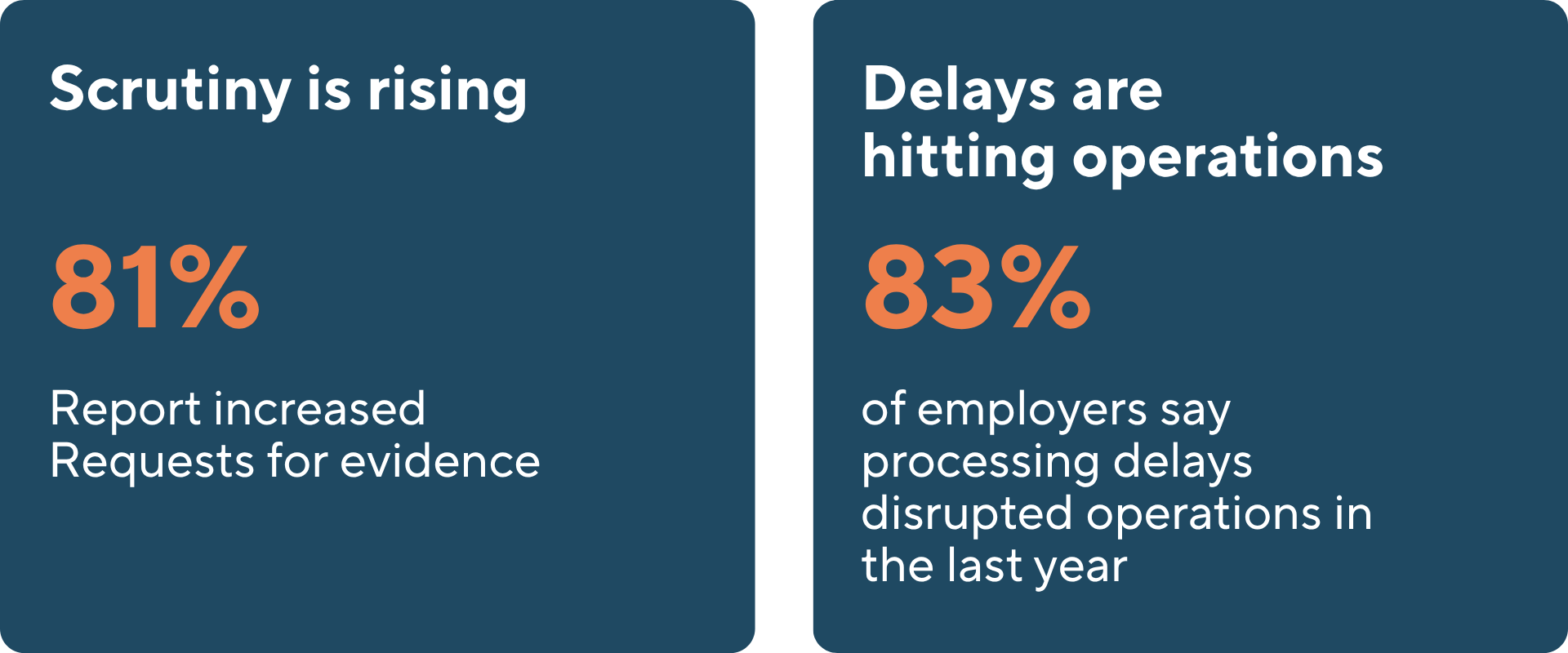
When asked about RFE trends over the past four years, 81% of employers report that RFEs for the visa petitions or applications they file have increased.
Larger Programs Face the Most Scrutiny
RFE increases sharply with the number of foreign nationals, underscoring how program size shapes exposure.
Visa Process Challenges
Visa Challenges Are Hitting Some Sectors Much Harder
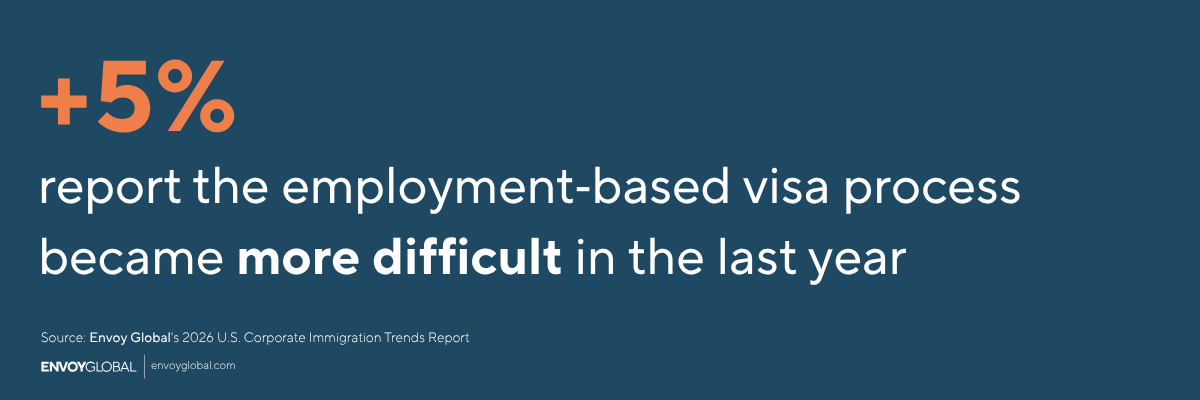
Perceptions of visa process difficulty vary significantly by industry, reflecting how differently policy changes are impacting employers’ day-to-day experience.
- Healthcare and life sciences: 51.2% say the process has become more difficult since 2025 — the highest of any sector.
Environment and agriculture: 50% say the process has become less difficult since 2025, aligning with recent policy adjustments to temporary worker programs.
Visa Challenges Are Hitting Some Sectors Much Harder
This year’s data shows that a majority of healthcare employers are facing increased difficulty with immigration processing. In real-time, we are observing how immigration policies that raise costs and slow processing are further constraining access to healthcare workers.
Some healthcare workers who have already been recruited, credentialed, passed U.S. licensing exams and waited a few years for their priority dates to become current were hit with further delays caused by the administration’s travel ban and immigrant visa pause.
For a deeper look at why these impacts are hitting certain industries harder, read Sherry Neal’s analysis on how the immigrant visa pause has disrupted long-planned workforce pipelines.
Sponsorship Challenges
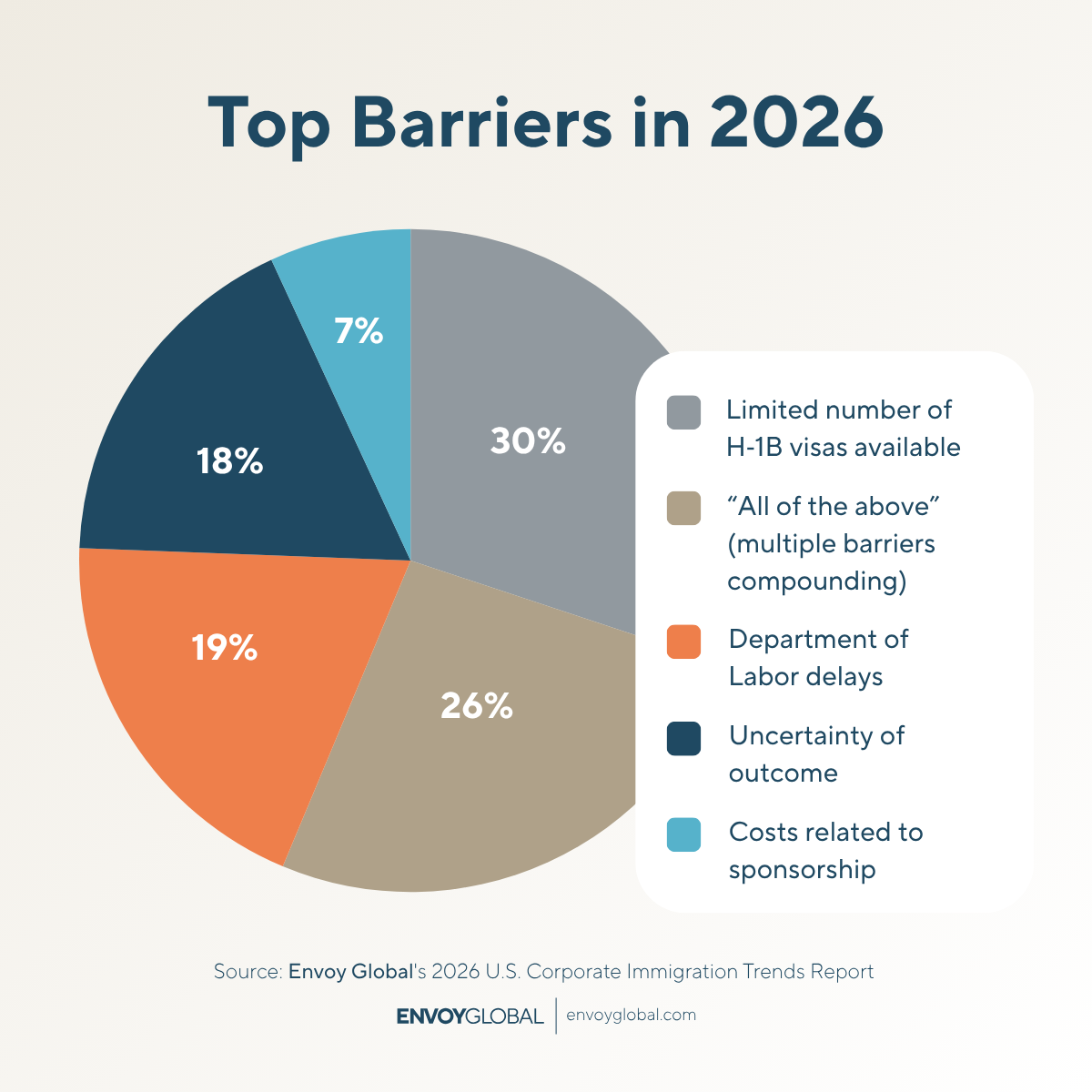
The limited number of H-1B visas remains the most significant barrier to sponsorship in 2026, a constraint that continues to shape employers‘ hiring strategies.
The Primary Barriers to Sponsorship
The strong showing of “all of the above” underscores that employers are rarely facing a single isolated challenge; rather, they are navigating interconnected barriers spanning visa limits, processing delays, rising costs and uncertain outcomes. These compounding pressures amplify risk across the entire sponsorship lifecycle.
For many employers, the $100,000 H‑1B fee has become a stark symbol of this cumulative risk, as a previously common fix of departure and re-entry to the U.S. can require a $100,000 payment.
H‑1B Limitations Still Dominate Sponsorship Challenges
The H‑1B cap remains the defining structural constraint in the sponsorship process, increasingly shaping how employers approach talent strategy.
While the cap itself is not new, recent policy developments—such as increased fees and evolving selection mechanisms—may be magnifying its impact.
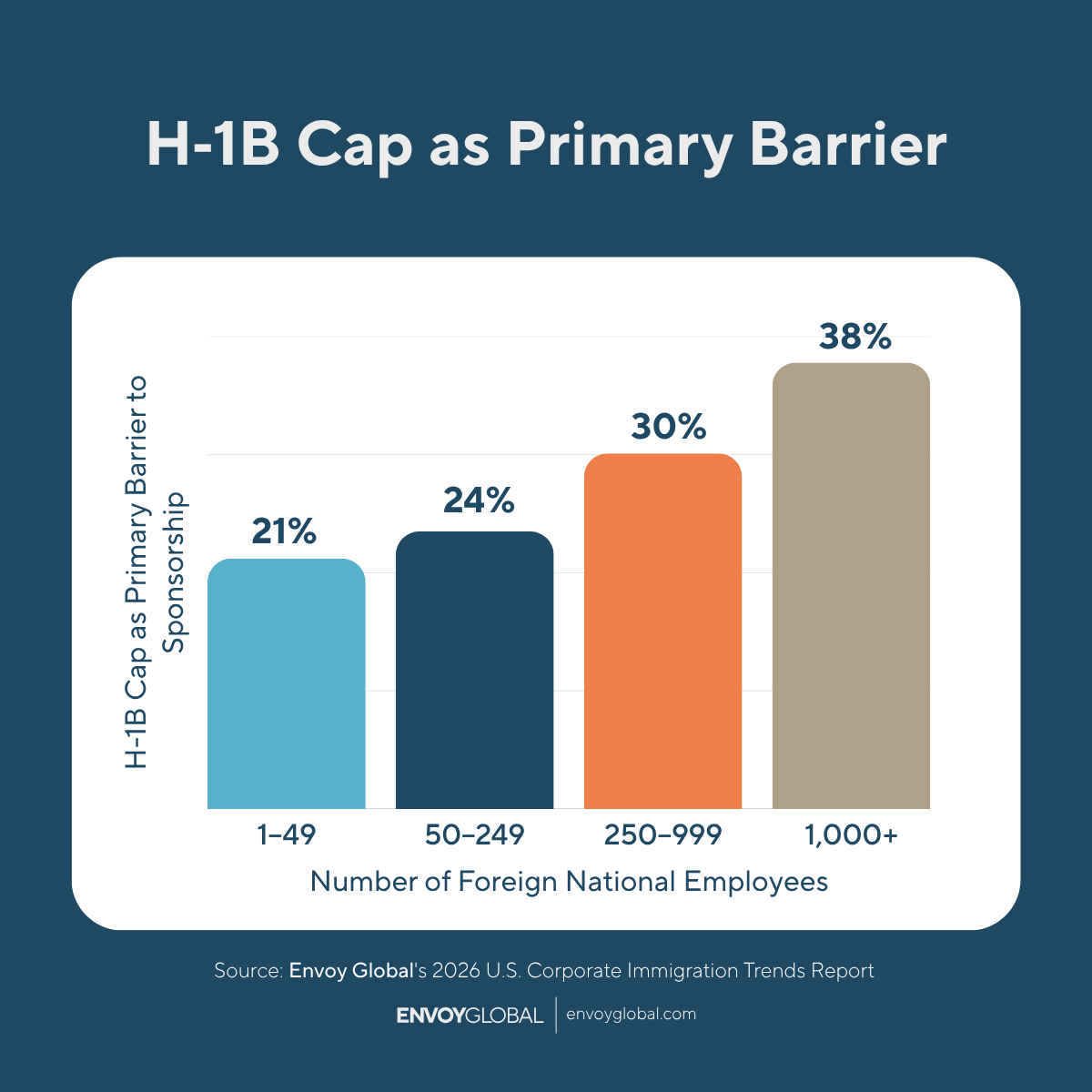
And in 2026, organizations with larger sponsored populations experience this constraint most acutely.
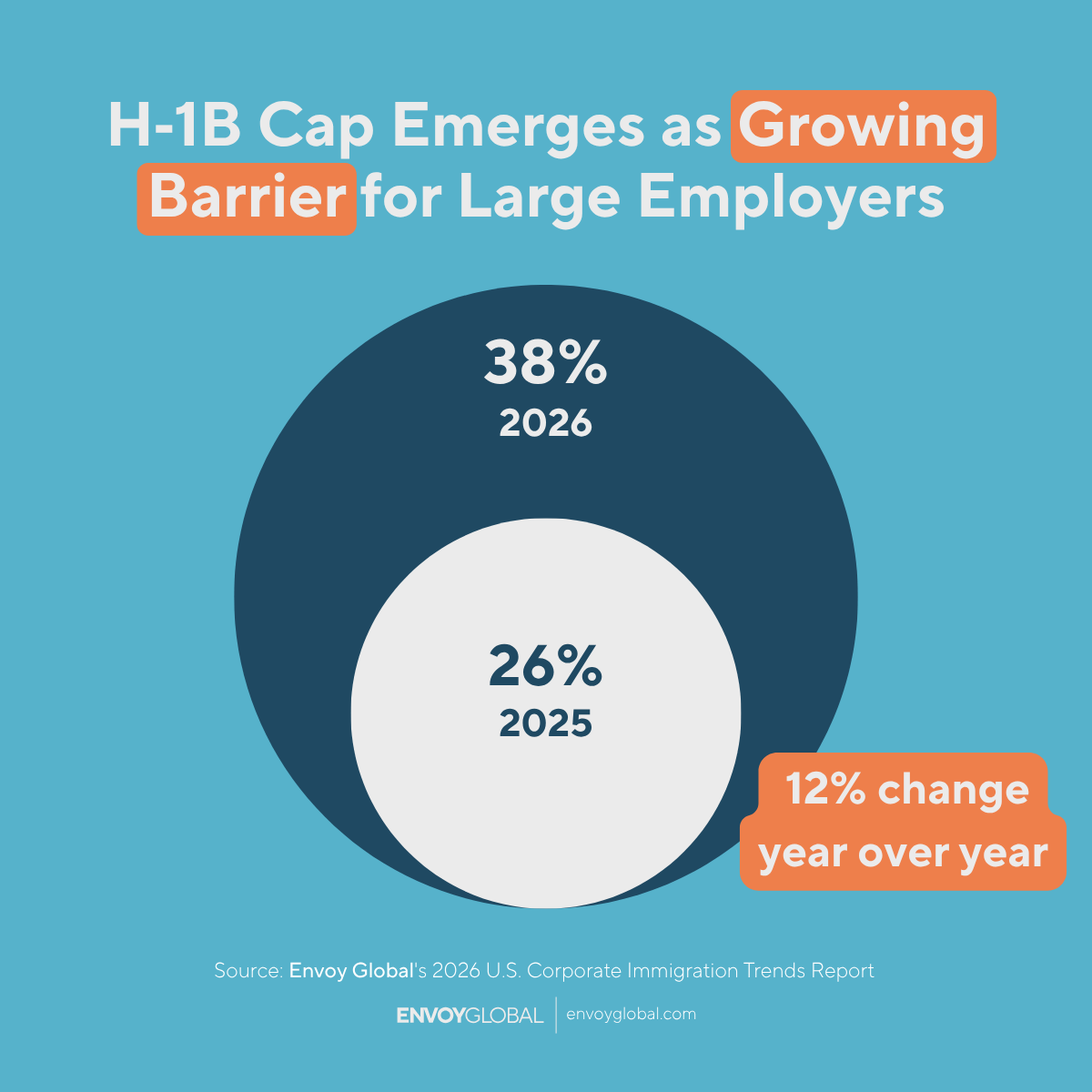
In the last year, large employers (1,000+ foreign nationals) have increasingly cited the limited supply of H‑1B visas as their top barrier to hiring and sponsoring foreign national talent in the U.S.
H‑1B Cap Pressure Rising Most Among the Largest Workforces
Compared to 2025, employers with 1,000+ sponsored foreign national employees reported the sharpest increase in identifying the H-1 B cap as their primary barrier.
Rising Talent Loss Due to Visa Challenges
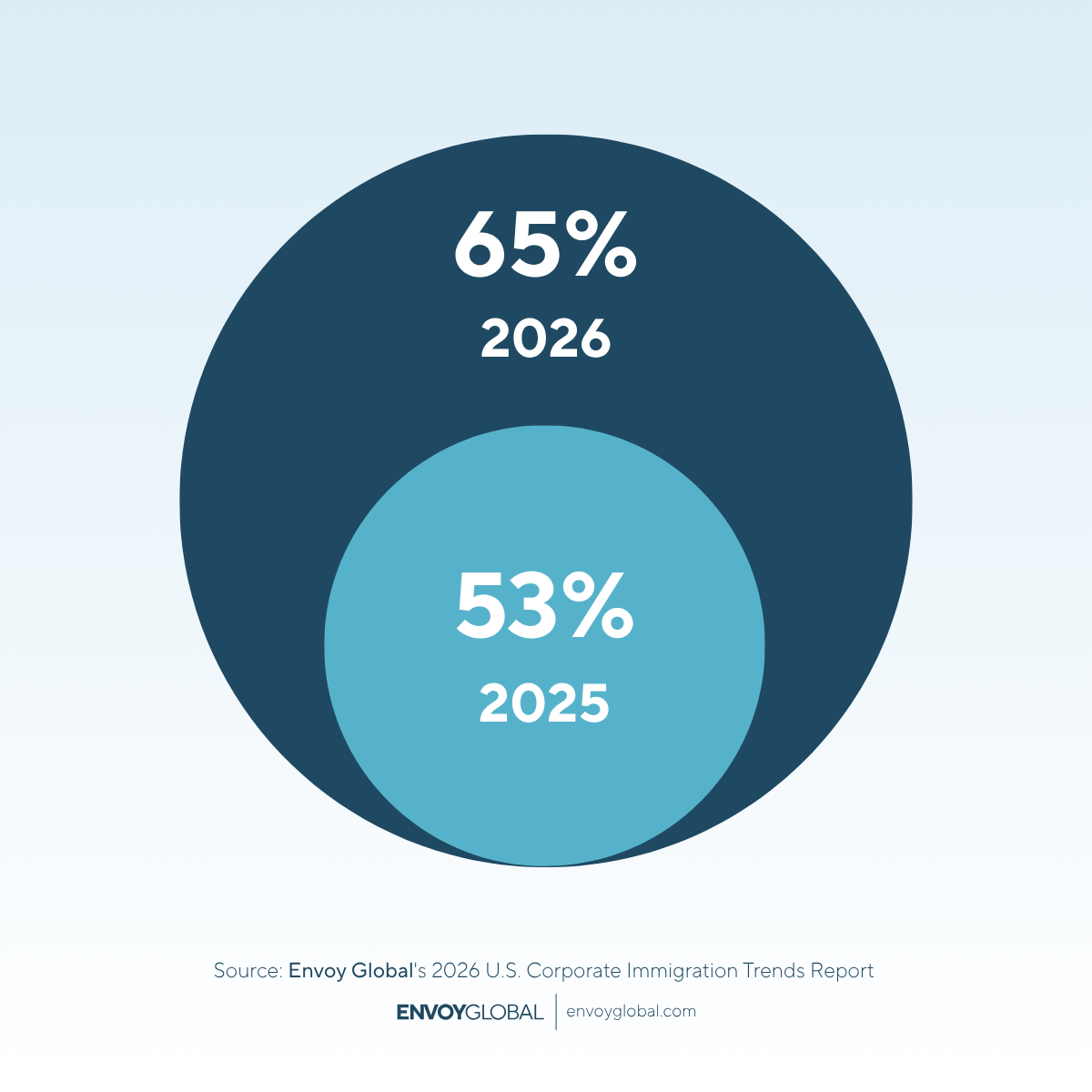
In an increasingly complex and unpredictable immigration environment, workforce disruption is becoming more common.
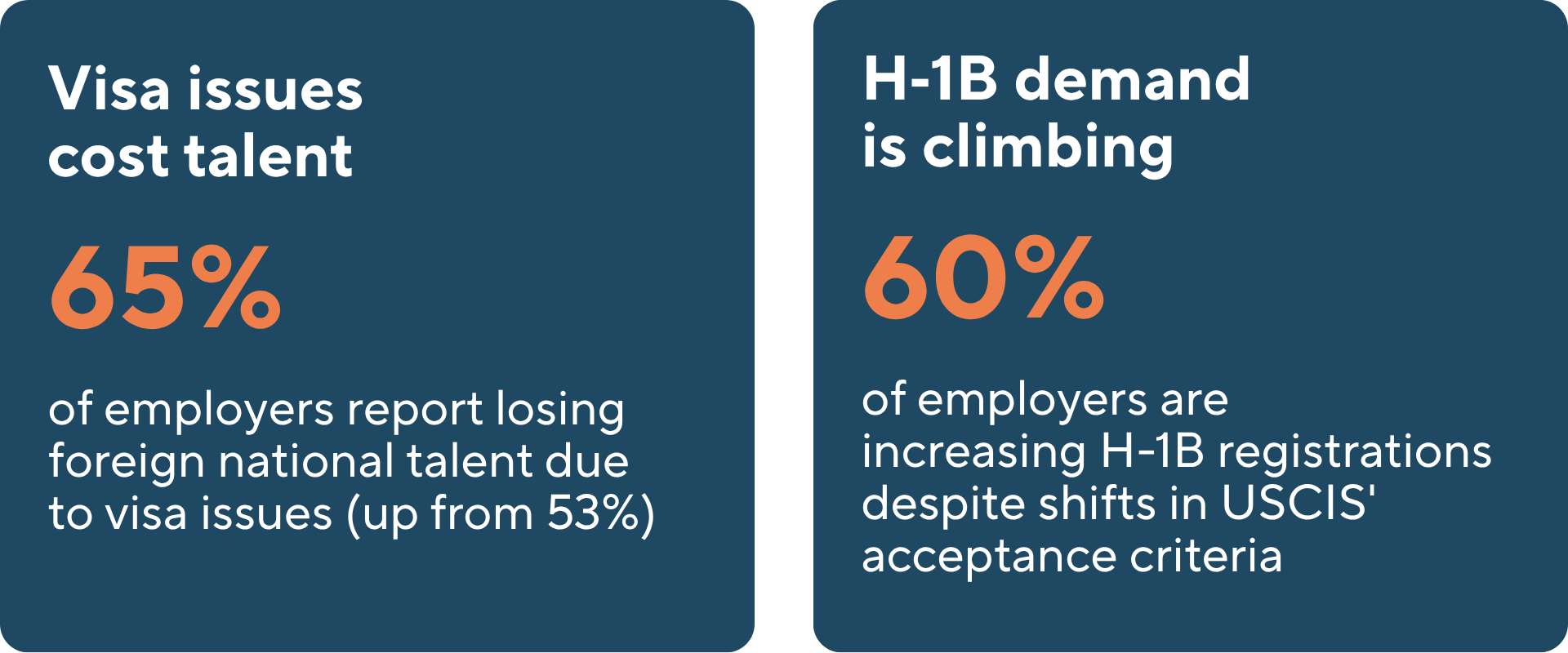
In 2026, 65% of employers report that foreign national employees left the U.S. in the past year due to visa-related issues—up from 53% in 2025.
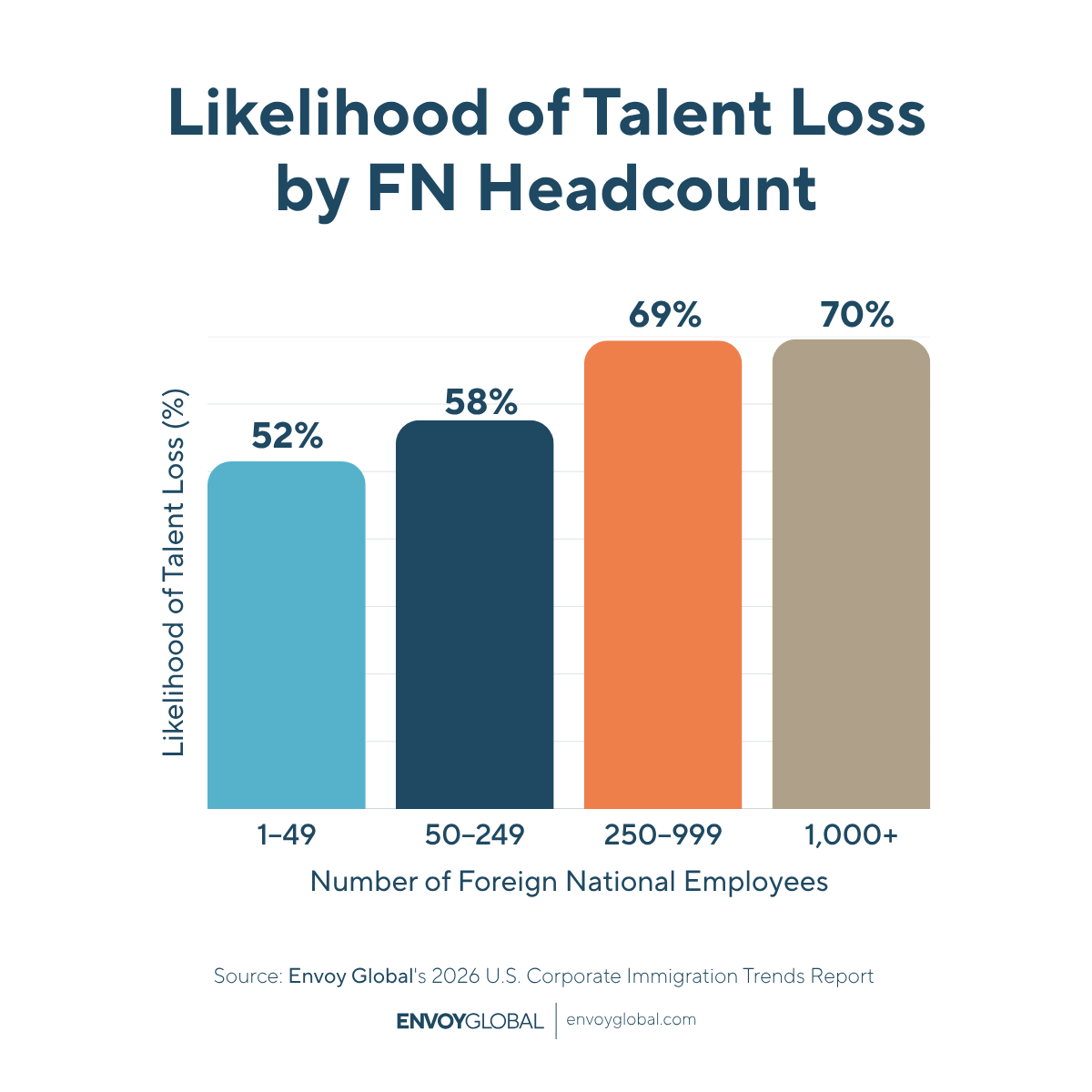
Talent Loss Increases with Program Size
Nearly 7 in 10 employers with 250+ sponsored foreign national employees report losing talent due to immigration challenges. And H‑1B‑heavy employers are even more affected: Organizations with large H‑1B populations report talent loss rates as high as 76.5%.
Nearshoring and Offshoring Become Core Strategies
As talent loss accelerates, employers are increasingly turning to global parking, nearshoring and offshoring to retain critical skills and maintain business continuity.
Employers Expect to Shift More Roles Abroad in 2026
In 2026, 68% of companies expect to turn to nearshoring or offshoring to address immigration barriers and domestic labor shortages.
H‑1B‑Heavy Sectors Lead the Shift towards Nearshoring and Offshoring
Organizations with large H‑1B populations show the strongest pivot toward global redistribution.
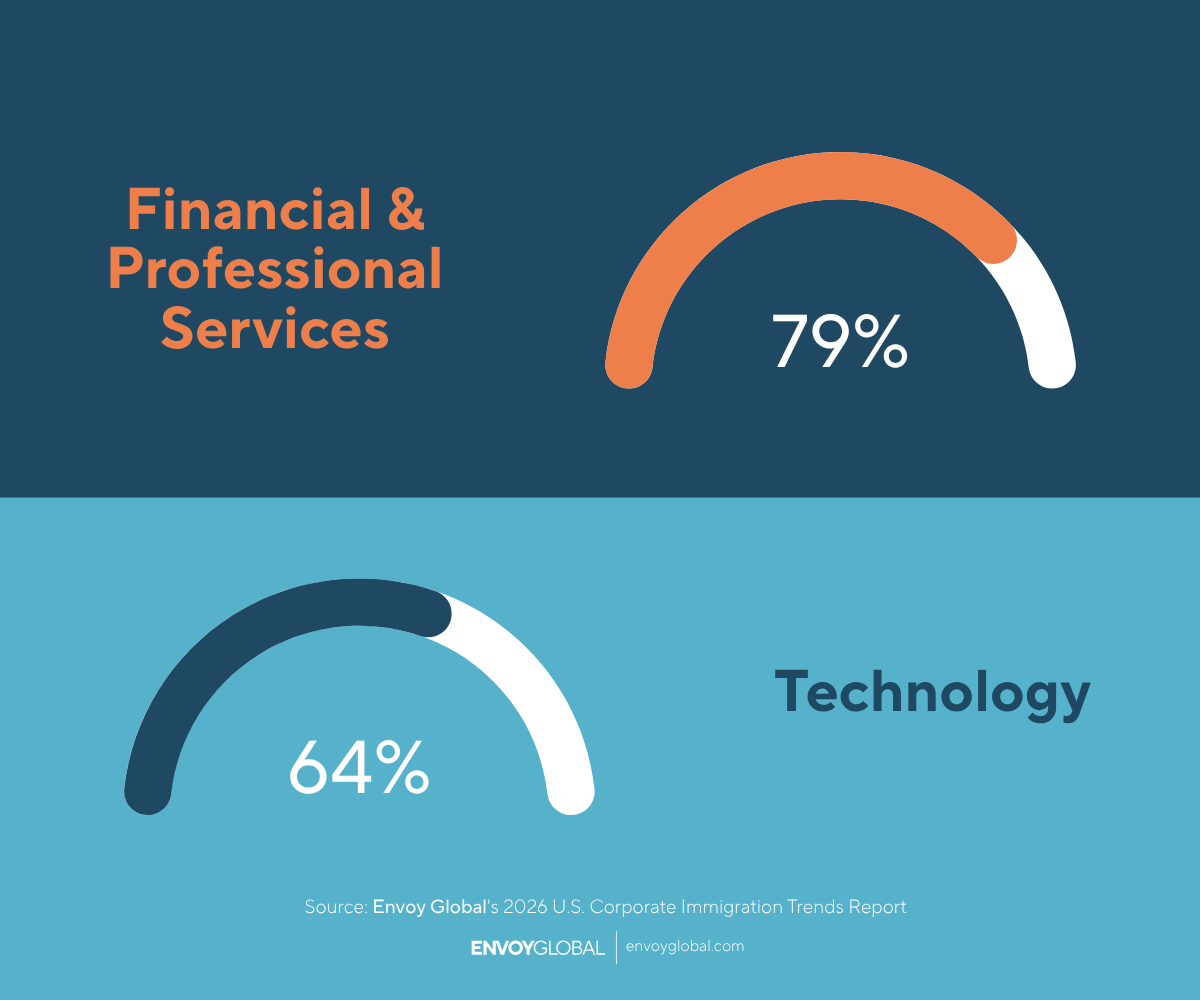
Nearshoring Trends by H‑1B Program Size
Employers with larger H‑1B populations are significantly more likely to turn to nearshoring or offshoring in 2026. As foreign national headcount grows, organizations increasingly rely on global redistribution strategies to maintain continuity and access talent without U.S. immigration constraints.
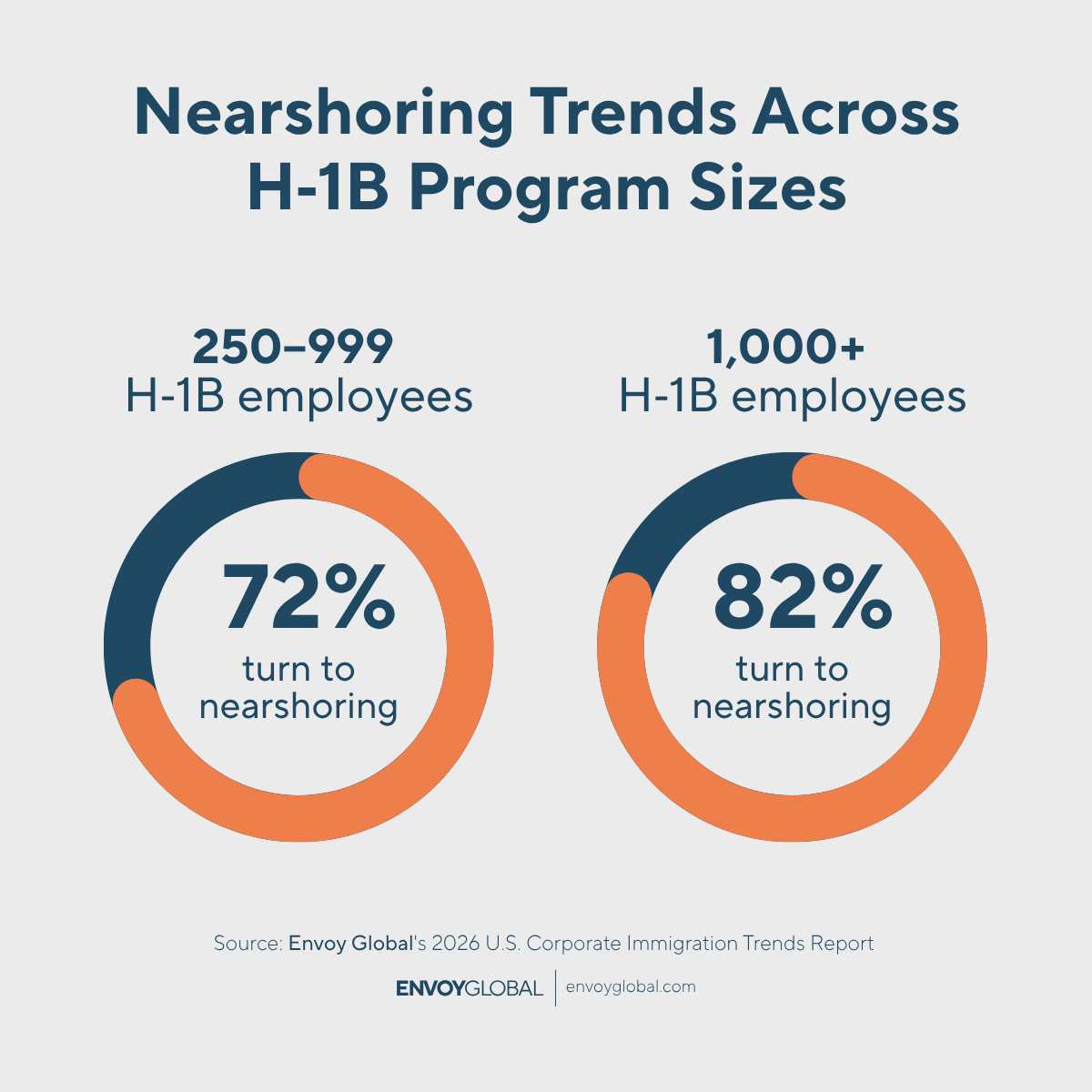

Visa Constraints Are Reshaping Talent Strategies in High-Skill Industries
Both the financial and professional services and technology sectors rely heavily on specialized, high-skilled talent pools, including software engineers, data scientists, quantitative analysts and consulting professionals, where domestic labor supply has not consistently met demand.
Historically, the H-1B and L-1 visa programs have served as critical workforce pipelines to fill these gaps. However, increasing visa unpredictability has materially reduced employers’ ability to access and retain this talent in the U.S. reliably.
For a deeper look at why these sectors are leading the shift toward global redistribution, read Nicole Harnett’s analysis on how structural visa constraints are reshaping workforce strategy across H‑1B‑heavy industries.
Immigration Program Management in 2026
Despite growing complexity across the immigration landscape, employers are continuing to move forward with immigration programs by expanding internal ownership, with HR and mobility teams taking on broader roles across both strategy and day-to-day execution.
Immigration Oversight Teams
99% of organizations have two or more people responsible for immigration. As the immigration landscape becomes more complex, oversight is expanding, with more employees involved in managing immigration programs across the organization.
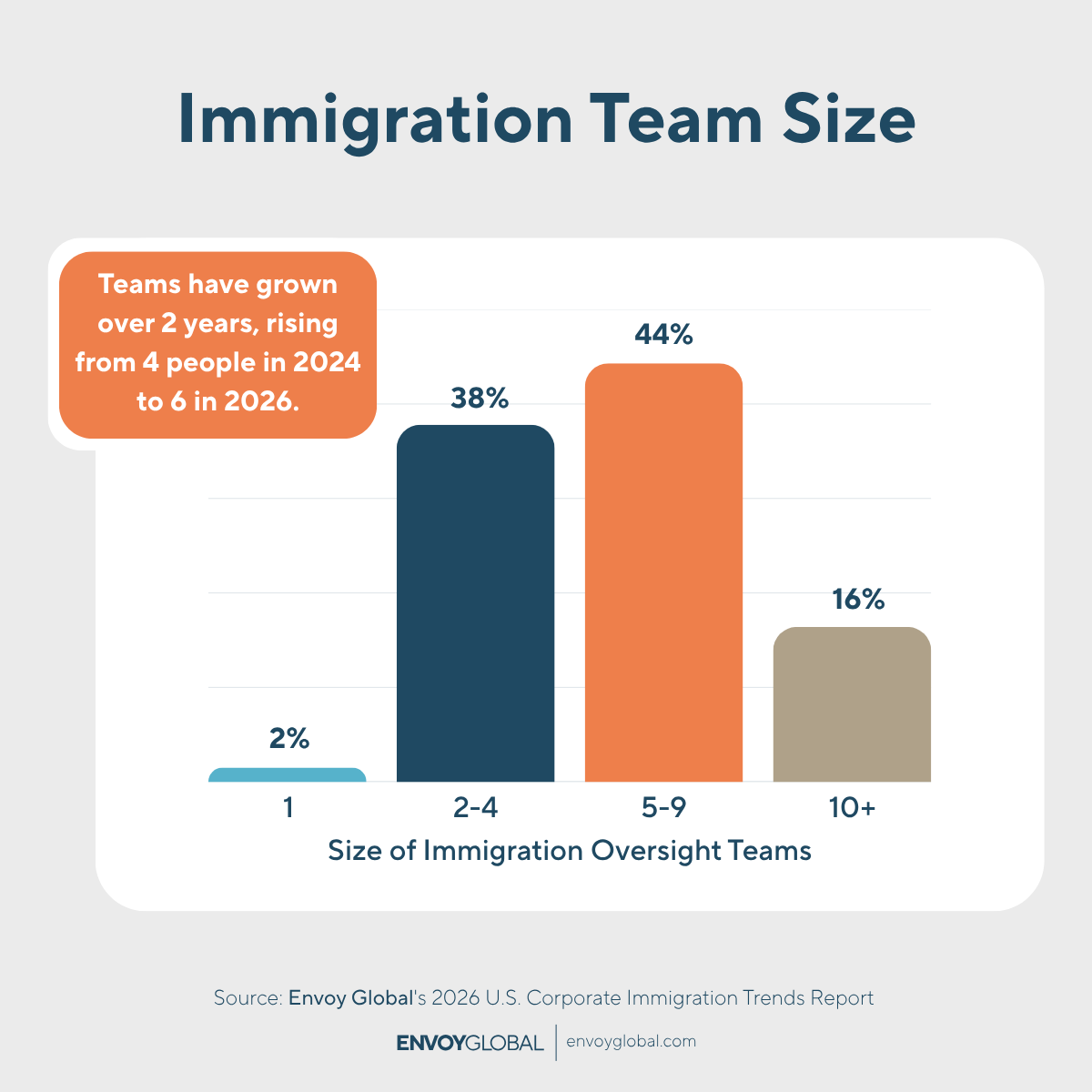

Rising Complexity Is Driving Larger Immigration Teams
As immigration programs grow more complex and high‑stakes, employers are expanding the number of individuals involved in oversight to manage volume, compliance demands and risk.
Larger teams reflect the need for greater coordination across filings, timelines and stakeholders, as well as increased attention to audit readiness, budgeting and long‑term workforce planning.
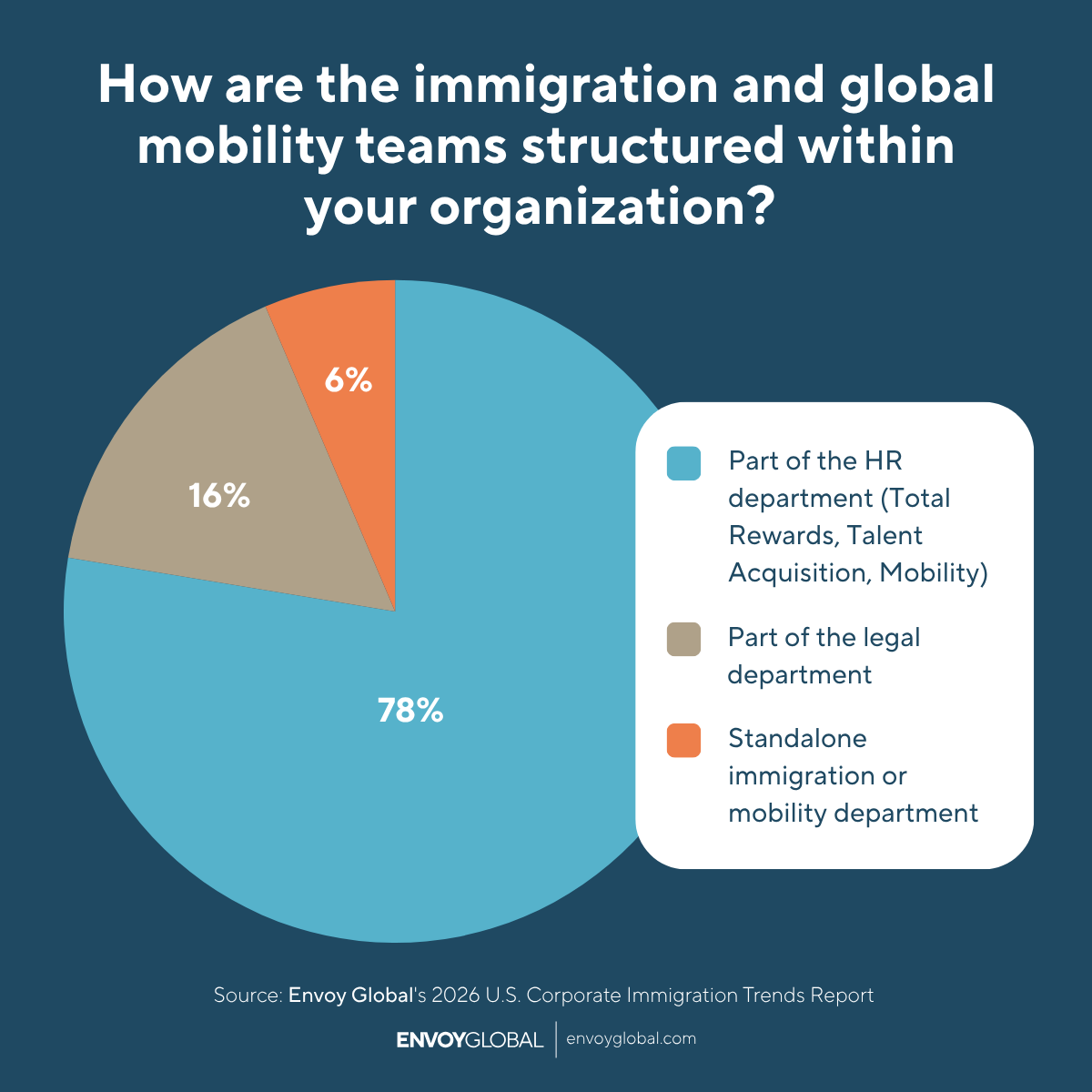
Immigration Still Sits with HR
As these teams grow, employers are becoming more deliberate about where immigration-related work sits within the organization.
In 2026, more than three‑quarters of organizations place immigration within HR functions such as talent acquisition, mobility and total rewards.
HR Is Managing a Broader Range of Immigration Responsibilities
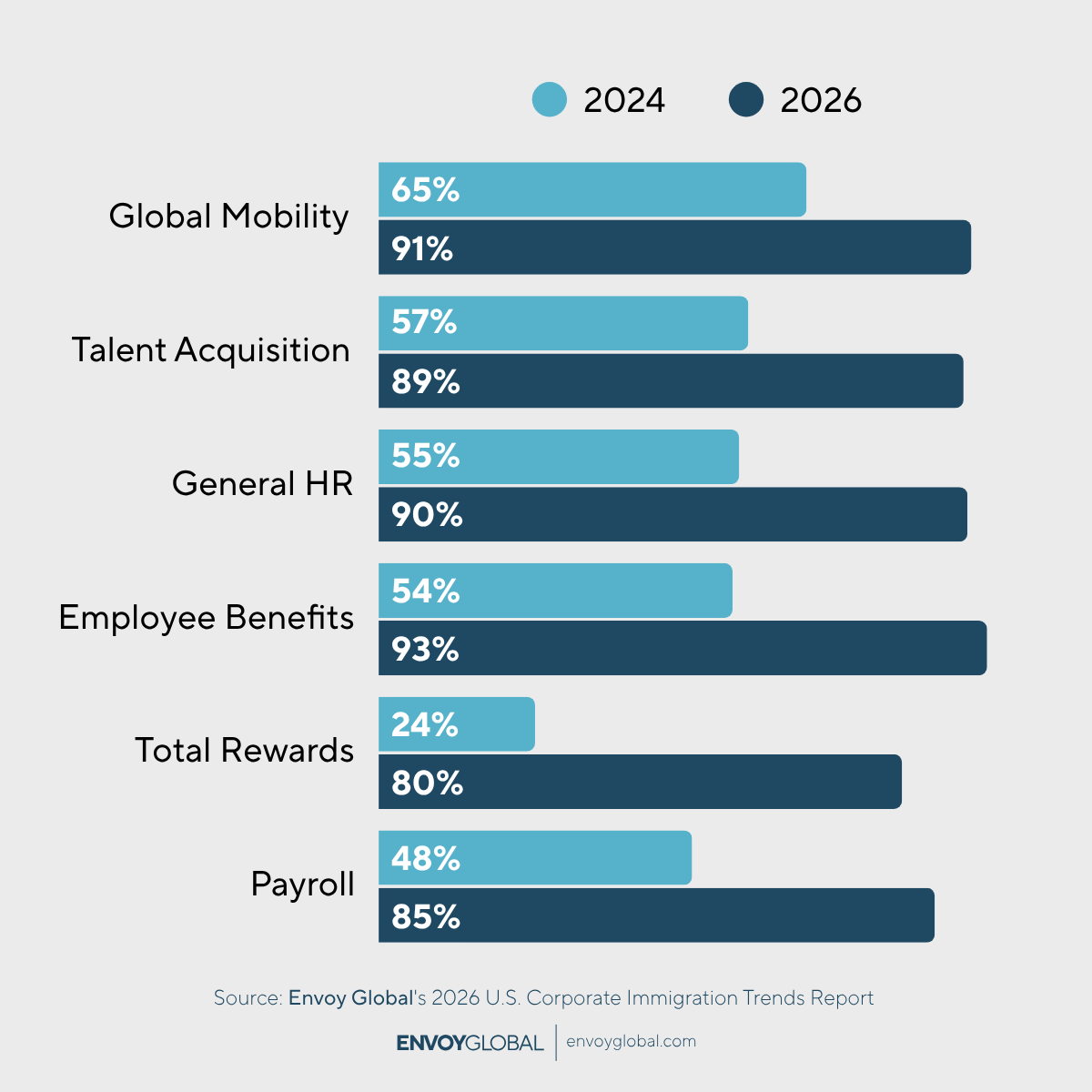
HR remains the primary department owning immigration work, but the scope of what these teams manage has grown. By 2026, respondents reported they are involved in an average of six HR functions.
Involvement increased across almost every HR‑related area between 2024 and 2026:
Budget Ownership
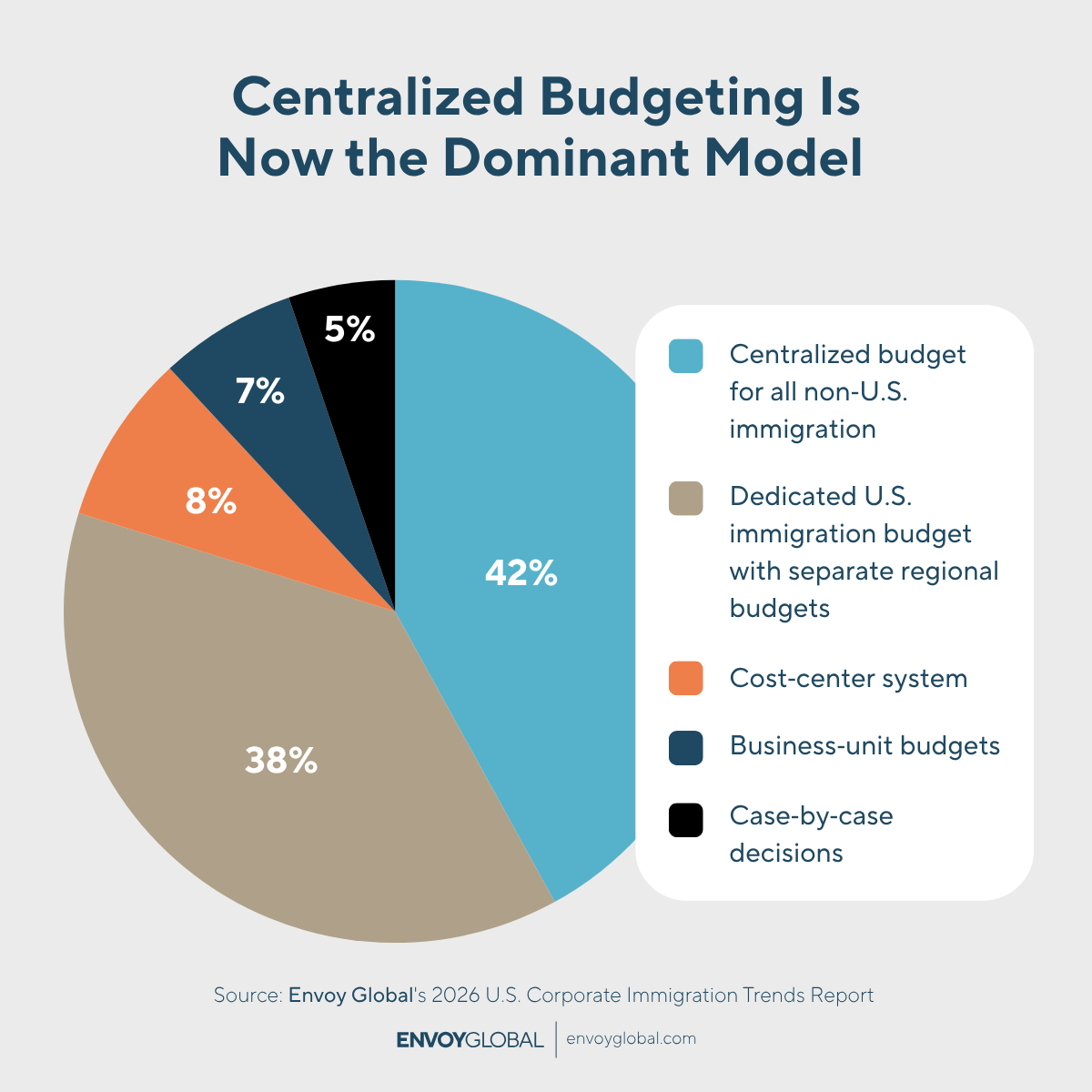
Employers are still separating U.S. and global immigration budgets, but both are increasingly being managed through centralized models.
Centralized budgeting for non‑U.S. immigration is the most common approach, followed closely by centralized budgeting specifically for U.S. visa sponsorship.
Foreign National Populations & Visa Portfolio Benchmarks
As immigration programs grow, employers are managing not only larger foreign national populations but also increasingly diverse visa portfolios. This shift reflects a move toward more flexible, multi-pathway approaches to sponsorship as external challenges persist.
Visa Mix Varies by Program Size
In 2026, most employers are managing a mix of H-1B, F-1 OPT/STEM OPT, L-1 and other temporary visa categories.
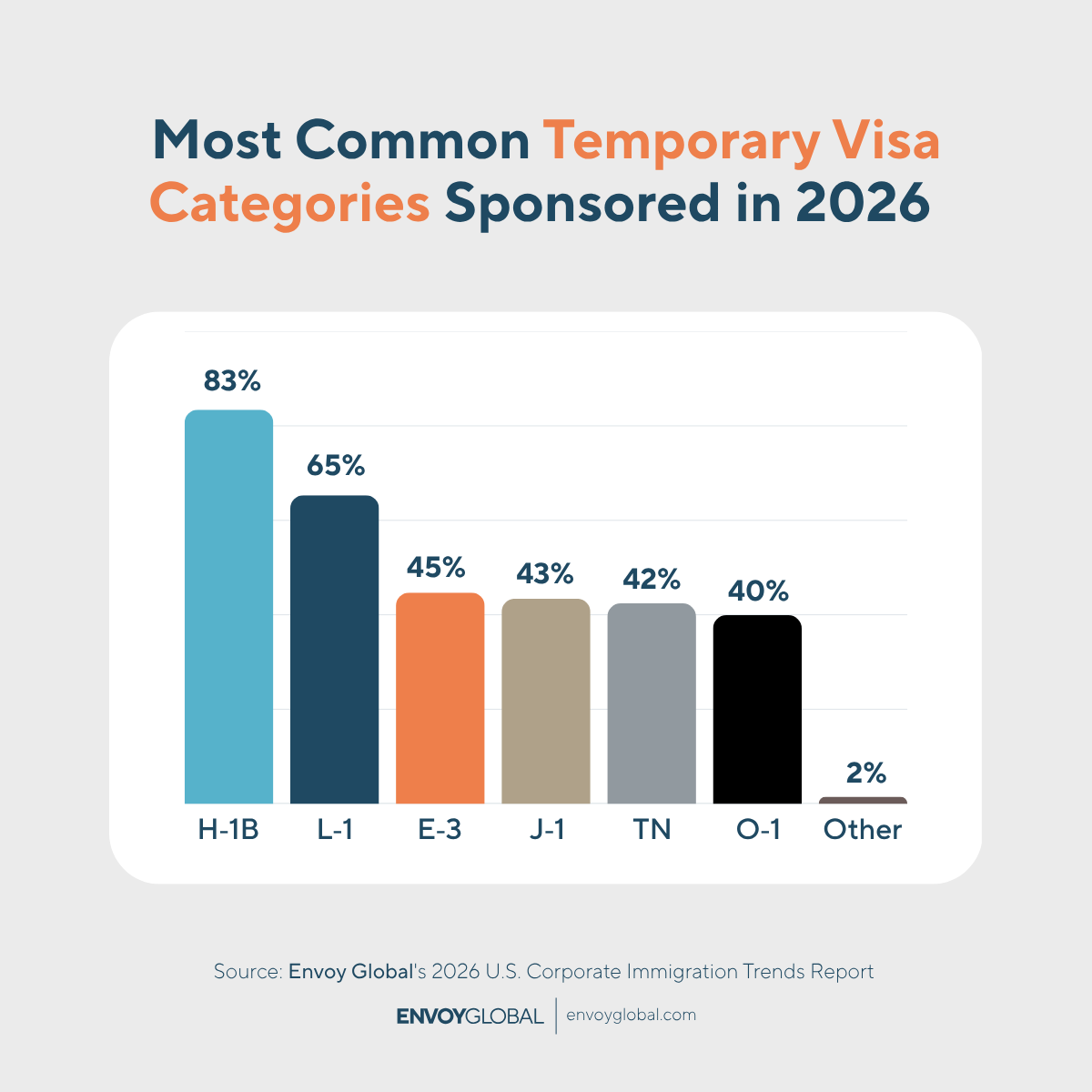
Employers continue to rely most heavily on H– 1B and L-1 visas, while categories such as E-3, J-1, TN and O-1 serve as important supplemental pathways for specialized, early-career and niche talent needs.

Why the H‑1B Remains the Default Talent Pipeline
The H‑1B remains the most common visa category because it is the only broadly applicable pathway that spans all industries, company structure and size and worker nationalities, making it the default option for professional talent hiring.
By comparison, many other visa types are more limited in scope—whether based on the nationality of the foreign national (TN for Canadian and Mexican citizens, E‑3 for Australian citizens, and H‑1B1 for Singaporean and Chilean citizens), the individual’s level of achievement (O‑1 for highly accomplished talent), or the employer’s structure (L‑1 for multinational organizations and E‑2 for companies with substantial foreign investment). As a result, these categories typically function as supplemental channels rather than primary talent pipelines.
While policy changes may influence how employers use the H-1B program (e.g., by focusing on H-1 B transfers within the U.S. and limiting or excluding offshore hiring), they are unlikely to drive significant diversification across other visa categories due to the limitations inherent in those categories. As such, the H-1B will likely remain the predominant employment-based nonimmigrant visa option.
How Immigration Portfolios Vary by Program Size
As organizations scale, their visa usage expands from a few core pathways to a broader, more flexible mix:
| Foreign National Headcount | Typical Visa Portfolio | Visa Categories |
| 1–49 employees | H‑1B, L‑1, TN, J‑1 | ~2 core pathways |
| 50–249 employees | H-1B, L-1, TN, J-1, E-3 | ~2–3 pathways |
| 250–999 employees | H‑1B, L‑1, TN, J‑1, E‑3, O‑1 | ~3 pathways |
| 1,000+ employees | H‑1B, L‑1, TN, J‑1, E‑3, O‑1 + additional niche categories | ~4+ pathways |
How Employers Support Key Talent Populations in 2026
As foreign national populations and visa portfolios continue to play a central role in workforce planning, employers are taking a more deliberate approach to supporting key talent populations and long-term program strategy.
H-1B Visa Strategies
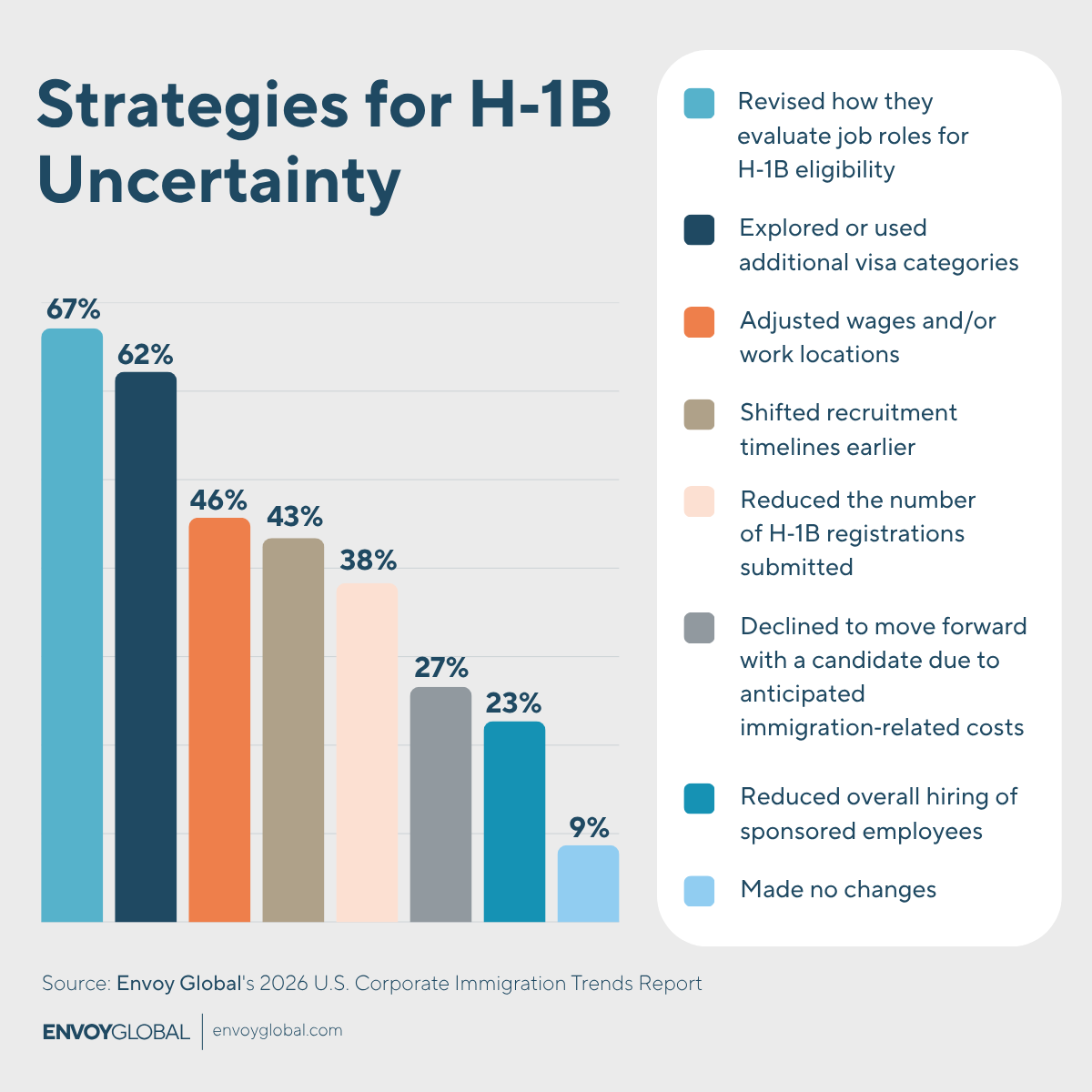
Pressure on the H-1B program continues to build, driven in part by a wage-weighted system and the 2025 $100k fee. In response, employers are adjusting how they use H-1B sponsorship, making more selective, targeted changes to hiring and program participation.

Rethinking H‑1B Sponsorship Strategy
Overall, employers are becoming more strategic with their sponsorship, whether that means reducing sponsorship or being more stringent about which roles they sponsor.
This helps mitigate increased costs, difficulties and risks with sponsorship. Employers who are not reducing their overall sponsored population may require specific work locations, limiting changes that would require amendments to avoid extra filings and, by extension, riskier cases and strategies.
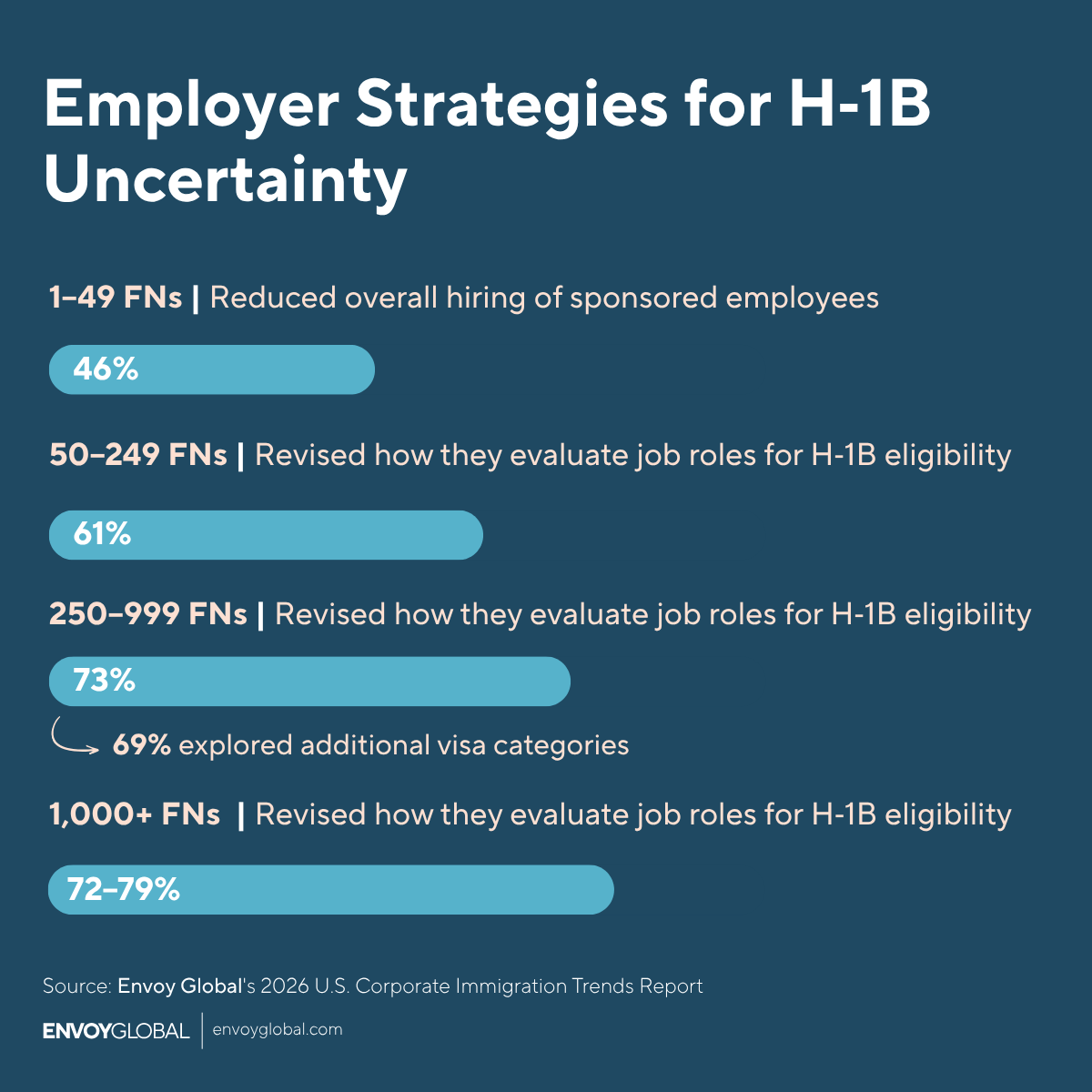
Program Size Shapes H-1B Strategy
Changes to the H-1B program introduced in late 2025 and early 2026 are driving different responses, depending on program size. Smaller organizations are more likely to scale back hiring, while larger programs are refining how they use H‑1B sponsorship and exploring alternative visa pathways.
H-1B Registration Behavior in 2026
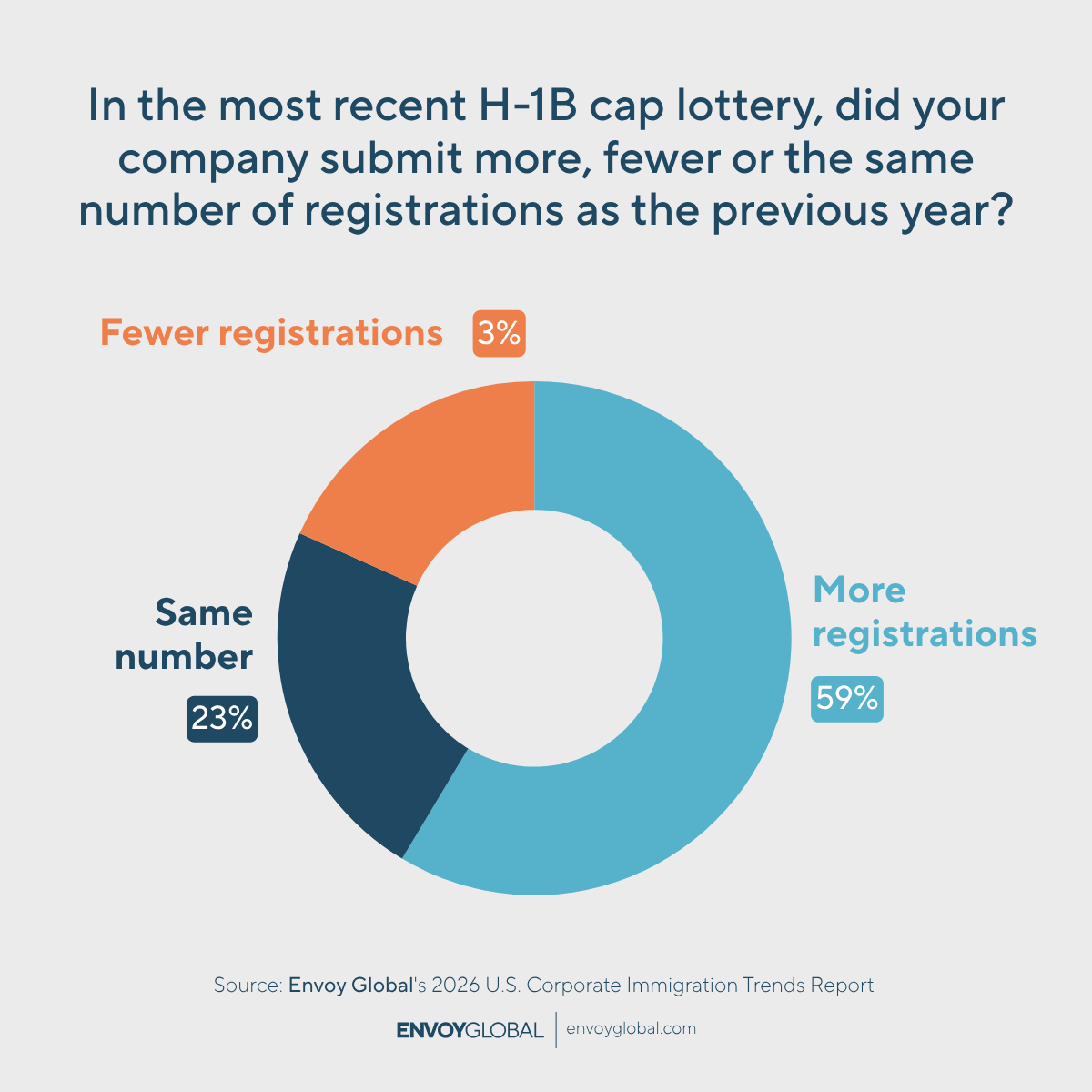
H‑1B registration demand remains strong in 2026, even as the system becomes increasingly challenging.
Nearly six in ten employers submitted more registrations than the previous year, even as USCIS accepted fewer overall (343,981 in FY 2026 vs. 211,600 in FY 2027), indicating that employer demand for H‑1B talent continues to outpace an increasingly selective acceptance system.
Scale Shapes H‑1B Registration Trends
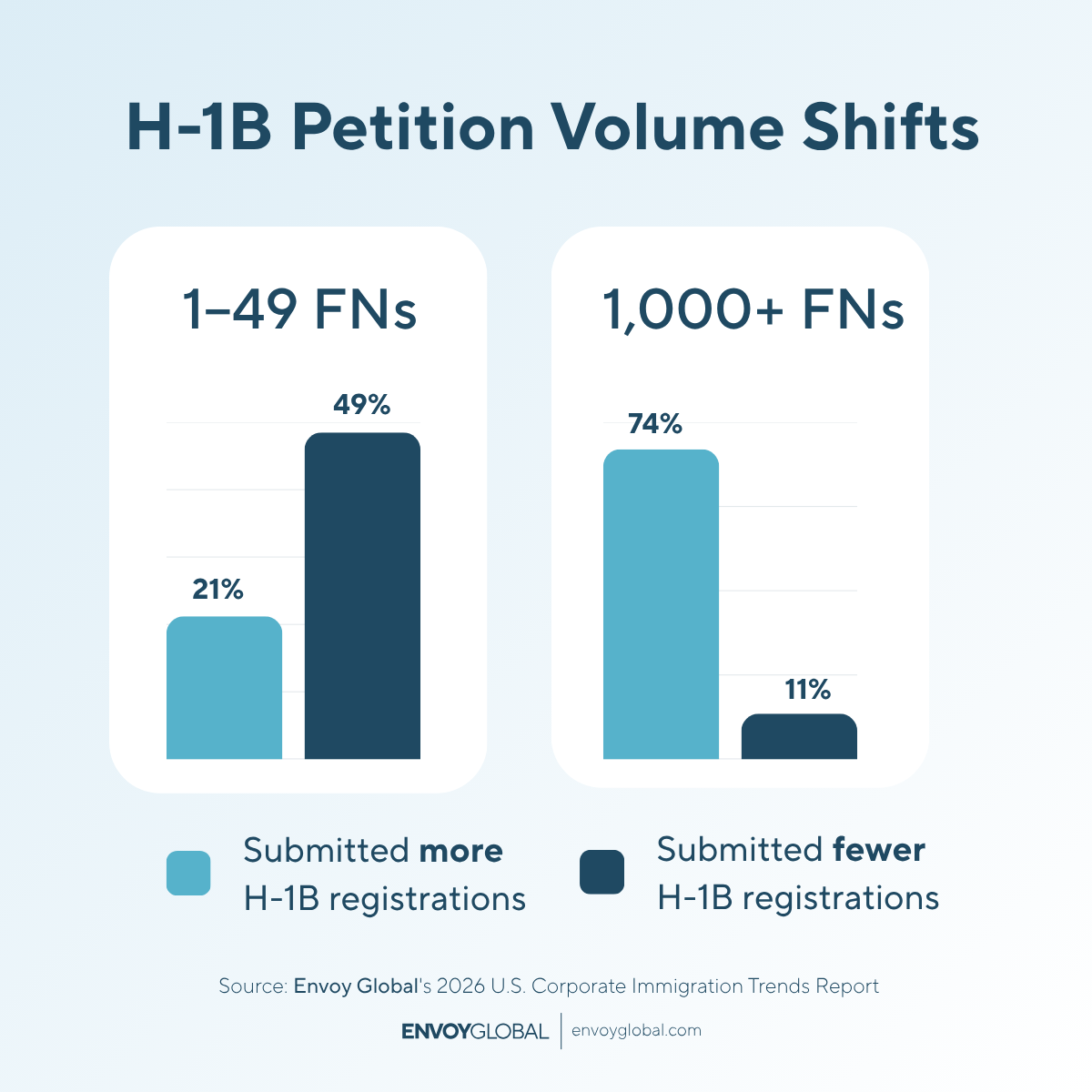
The trend for submitting more H-1B regulations is not uniform. The data reveals a widening gap between organizations that can continue scaling their investment in H‑1B and those that cannot.
Larger employers are far more likely to increase participation. Smaller organizations, by contrast, are more likely to step back in 2026 and reduce registrations.
This year, most employers filed between 26 and 100 registrations. Nearly one in five submitted more than 100.
Growth Centers on High‑Skilled Industries
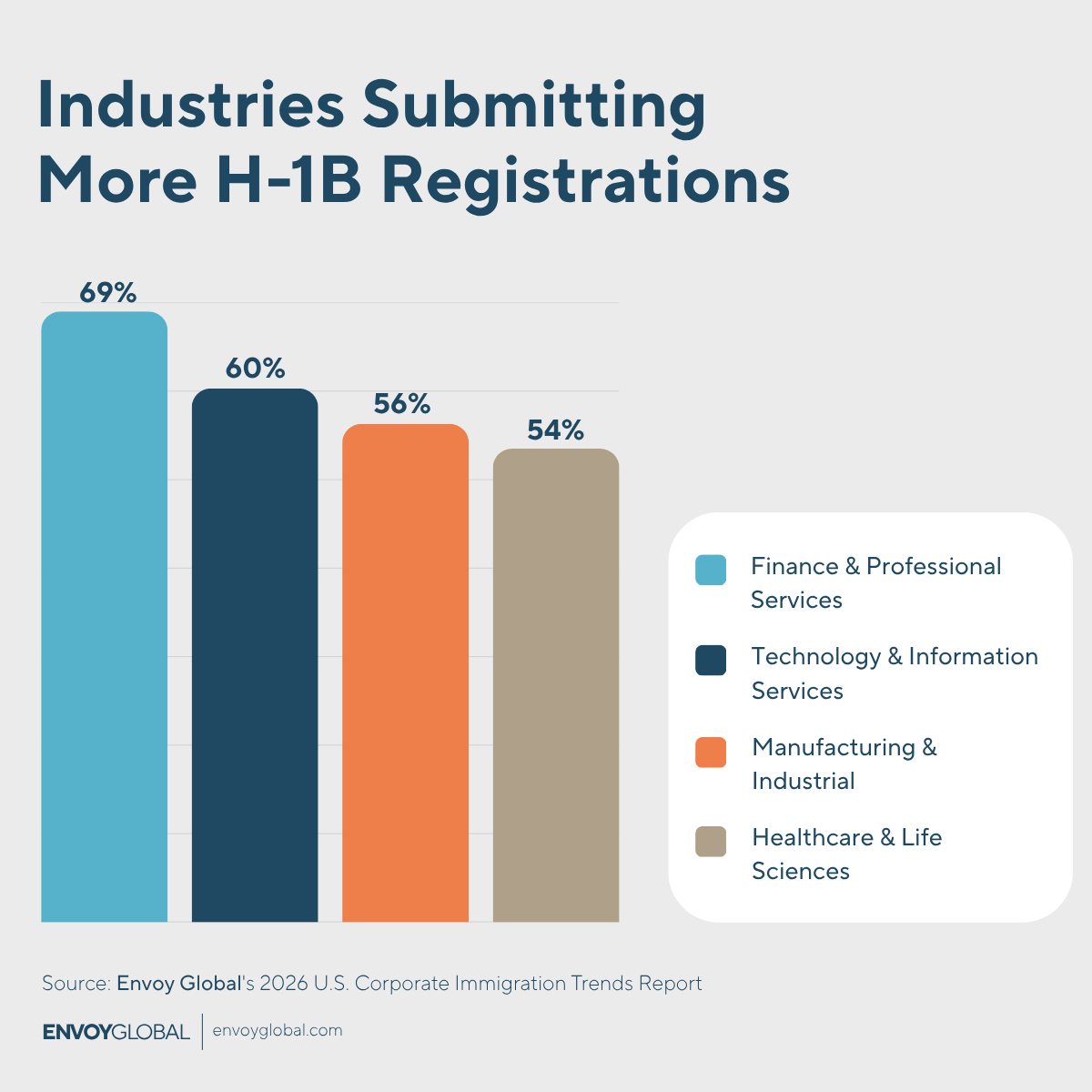
Sectors that depend on high-skilled talent have seen an especially concentrated increase in H-1B registrations:
Inside the H‑1B Backlog
While demand remains strong, the volume in H-1B registrations does not necessarily reflect a proportional increase in new hires. In many cases, employers are re-registering candidates who were not selected in previous H-1B lotteries.
Companies that employ workers on OPT or STEM OPT extension often submit registrations for them each year until they are selected, alongside newly hired candidates. As a result, higher registration volumes frequently reflect a build‑up effect, rather than a pure increase in sponsorship.
This dynamic also explains why larger employers – who have a deeper bench of OPT and STEM OPT employees in addition to new hires – are more likely than smaller employers to see an increase in H-1B registrations.
F-1 Visa Strategies
Nearly all employers that hire F‑1 students now support work authorization processes such as OPT, STEM OPT and CPT, underscoring how essential early‑career talent has become to workforce strategy in 2026.
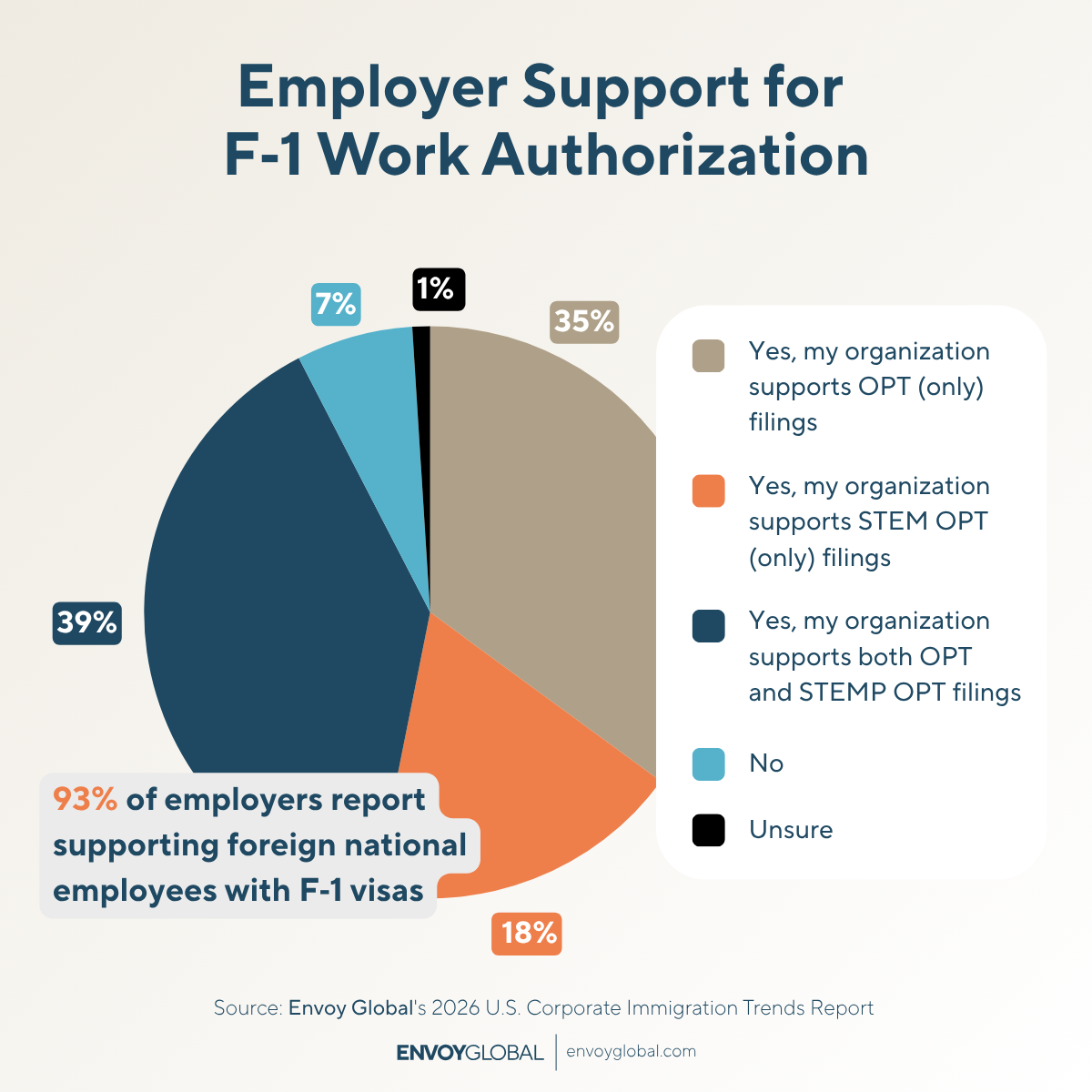
F‑1 Pathways Are a Talent Pipeline
The widespread majority of employers supporting F-1 OPT and STEM OPT filings reflects the critical role student visa pathways play in addressing talent gaps in the U.S. workforce, particularly in technical and specialized roles.
Support for STEM OPT, in particular, highlights its value as an extended work authorization option that provides employers with additional time to plan next-step visa sponsorship.
As competition for H-1B visas continues and policy uncertainty persists, employers increasingly view F-1 pathways, especially eligibility for F-1 STEM OPT, as an important part of a multi-year, phased immigration strategy.
Green Card Strategies
Over the past decade, green card sponsorship timelines have accelerated significantly, with employers moving earlier to secure long‑term retention.
This shift reflects sustained competition for global talent and a need for greater predictability in an increasingly complex policy environment.
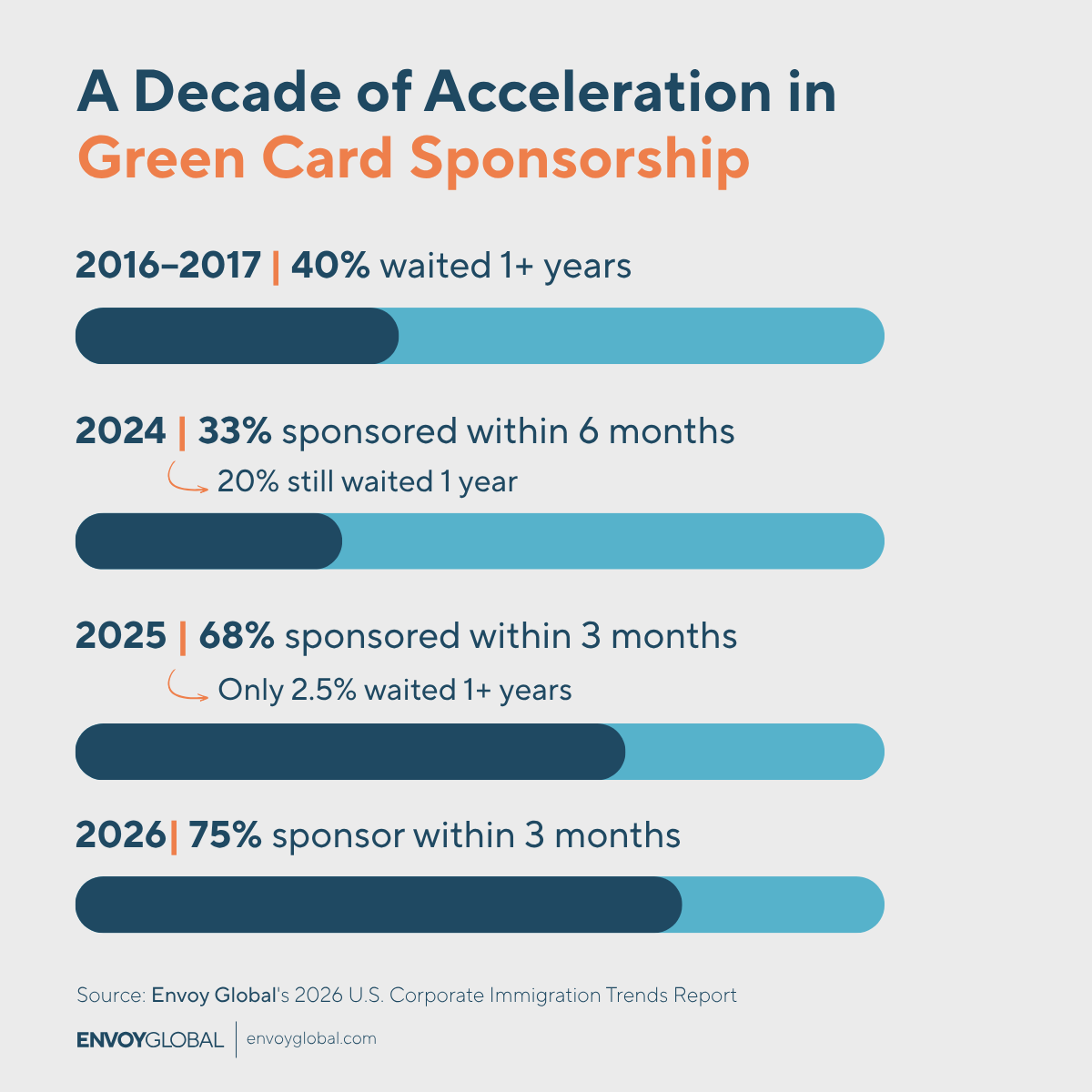
Shifting Strategy: Earlier Green Card Sponsorship
Two main factors likely drive employers’ decision to speed up green card sponsorship – long processing times and uncertainty about nonimmigrant visas.
With PERM at 16–18 months and I‑485 adjudications slowing due to additional background checks and public‑charge reviews, individuals are waiting much longer to obtain their green cards. As this is the ultimate goal for most sponsored employees, it is necessary to start the process sooner, a trend likely to increase following USCIS’s May 22 memo on heightened discretion.
Moreover, continuous changes and rising fees to the H-1B program — from the $100k fee to wage-based registration and increased scrutiny — are creating urgency for companies to obtain green cards for more certain work authorization and reduced risk.
For a full analysis of these green card trends and Rita Ambrosetti’s insights, read the complete breakdown.
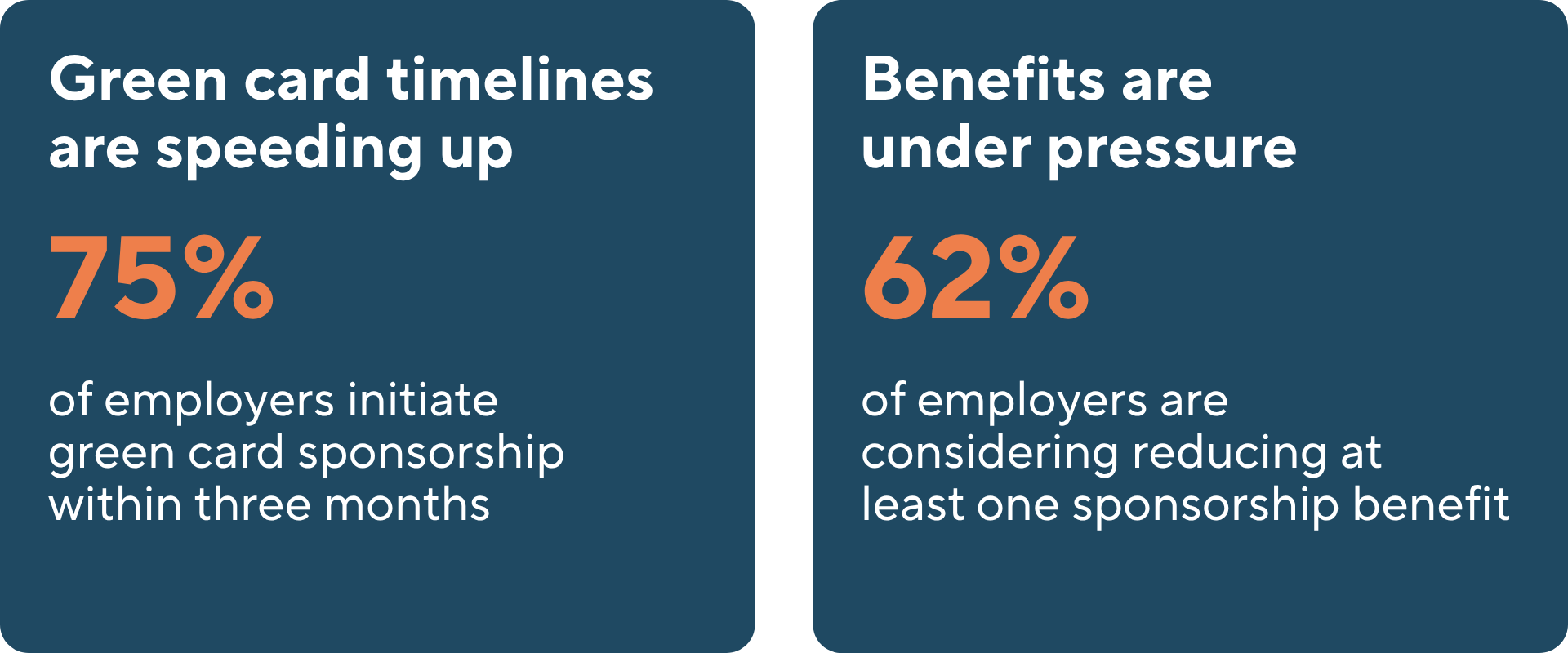
In 2026, three in four employers begin green card sponsorship within the first three months of employment.
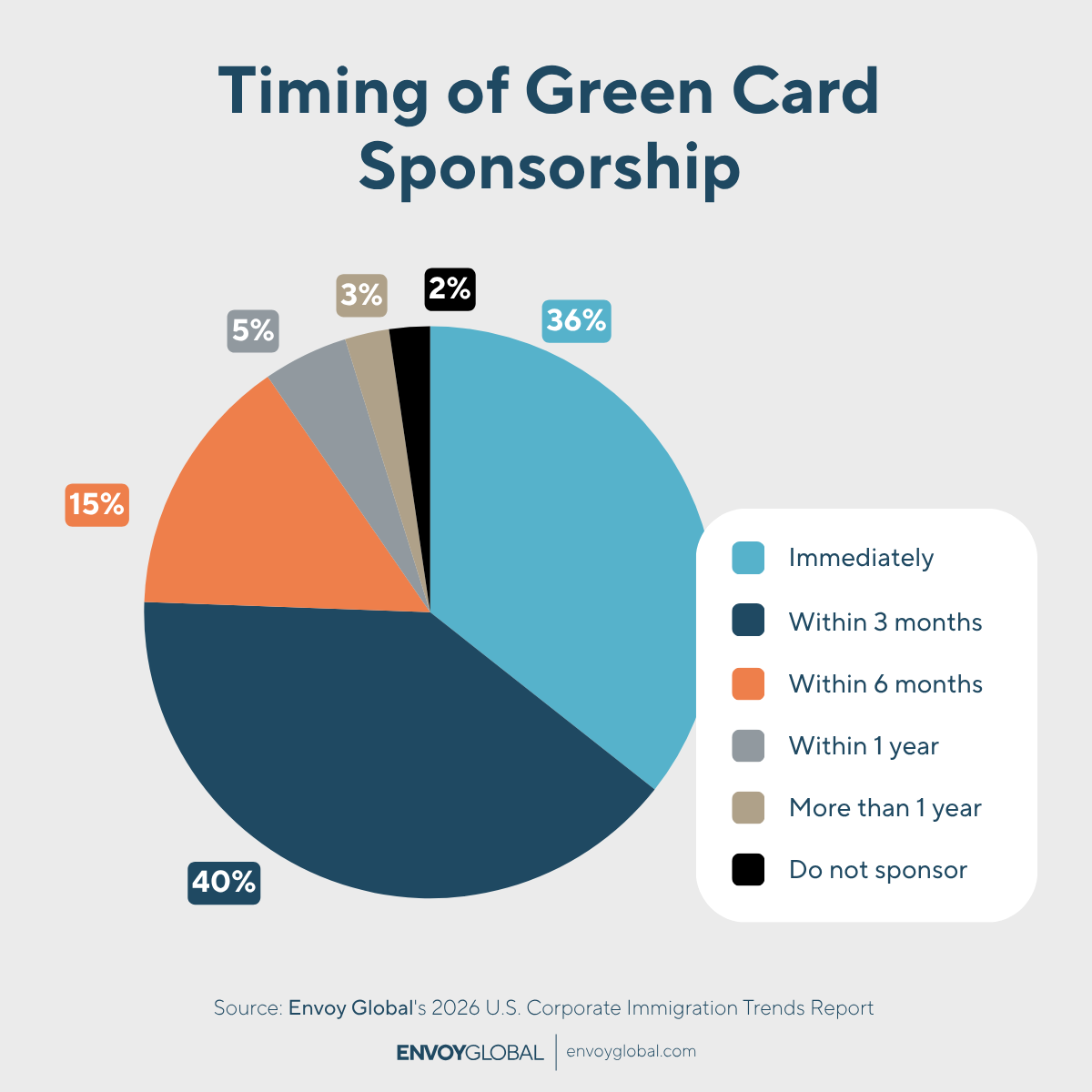
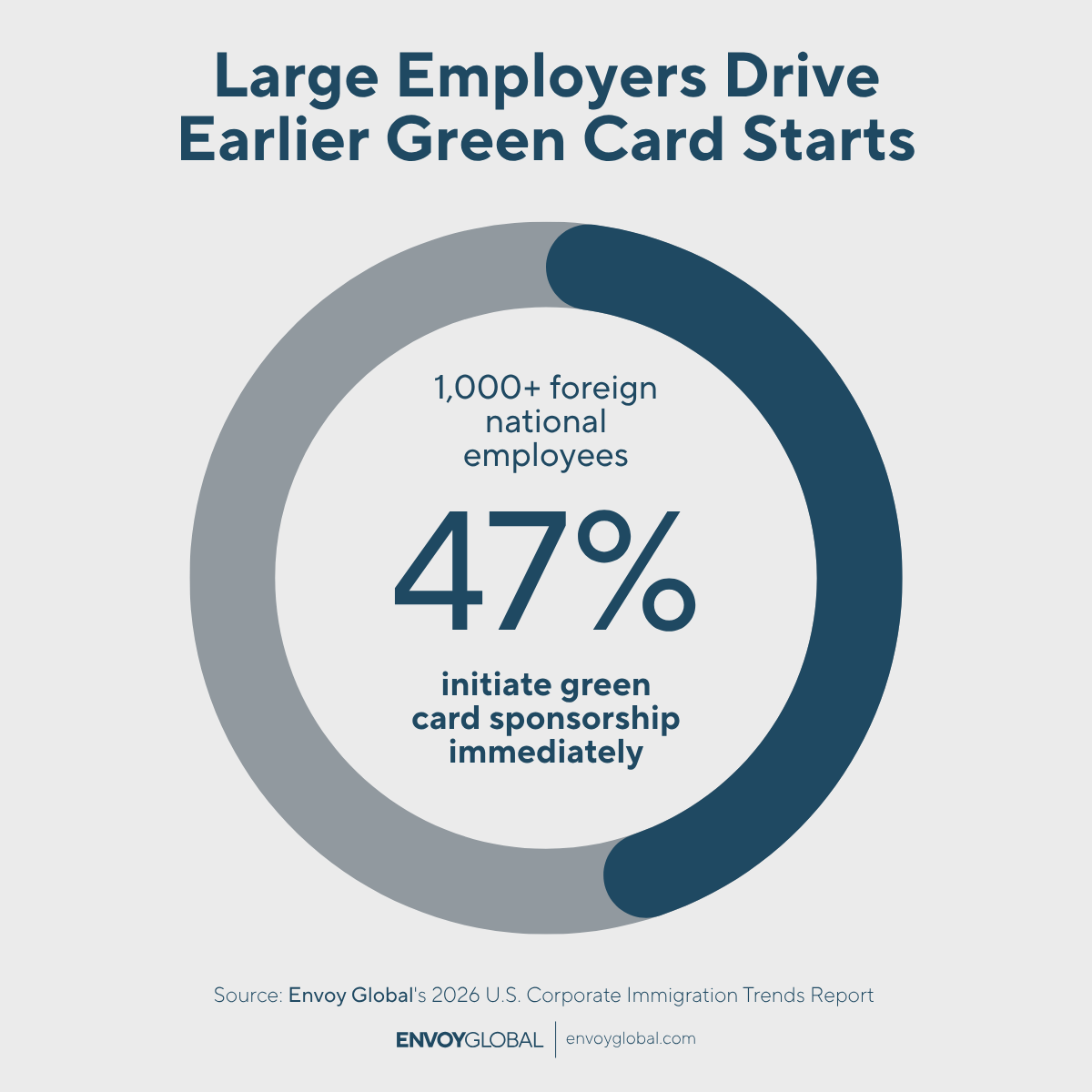
Larger Programs Are Driving the Shift to Early Sponsorship
The move toward early sponsorship varies across employers, with organizations with higher foreign national headcounts driving the trend.
Green Card Cost Coverage and Retention Strategy
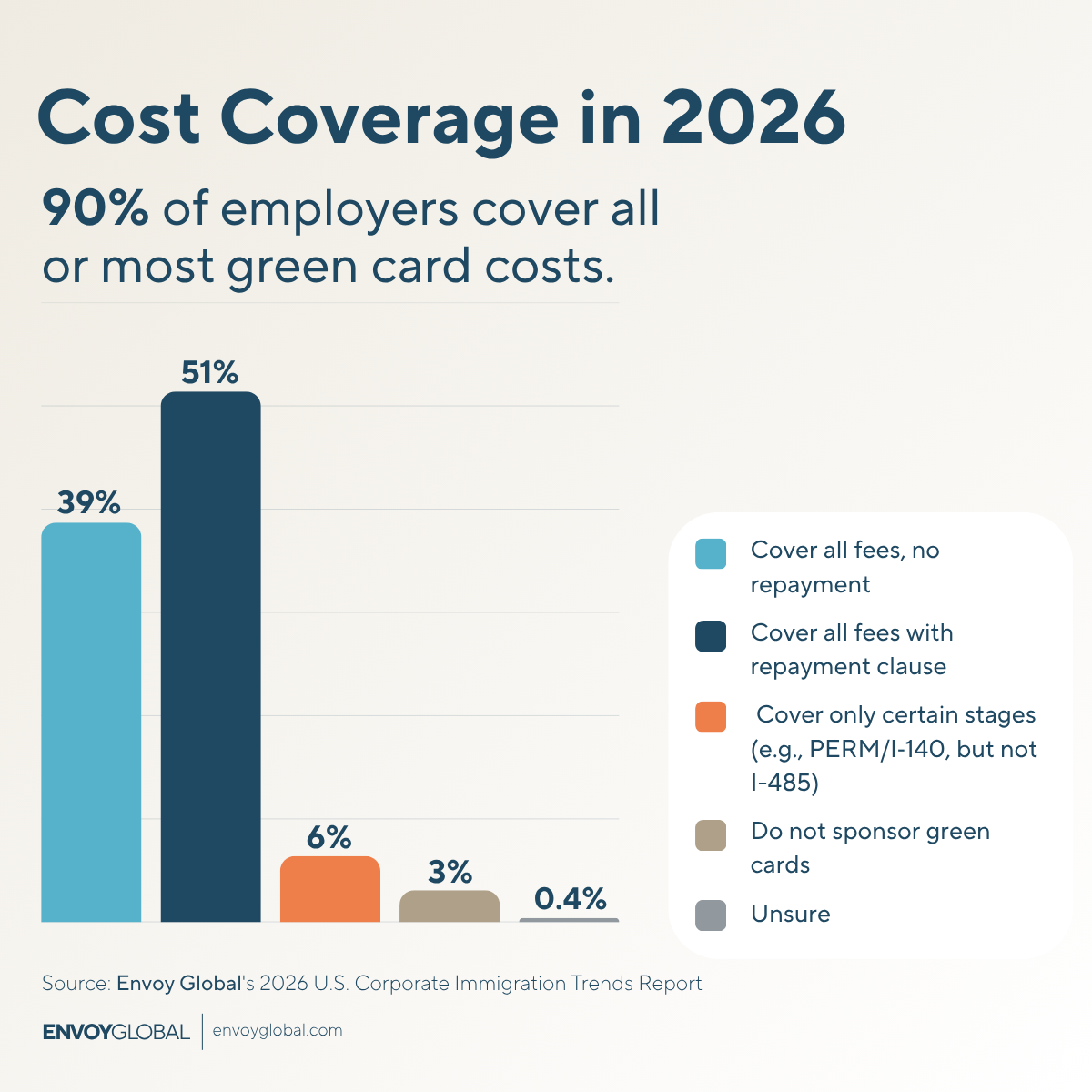
As employers move sponsorship earlier in the employee lifecycle, covering green card costs has become a key approach for securing and retaining talent.
Investing in Talent Through Green Cards
Employers increasingly view green card sponsorship not as a discretionary benefit, but as a core component of long-term talent strategy and workforce stability.
With roughly 90% of employers covering all or most green card costs — and over half pairing that coverage with repayment provisions — the approach is both competitive and pragmatic.
In today’s labor market, particularly for highly skilled roles, the cost of sponsorship is often outweighed by the cost of attrition. Employers invest significant time and resources in recruiting, onboarding and training foreign national employees.
Ultimately, the data underscores a clear shift: employers are treating immigration sponsorship as an investment in talent continuity and competitive advantage.
Read Nicole Hartnett’s full analysis on green card cost coverage and retention strategy.
Long-Term Planning
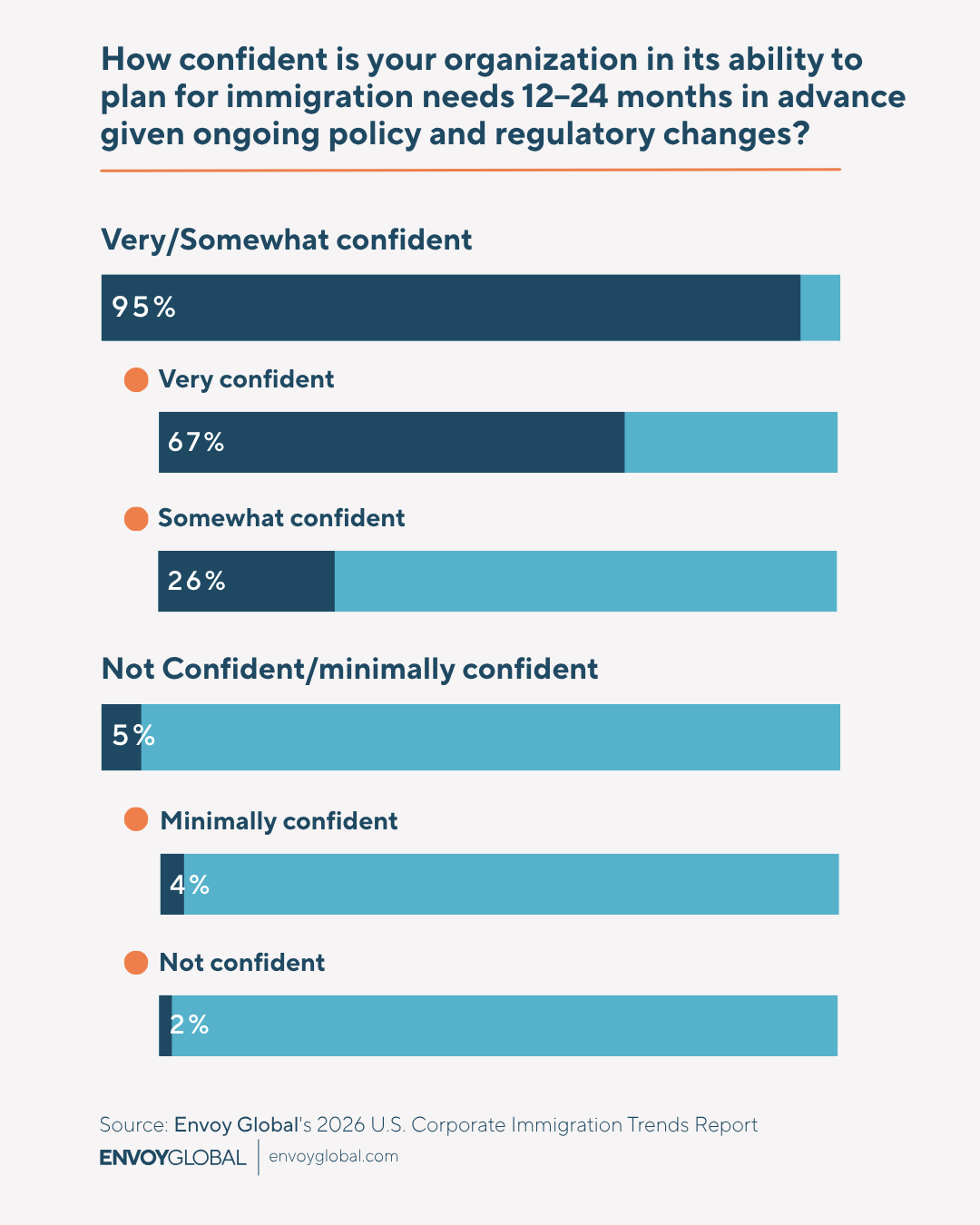
Despite operating in an increasingly complex and evolving immigration landscape, employers report high confidence in their ability to plan.
In 2026, 94.6% of organizations say they are very or somewhat confident in forecasting immigration needs 12–24 months ahead.
Immigration Program Budget and Benefits
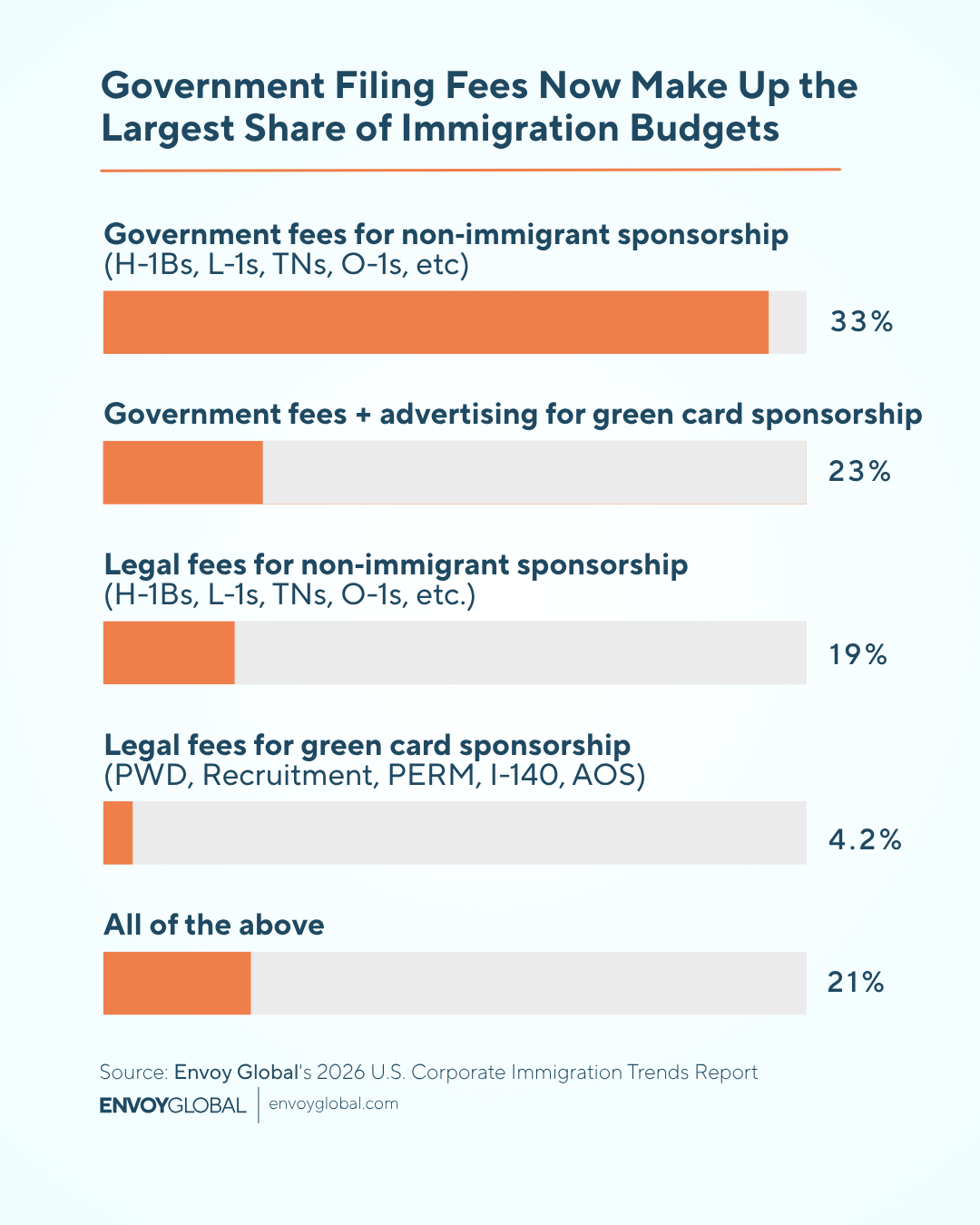
Cost pressures are becoming more visible in immigration program planning, with government filing fees accounting for the largest share of budgets in 2026.
Benefit Cuts in 2026
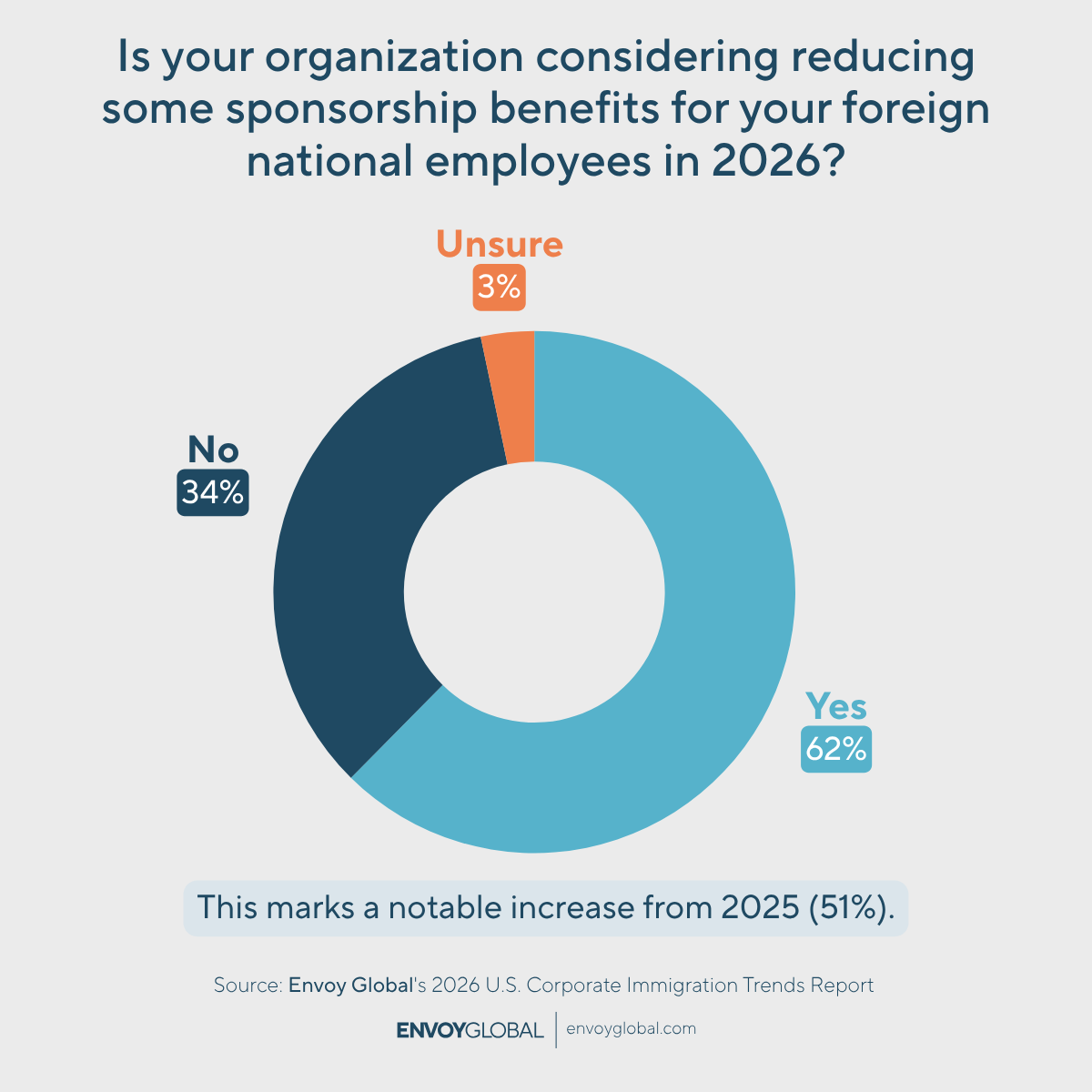
As costs rise, many employers are reevaluating what they can sustainably offer in their immigration programs.
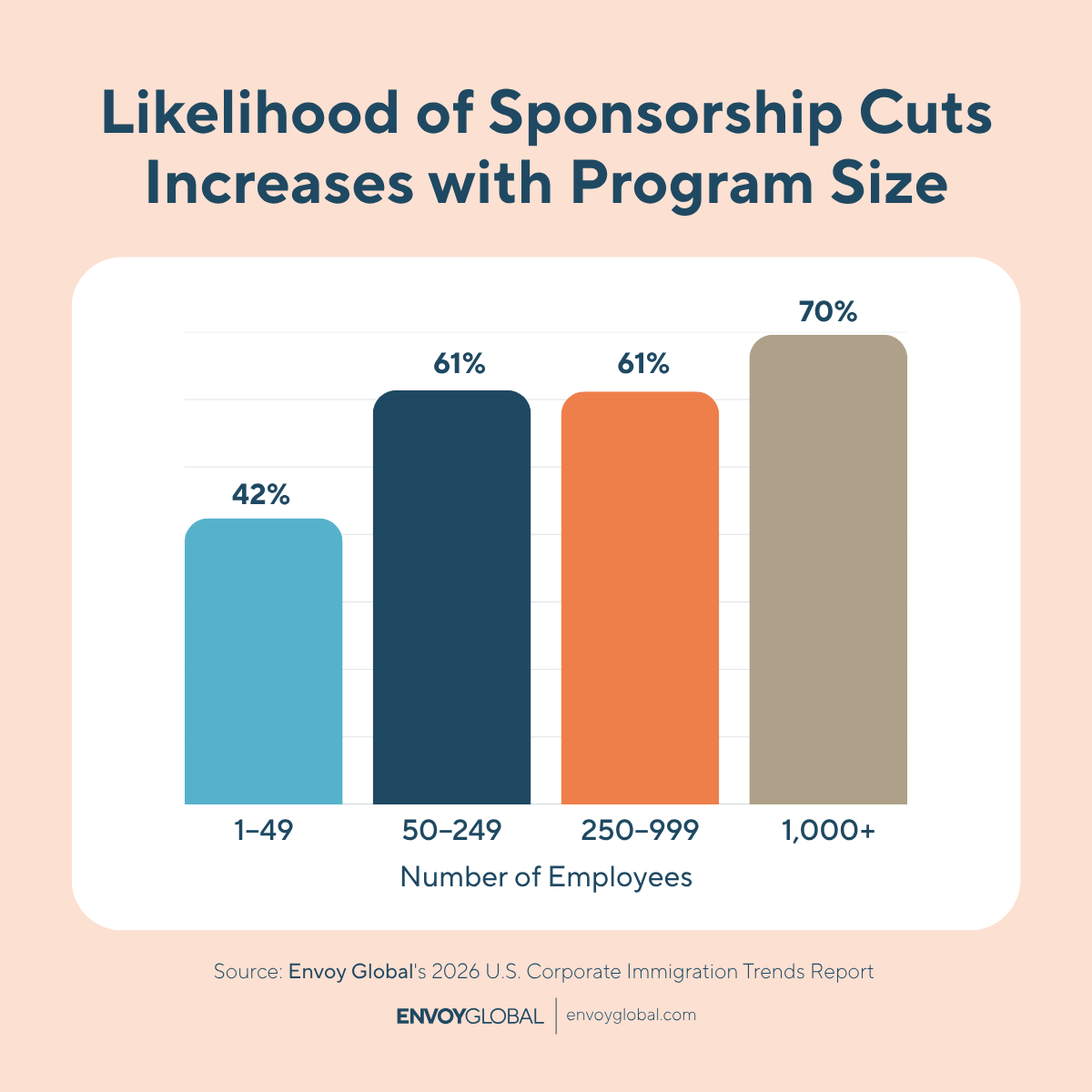
In 2026, 62.4% of employers are considering reducing at least one sponsorship benefit, up from 50.8% in 2025.
Larger Employers Are More Likely to Adjust Sponsorship Strategies
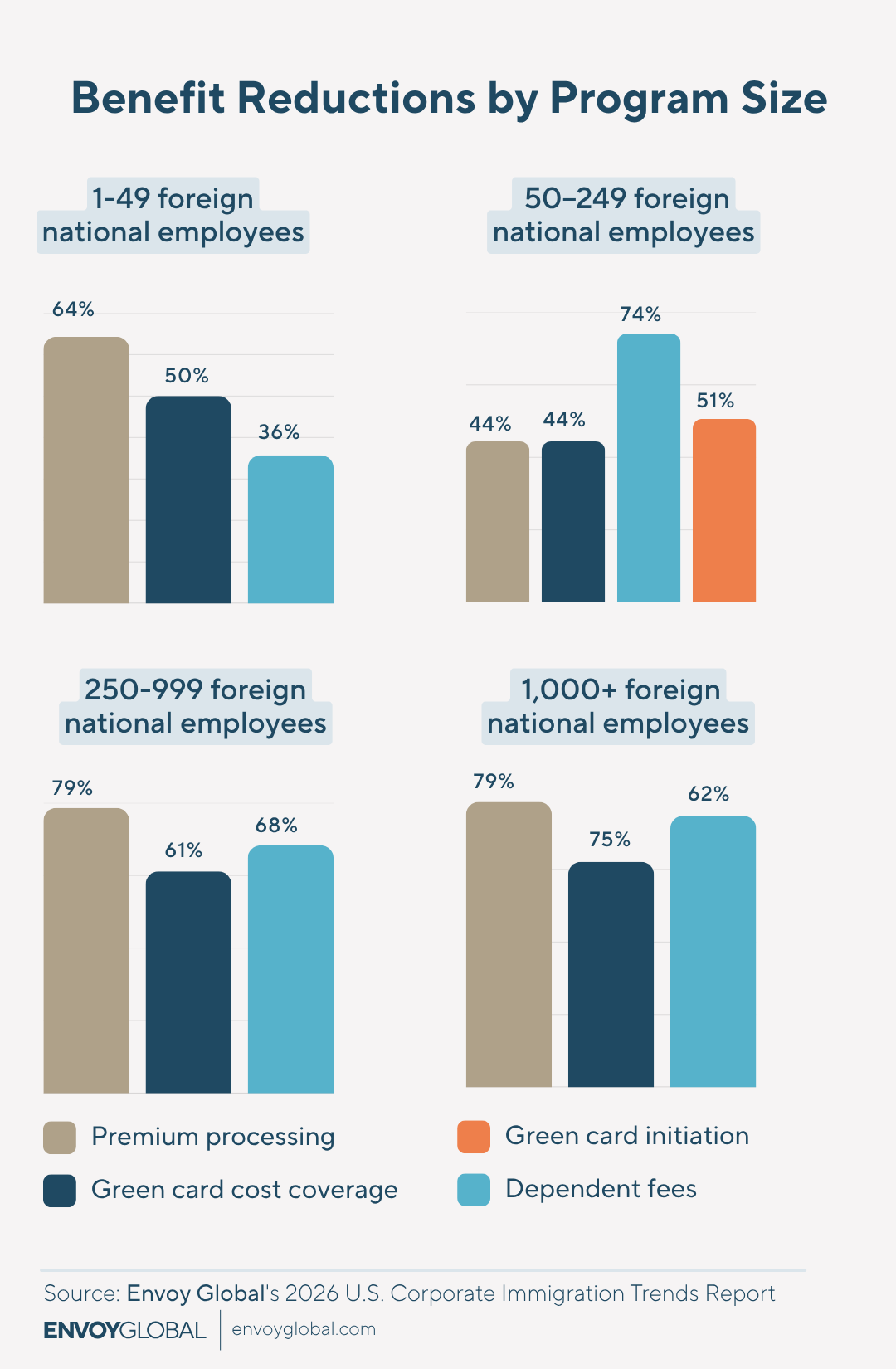
Larger organizations are more likely to evaluate reductions in benefits:
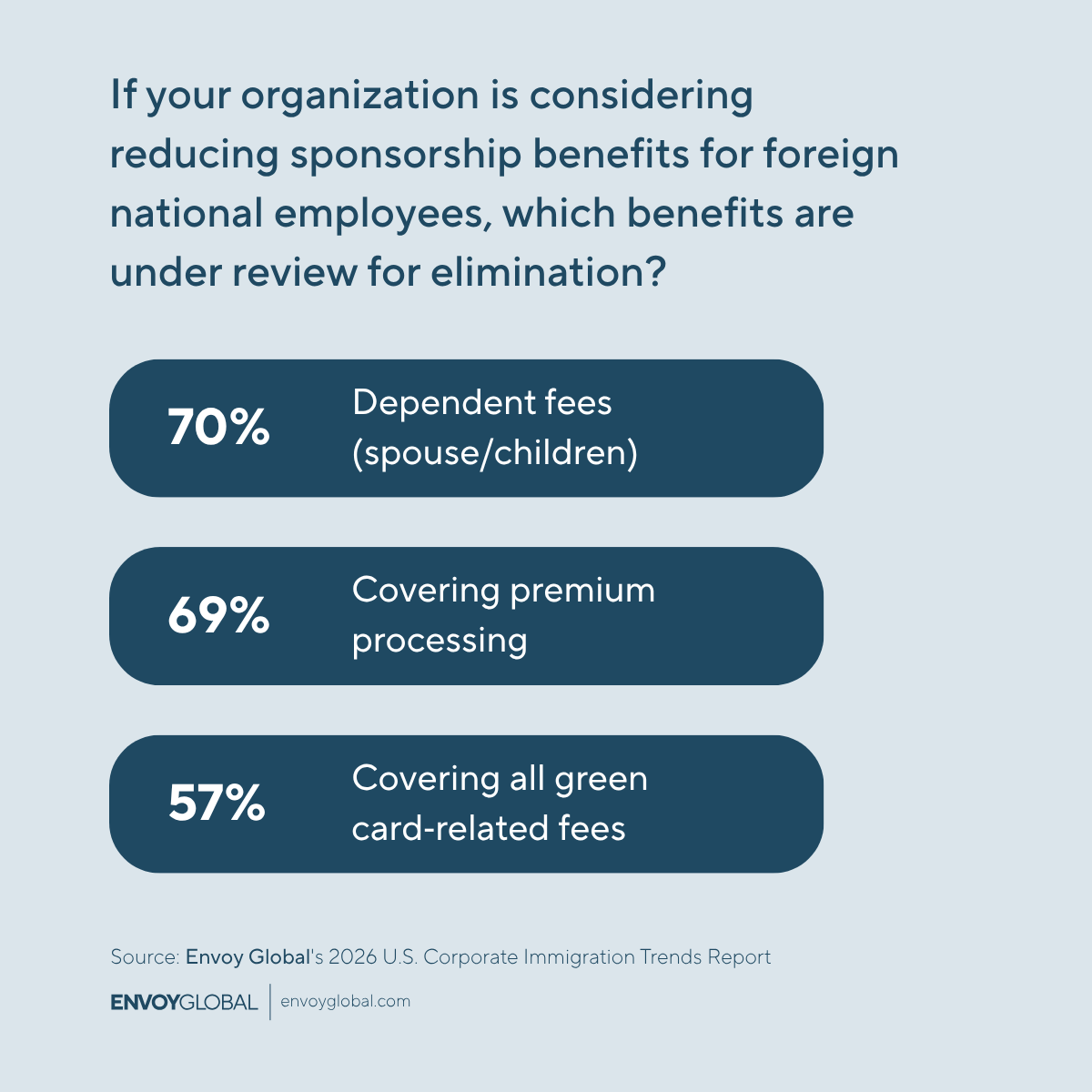
Benefits Most At Risk
Dependent-related benefits and premium processing are the most likely areas for potential reduction, reflecting their significant and ongoing cost impact.
Benefit Cuts Vary by Program Size
Premium Processing
Despite rising cost pressures, premium processing remains essential for maintaining predictability in immigration programs. In 2026, 82% of employers rely on it across key petitions, including H‑1B, L–1, O‑1 and certain green card stages.
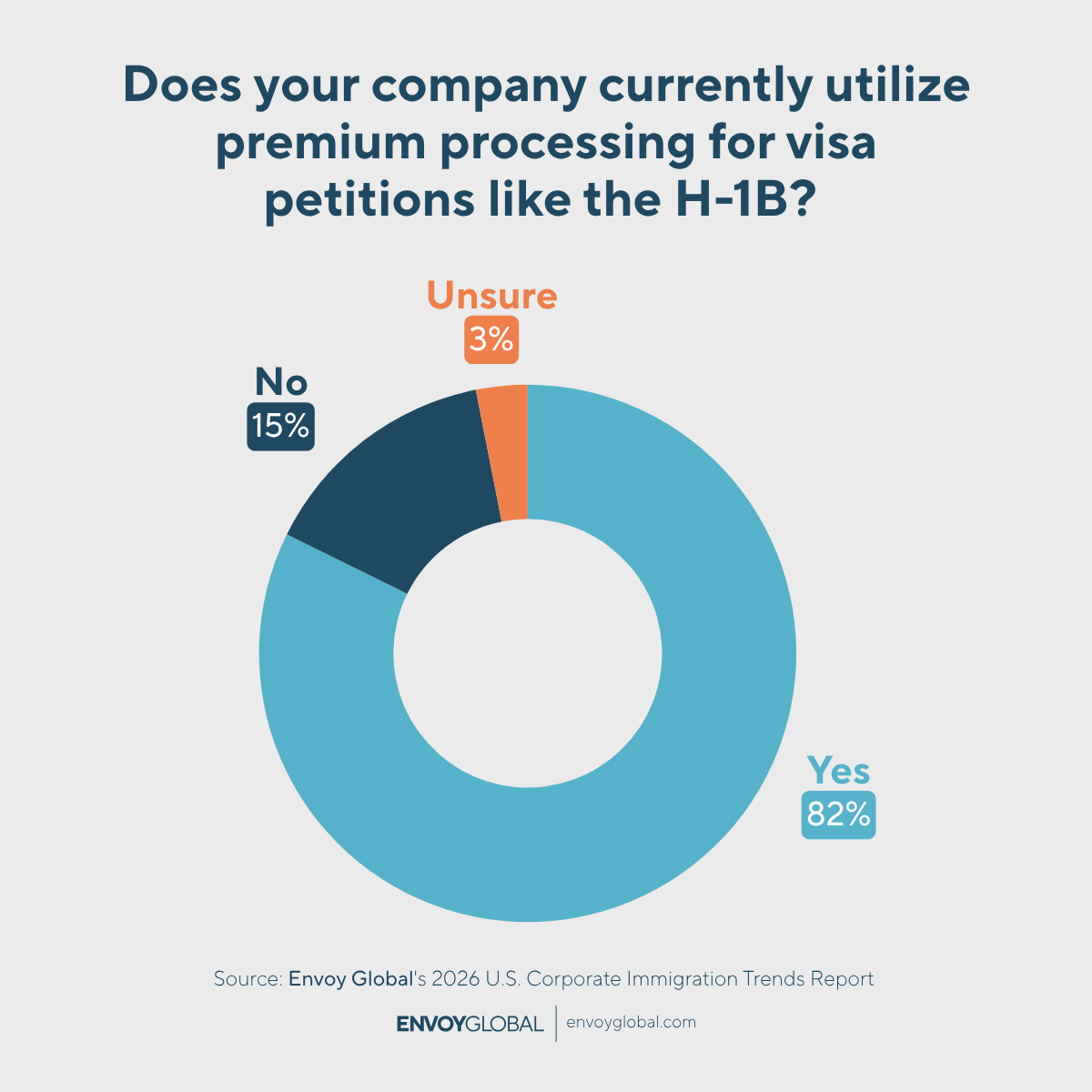

Delays Are Driving Premium Processing Demand
Longer processing times are pushing companies to add premium processing more often than in the past couple of years, particularly on nonimmigrant petitions.
With H-1B processing times averaging approximately 10-11 months, more routine processing petitions will require upgrades to premium processing to ensure continued work authorization and that employees have all the necessary documents to perform administrative tasks, such as renewing driver’s licenses.
Additionally, in a time of significant uncertainty, premium processing can help companies and employees feel they have some control over the process and quell anxiety.
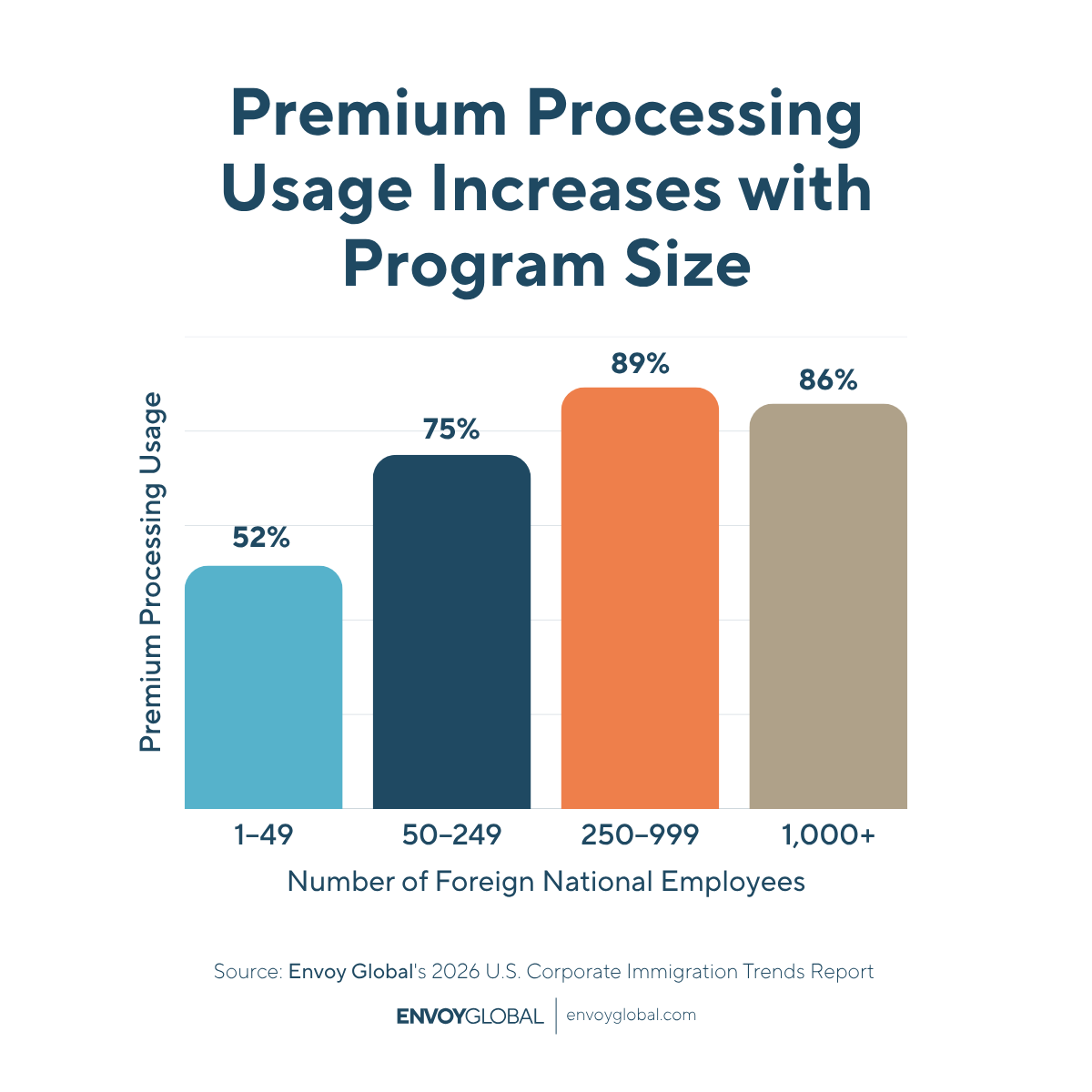
Premium Processing Usage Increases with Employer Size
Premium processing usage increases with employer size, peaking among mid‑size and large organizations:
How Employers Use Premium Processing Across H-1B Petition Types
Premium processing is used broadly across H‑1B petition types, with the highest use in cap cases and extensions. Among the 83% of employers that use premium processing, it covers nearly all major H-1B filings.
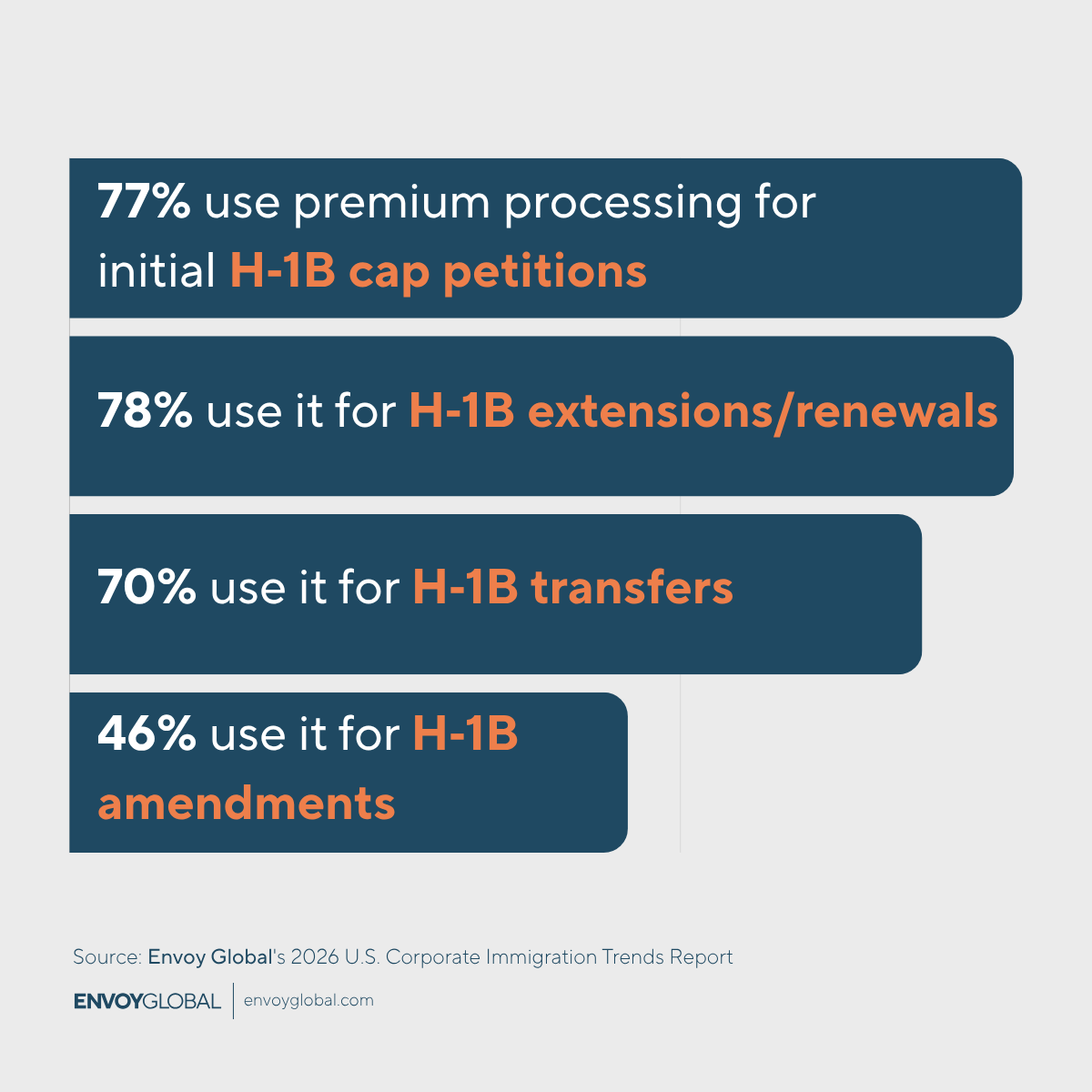
Premium Processing Across H-1B Filings
Employers overwhelmingly use premium processing for H-1B petitions, regardless of whether it is an initial H-1B cap petition, an H-1B transfer, or an H-1B extension. And almost half of employers reported using premium processing for H-1B amendments.
While many temporary work categories contain automatic extension of work authorization while an extension is pending (e.g., 240-day rule for H-1b, H-1b1, E-3, E-2, L-1, TN, O-1, etc.) the prolonged processing time at USCIS has prompted employers to upgrade petitions to premium processing – incurring the additional processing fee – to avoid disruption in employment.
High premium processing usage across all H-1B petition types reflects employers’ efforts to manage growing uncertainty and employee anxiety in the current immigration environment.
Despite the rising cost of premium processing this year, employers still rely on it as an operational safeguard, providing greater certainty about workforce continuity and supporting employee retention and morale.
Read Sherry Neal’s full analysis on premium processing usage.
Global Mobility Strategies
In addition to case management, HR and global mobility teams are increasingly responsible for managing adjacent operational challenges that extend beyond traditional immigration work. This expansion of responsibilities reflects a broader shift in how immigration now intersects with workforce operations and day‑to‑day planning.
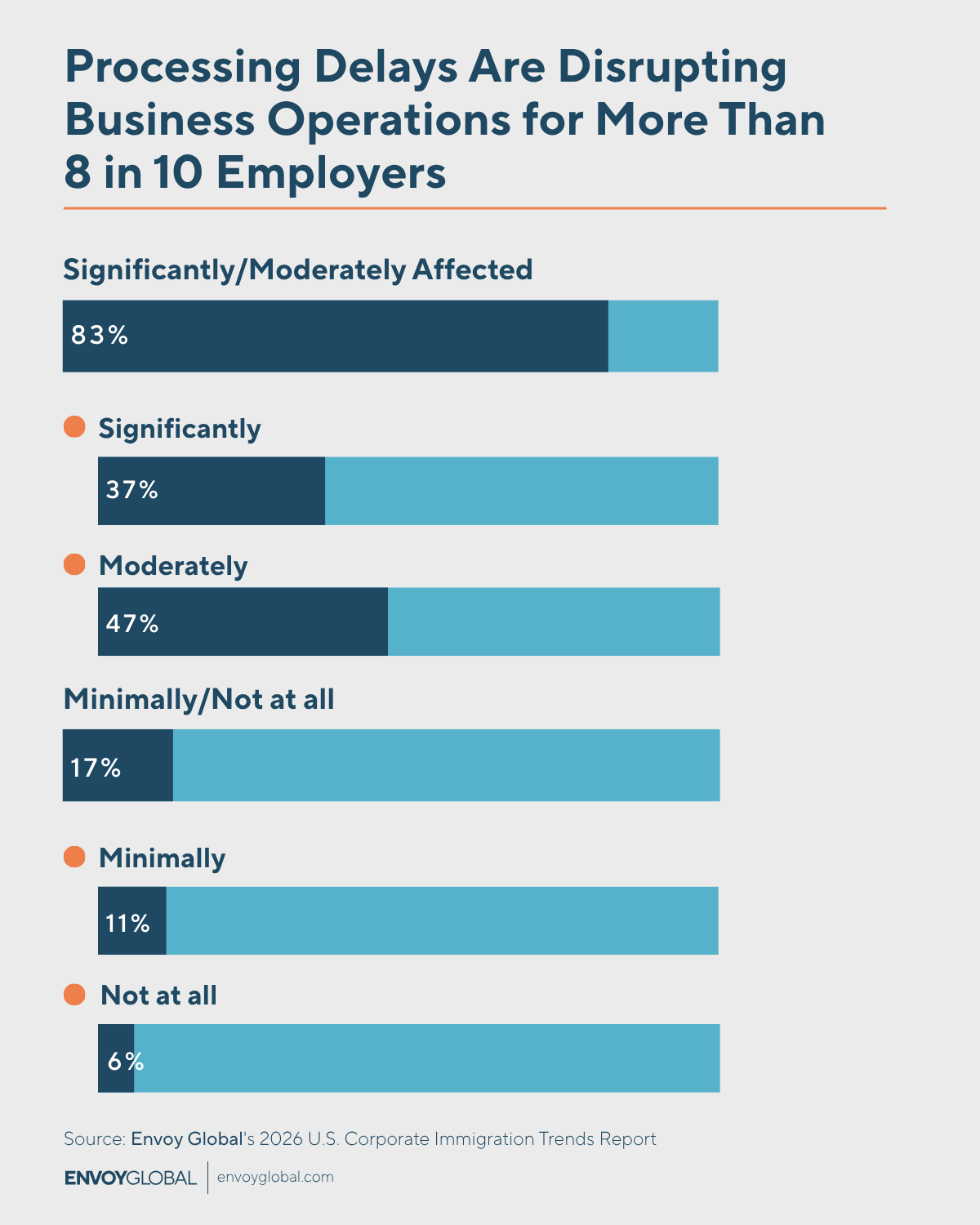
Processing Delays
In 2026, processing delays remain one of the most persistent challenges, affecting both hiring timelines and business continuity.
More than eight in 10 employers (83.2%) report that USCIS or consular delays have moderately or significantly impacted their operations, with over one-third indicating a significant effect.
Consular Delays Stall Critical Nurse Hiring Pipelines
Consular processing delays have had a disproportionate impact on healthcare organizations waiting to onboard internationally educated nurses who have passed the U.S. nurse licensing exam.
Unlike many other occupations, registered nurses often don’t qualify for H-1B and must complete the entire immigrant visa process abroad before they can enter the U.S. and begin employment.
Many healthcare organizations made employment offers and initiated sponsorship a few years ago—absorbing recruiting and legal costs and enduring visa retrogression—only to face additional delays from consular backlogs, the travel ban applicable to certain countries, and the 2026 immigrant visa pause for certain nationalities.
For employers, this translates into prolonged vacancies and heightened operational strain that may impact patient care.
Read Sherry Neal’s full analysis on immigration challenges facing the healthcare sector in 2026.
Travel-Related Risk
As disruptions extend beyond processing timelines, employers are also navigating increased uncertainty in global travel.
In 2026, shifting vetting procedures and evolving entry requirements continue to introduce risk, but most organizations report a high degree of readiness in managing these challenges.
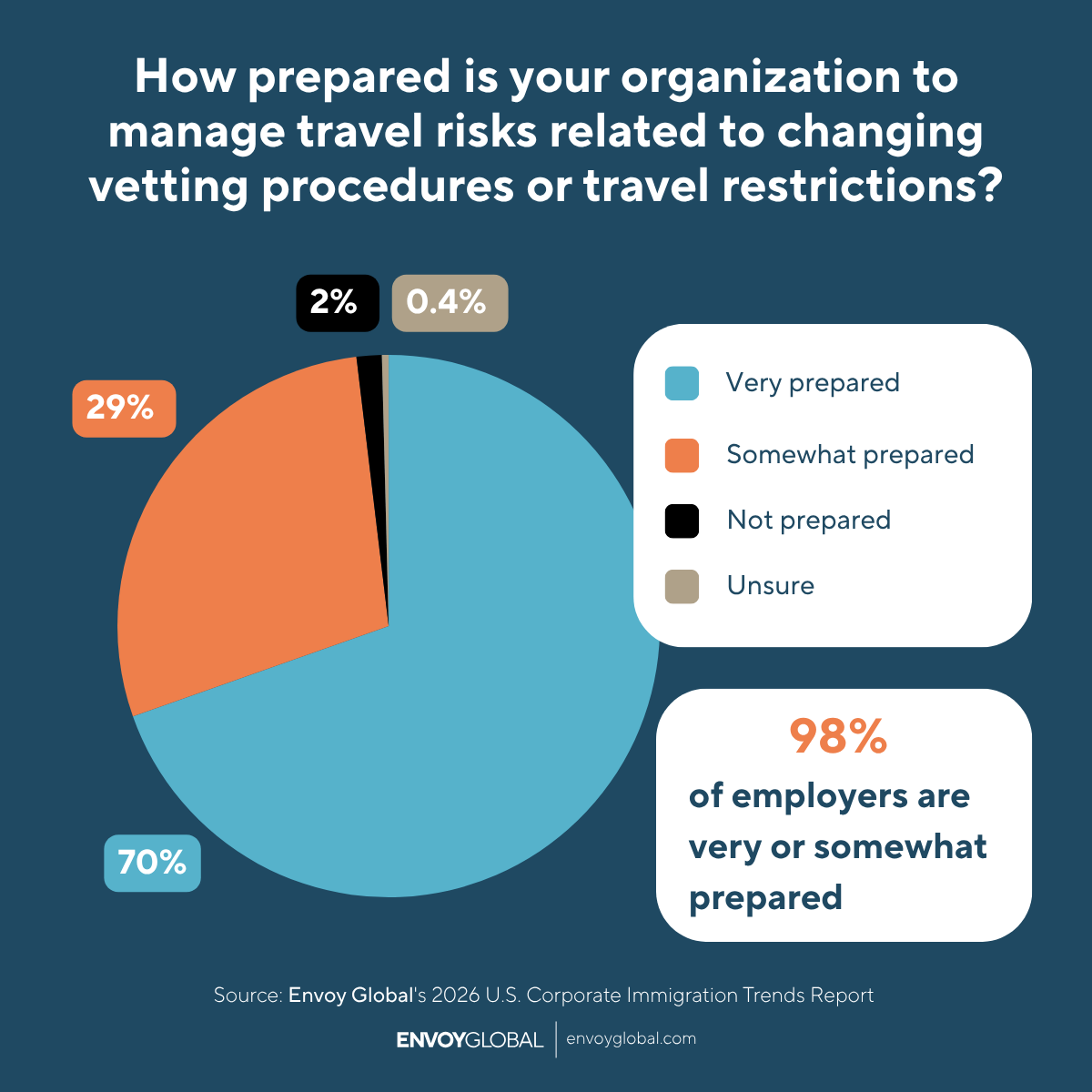
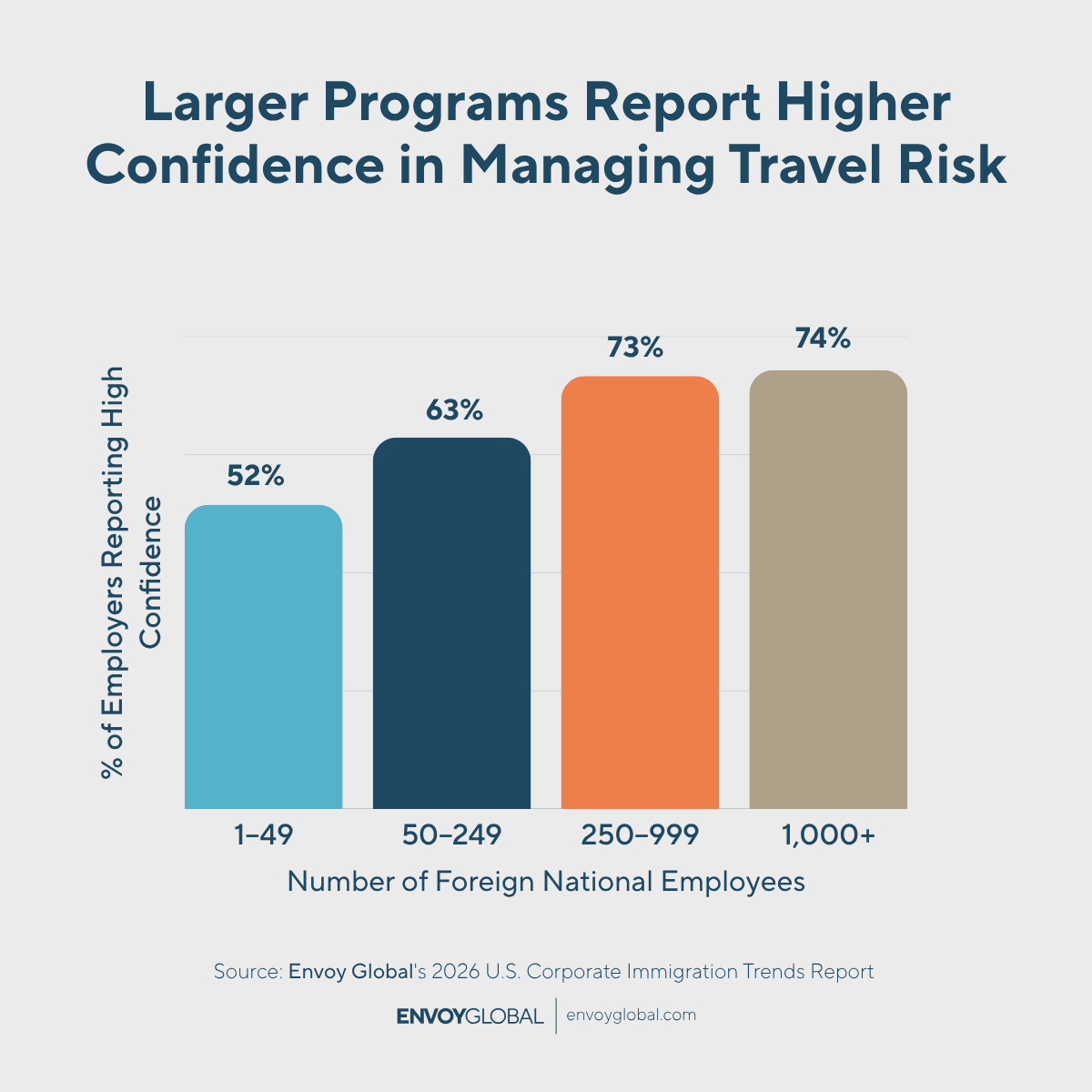
Larger Programs Report Higher Preparedness for Travel‑Related Risk
Preparedness increases with program size, reflecting the more established mobility infrastructure of larger employers.
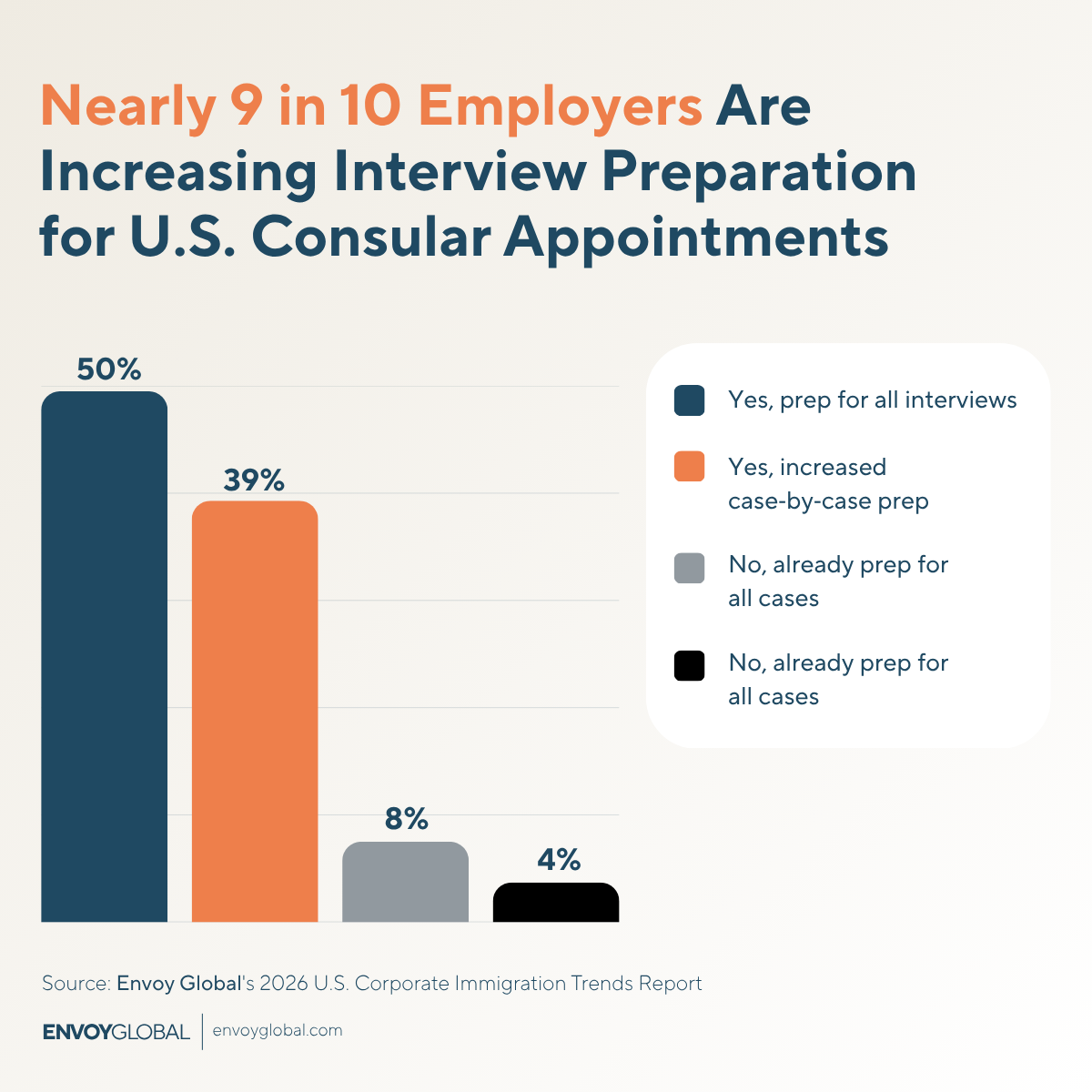
Consular Interview Preparation
Organizations increasingly use interview preparation for U.S. consular appointments in an effort to reduce uncertainty and improve consistency amid growing unpredictability.
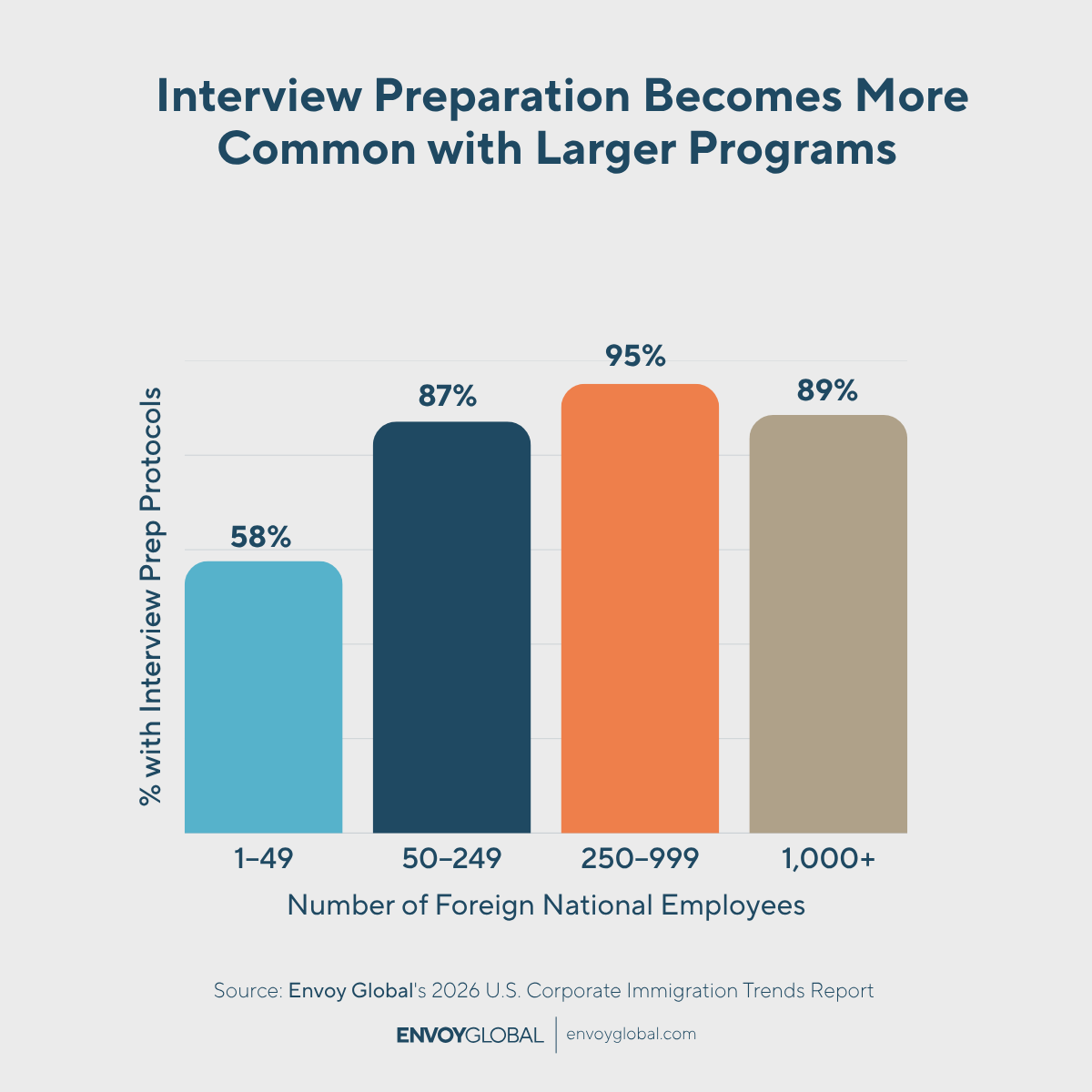
Interview Preparation Becomes More Common with Larger Programs
Larger employers, with higher case volumes and greater exposure to consular variability, are most likely to standardize interview-prep protocols.
U.S. Reentry Disruptions
When disruptions do occur, employers generally prioritize continuity over disruption.
Rather than taking immediate corrective action, most organizations are choosing to absorb short-term uncertainty to retain talent.
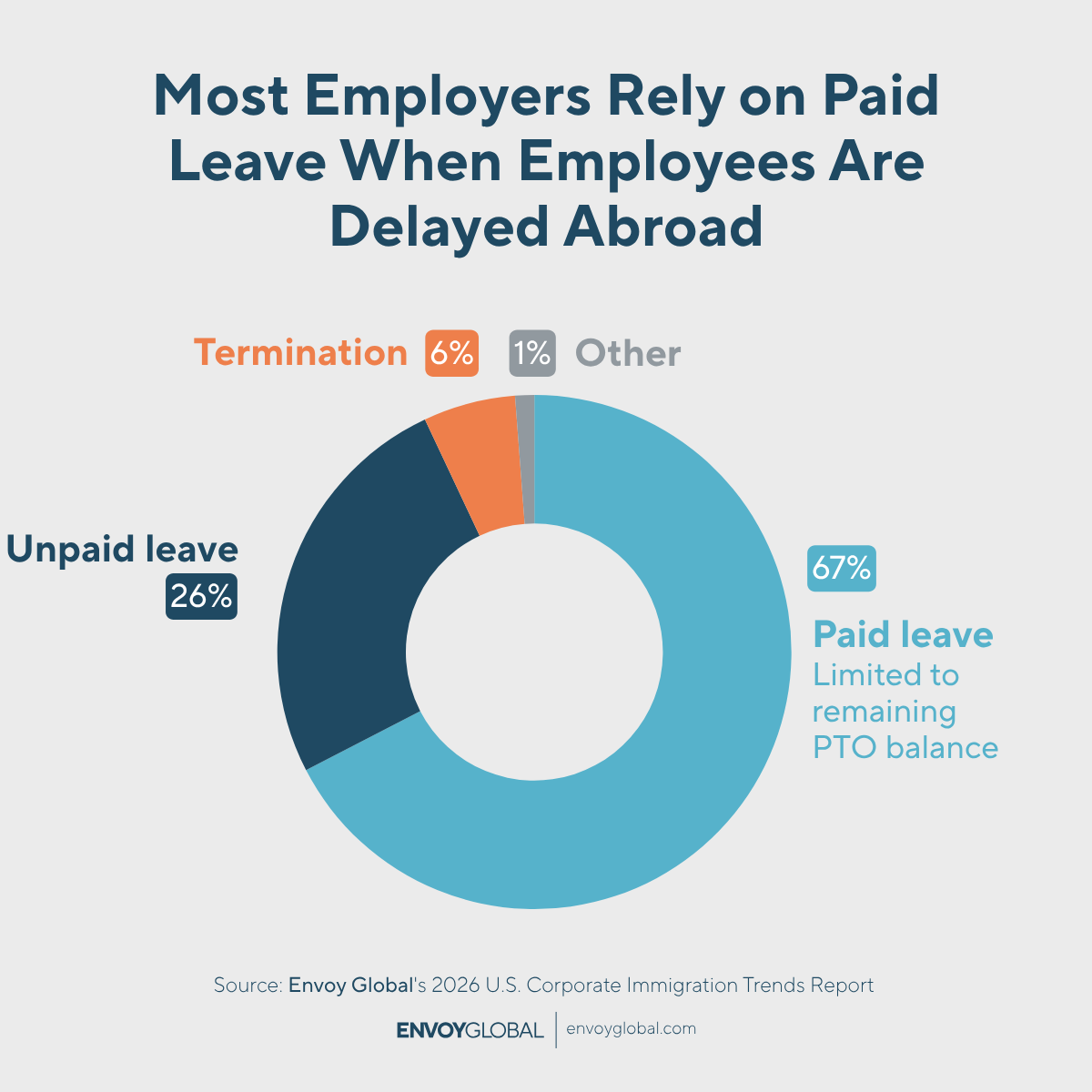
This response pattern suggests that, even in the face of prolonged uncertainty, employers are reluctant to lose talent due to factors outside the employee’s control.
Paid leave, in particular, appears to function as a buffer—allowing employers to maintain workforce continuity while navigating delays that remain difficult to predict or resolve quickly.
Paid Leave Emerges as a Strategic Response to Travel Disruptions
Paid leave as the primary response to reentry delays reflects a practical and risk-aware approach in an increasingly uncertain immigration environment.
In many cases, employers must carefully manage work authorization constraints, as employees outside the U.S. who are delayed in reentry may not be able to continue their U.S.-based employment functions remotely. Paid leave provides a clean, administratively manageable bridge until the employee can lawfully resume work in the U.S.
Ultimately, the widespread use of paid leave underscores a broader trend: employers are prioritizing talent retention and continuity amid systemic unpredictability.
Read Nicole Hartnett’s full insight on why paid leave has become a common employer response to entry disruptions – and how its impact varies across company size.
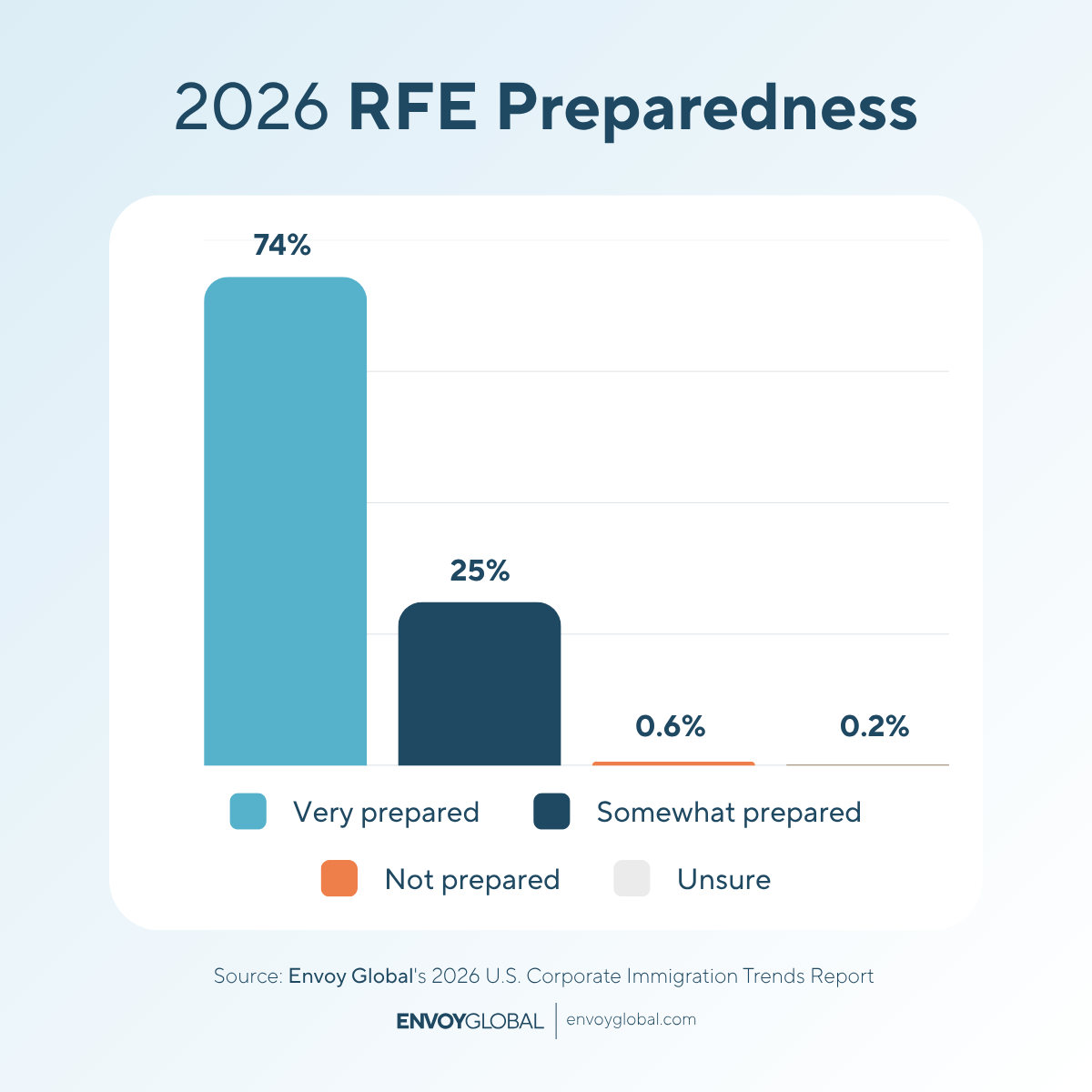
Compliance Preparedness
In 2026, employers report a high level of preparedness for immigration compliance, signaling more mature programs and stronger internal processes.
Relocation Strategies
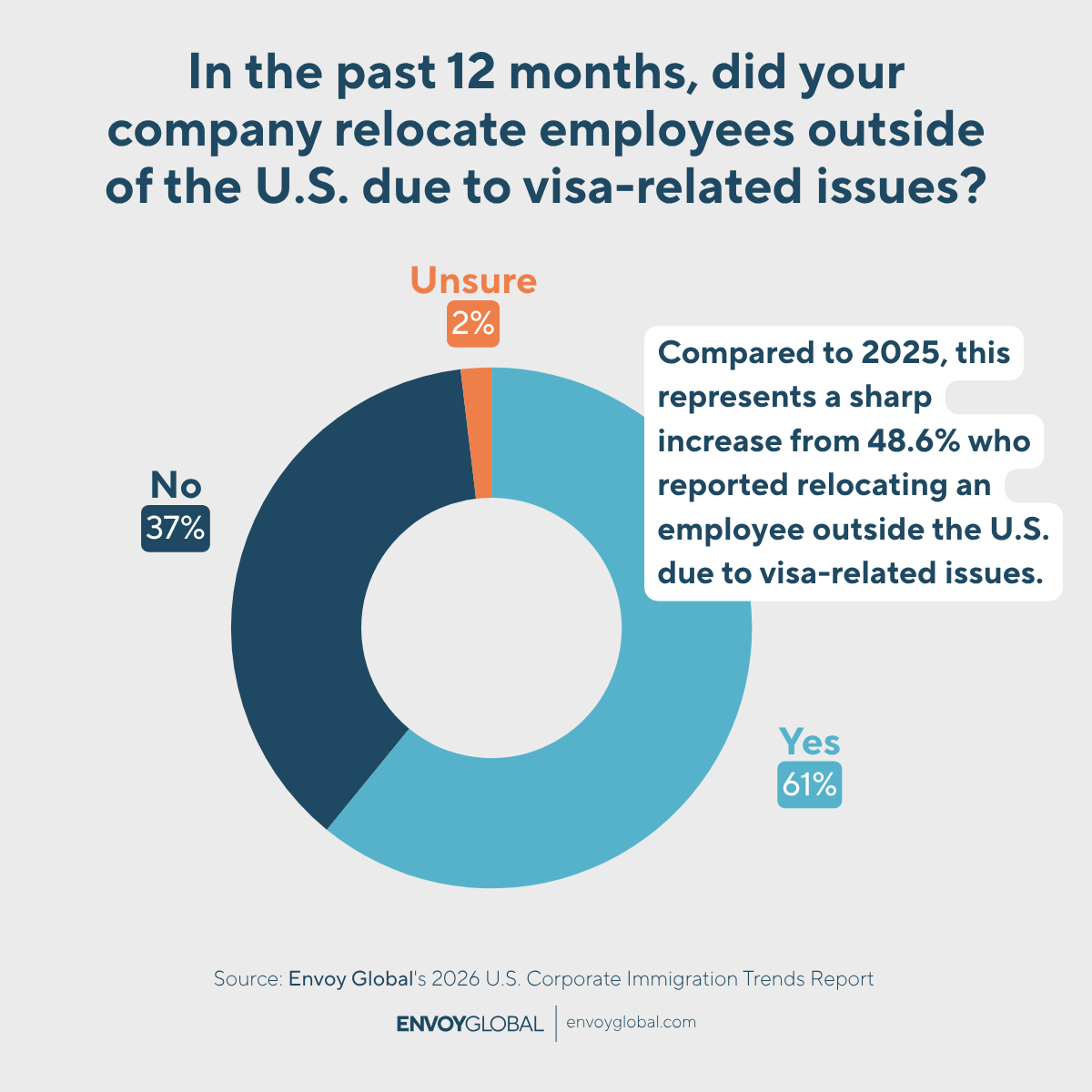
Relocation is becoming a core response to U.S. immigration constraints, increasingly shaping where organizations deploy and retain talent.
In 2026, six in 10 employers (60.9%) report relocating employees outside the U.S. due to denials, delays or other immigration barriers, marking a sharp increase from 48.6% in 2025.
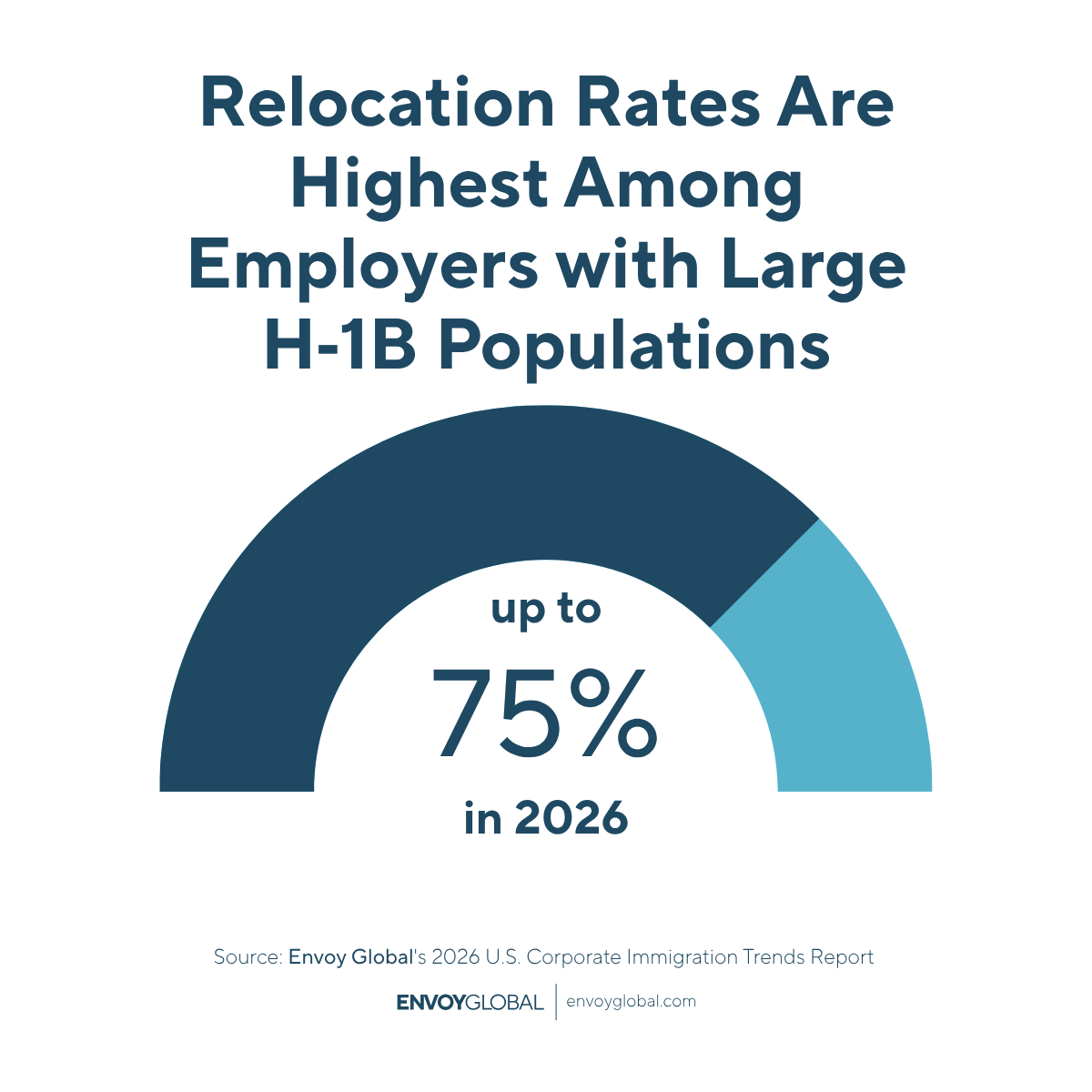
Relocation Rates Are Highest Among Employers with Large H‑1B Populations
Relocation is even more common among employers with large H‑1B and OPT populations, with rates reaching 75.3%.
Higher relocation rates among employers with large H‑1B and OPT populations reflect the growing influence of high‑skilled visa constraints on global workforce distribution, particularly for organizations with greater exposure to these programs.
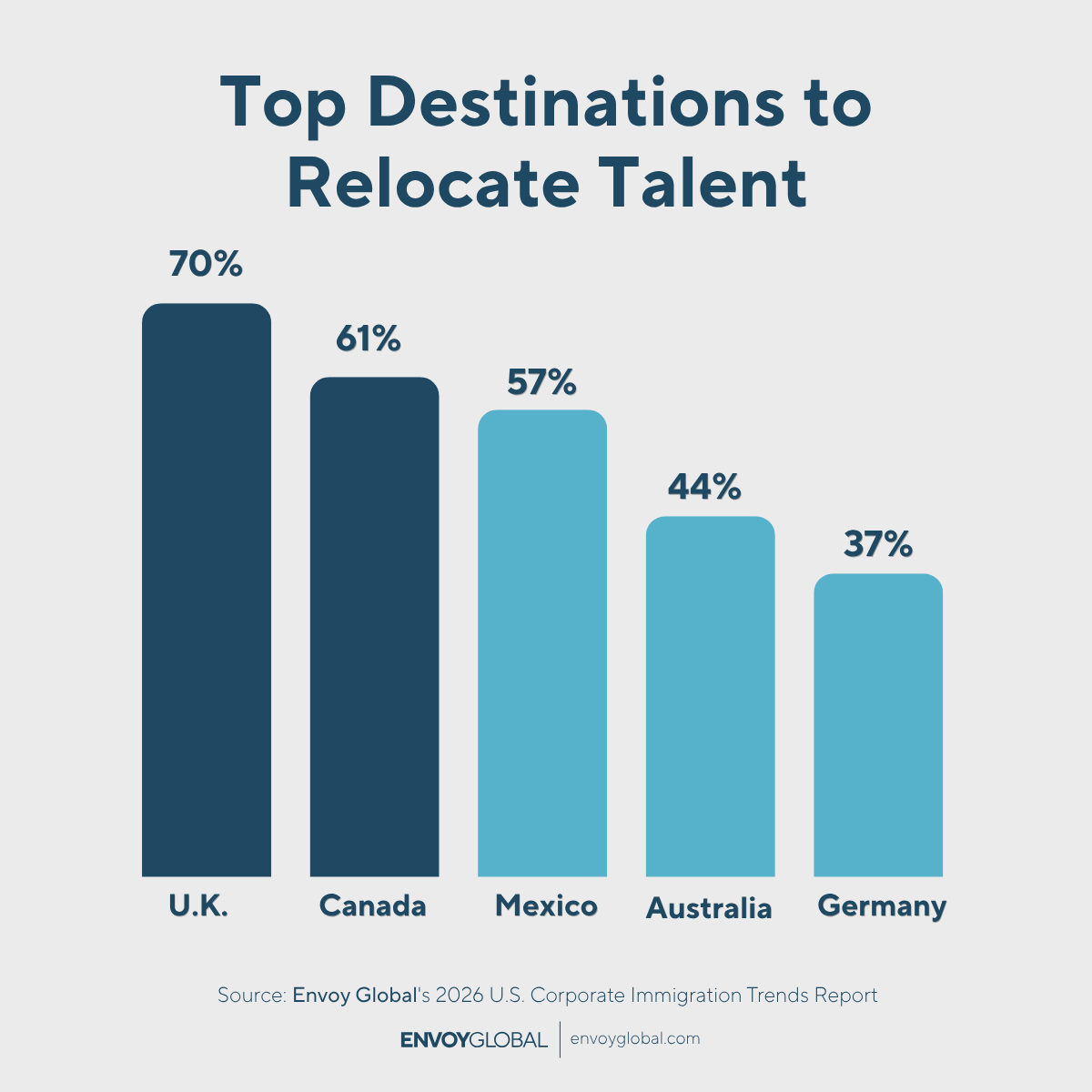
Where Employers Relocate Talent When U.S. Pathways Stall
Relocation patterns show a clear path: Canada, Mexico and the U.K. are the dominant destinations.
Where Employers Relocate Talent When U.S. Pathways Stall
| Destination | Share of Employers Relocating Talent to Each Destination |
| U.K. | 70% |
| Canada | 61% |
| Mexico | 57% |
| Australia | 44% |
| Germany | 37% |
| Europe (other than UK/Ireland/Germany) | 36% |
| Central & South America (other than Mexico) | 29% |
| China | 28% |
| Singapore | 27% |
| Ireland | 26% |
| India | 25% |
| Asia‑Pacific (other than Australia/Singapore/China) | 20% |
| Middle East | 17% |
| Africa | 10% |
Countries Viewed as More Favorable Than the U.S.
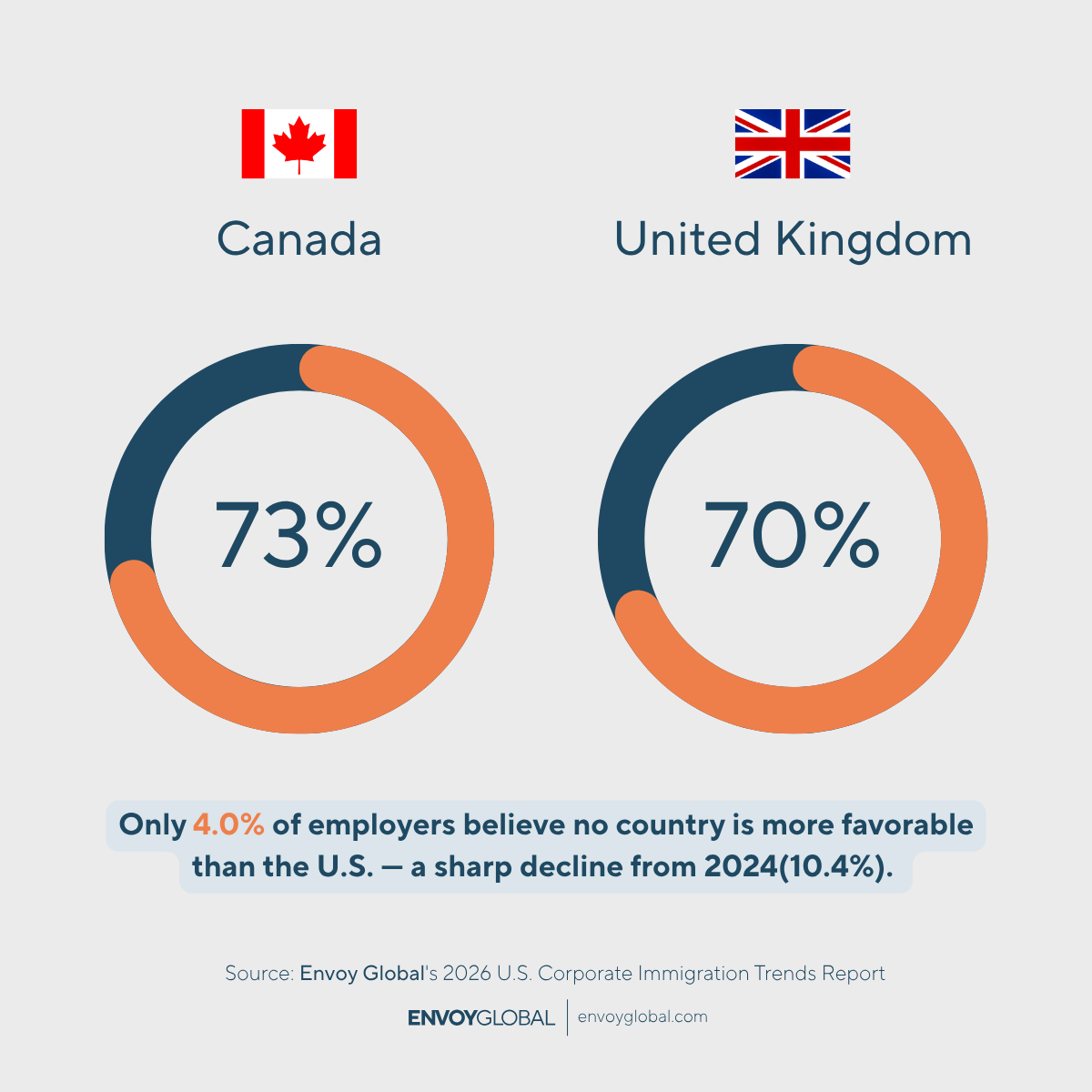
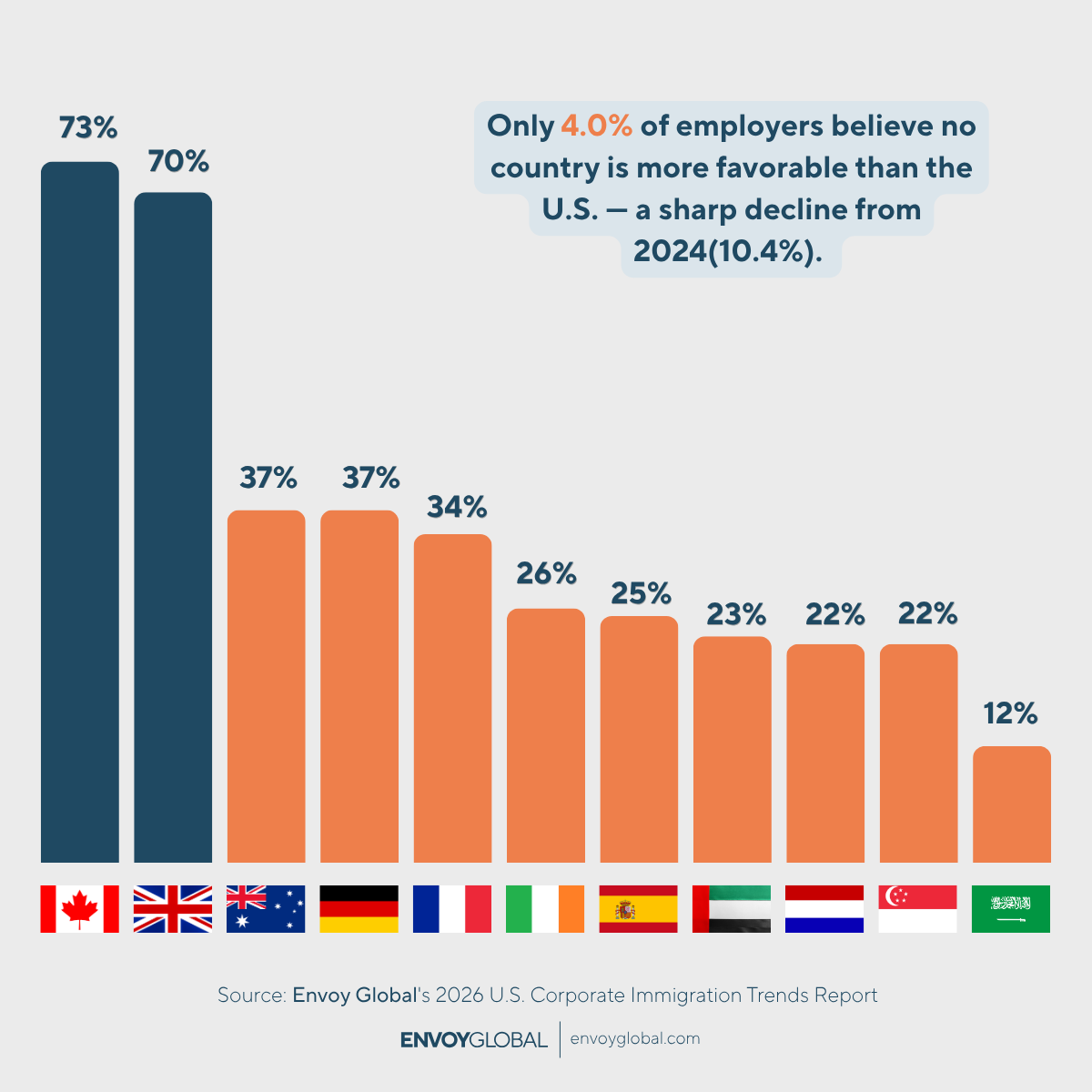
The destinations employers rely on for relocation closely mirror the countries they view as having the most favorable immigration systems overall.
Canada, the U.K., and Australia consistently rank among the most attractive destinations for U.S. employers.
Where Employers See the Most Favorable Immigration Systems
Near‑Universal Demand for Immigration Support
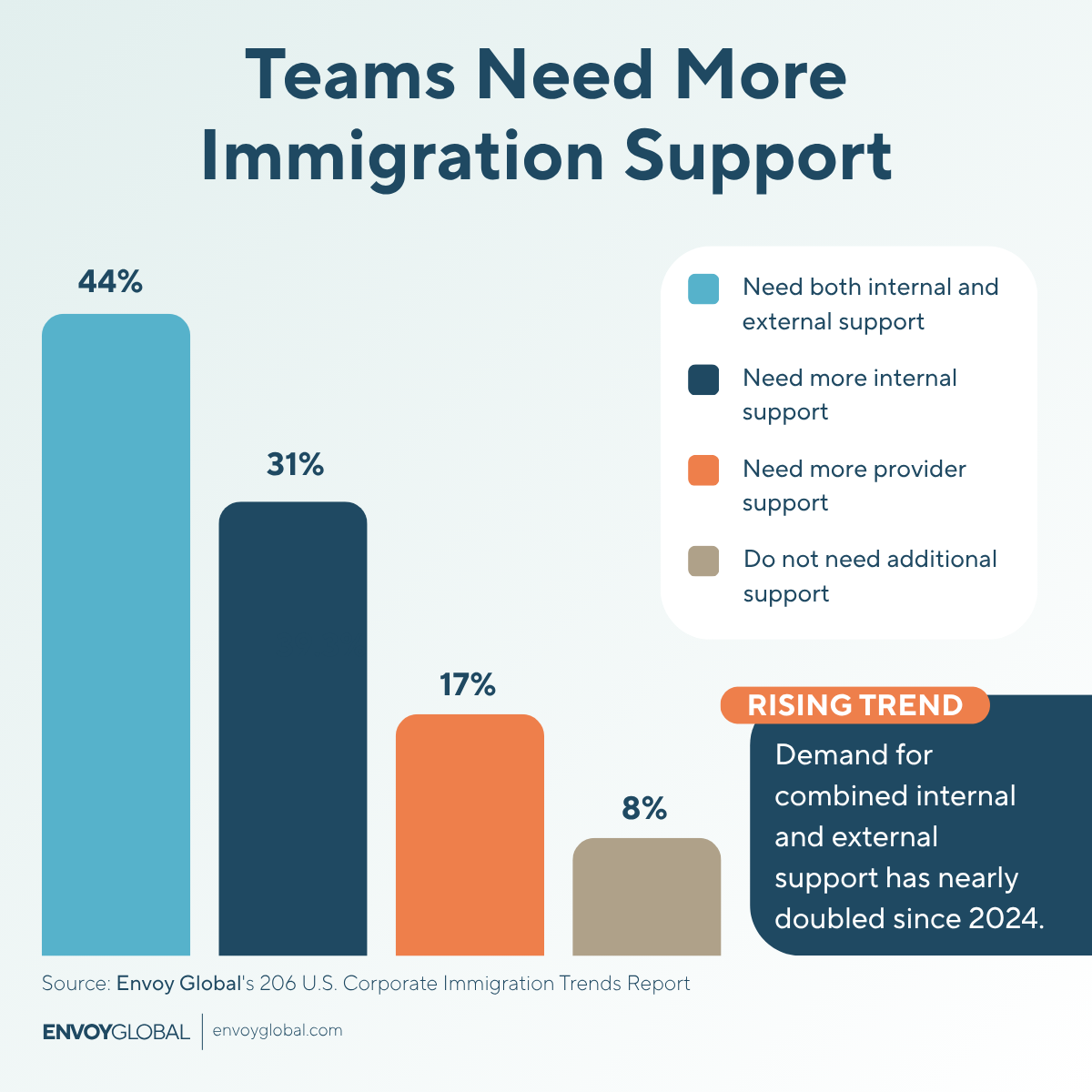
Taken together, these mobility challenges highlight how significantly the scope of immigration work has expanded in 2026.
HR and mobility teams are now operating across a broader, more complex set of responsibilities, often extending beyond traditional case management and straining internal capacity.
Nearly all employers report a need for additional support.
Larger Programs Report the Highest Need for Additional Support
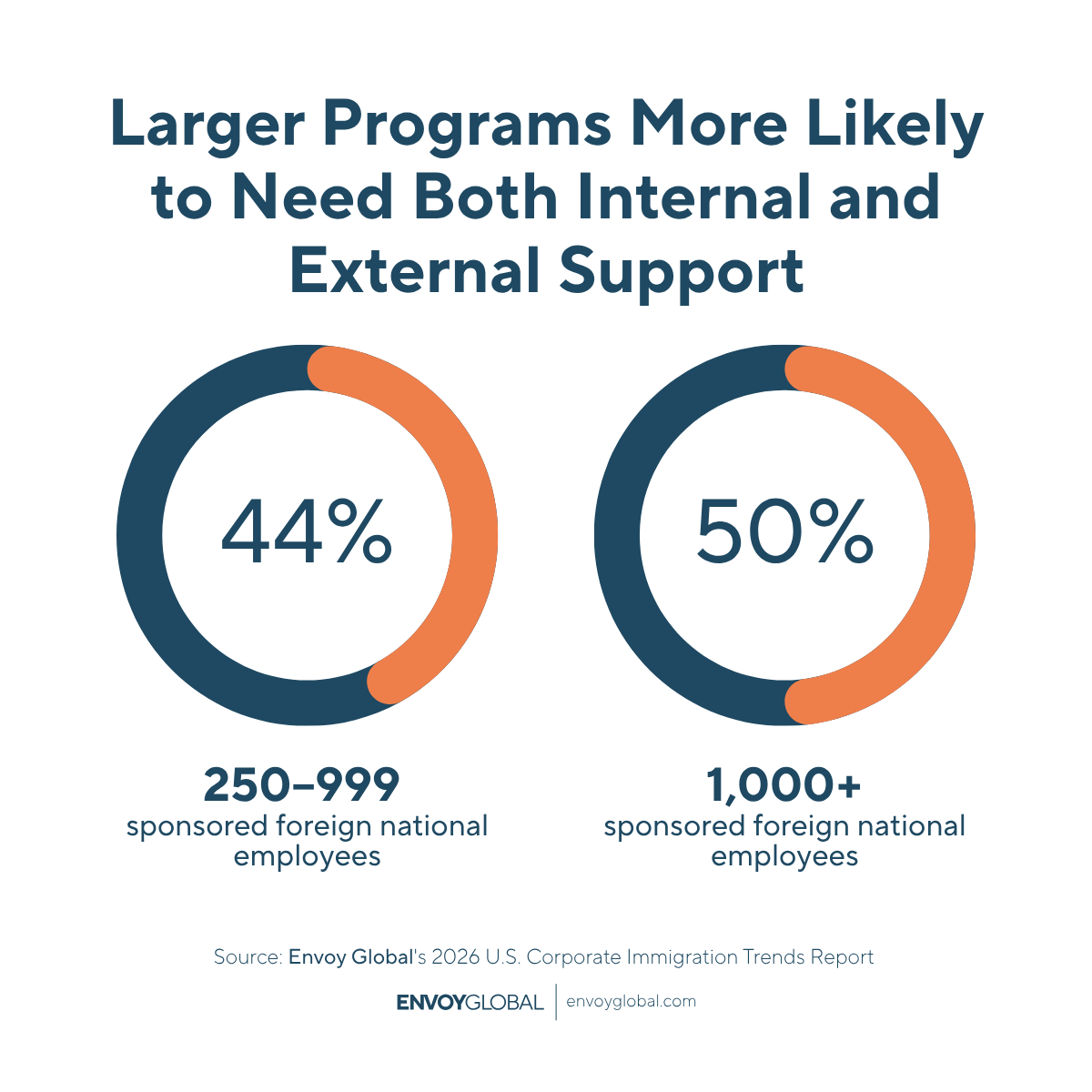
Employers with larger immigration programs report the greatest need for additional support:
Immigration Service Providers in 2026
With 98% of organizations now working with at least one immigration service provider, external support has become a central part of managing immigration programs.
In 2026, employers are reassessing whether their current immigration service providers can keep pace with programs that are becoming more interconnected and operationally demanding.
As programs evolve, expectations are shifting. Employers are looking for providers that can offer not just case support, but also the flexibility, insight and coordination needed to navigate a more complex, fast-moving environment.
Service Provider Switching Is Accelerating in 2026
More than half of employers — 54% — say they are considering switching immigration providers in 2026.
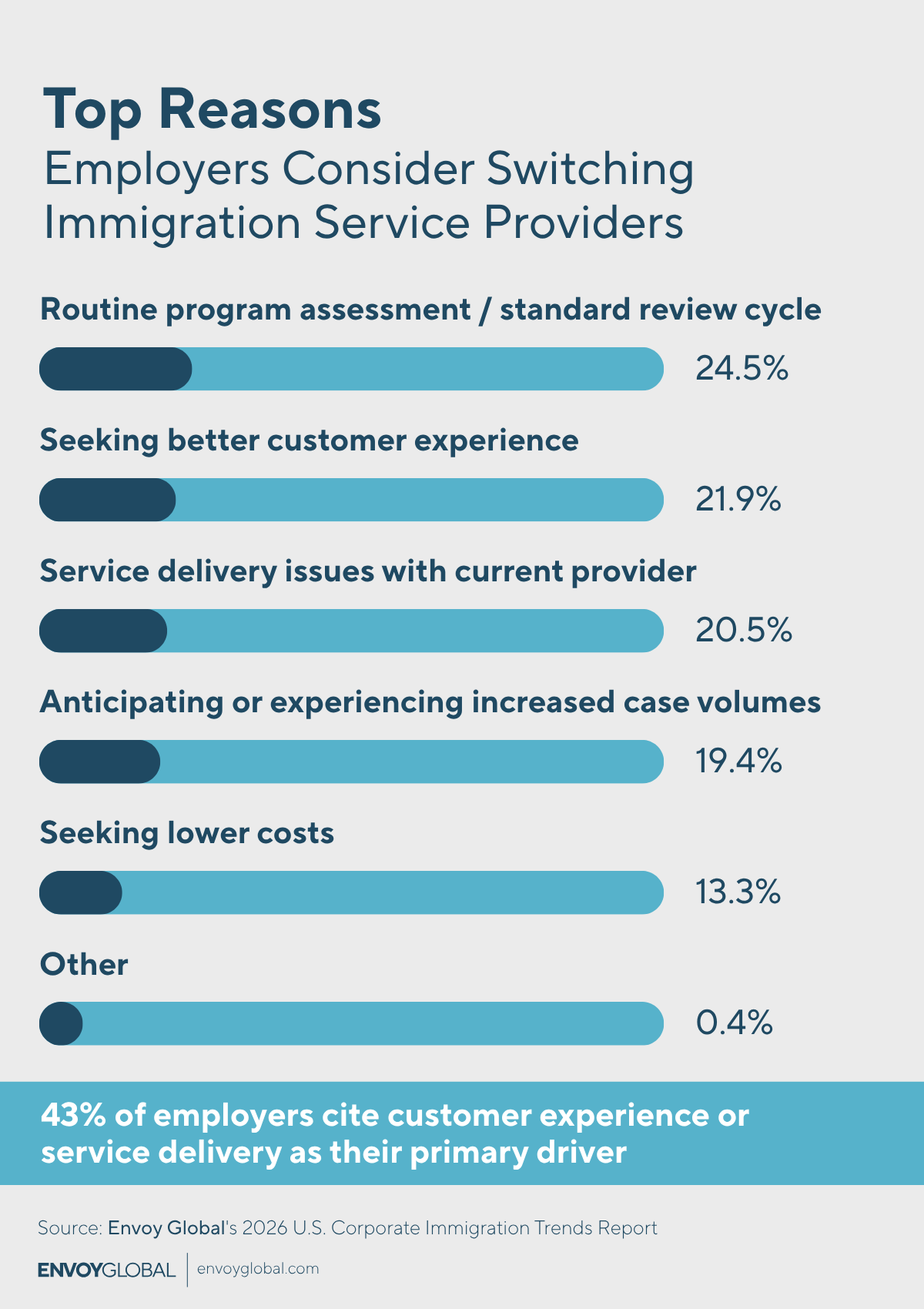
Service Quality and Customer Experience Are the Top Drivers
In 2026, providers are shaping their decisions based on the quality and effectiveness of service delivery rather than cost.
Employers Want Flexible, Hybrid Support Models in 2026
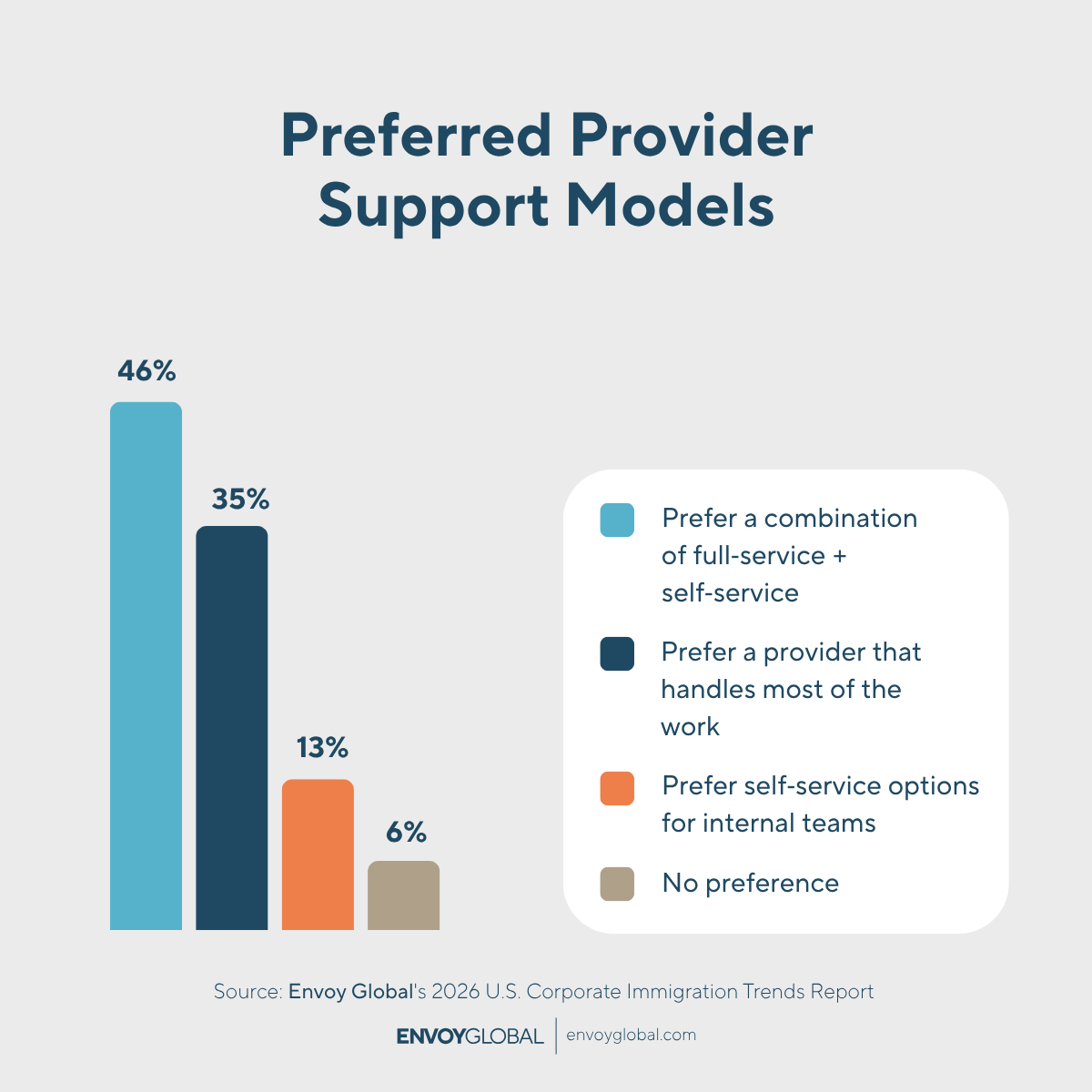
As immigration programs grow more complex and case volumes rise, employers are gravitating toward hybrid engagement models that blend full‑service support with self‑service tools. In 2026, nearly half of employers prefer a hybrid model — making it the top choice across the dataset.
This shift reflects two converging pressures:
- Rising complexity that requires expert, high‑touch support
- Rising expectations for efficiency, visibility and automation
Business Visa Needs Are Growing
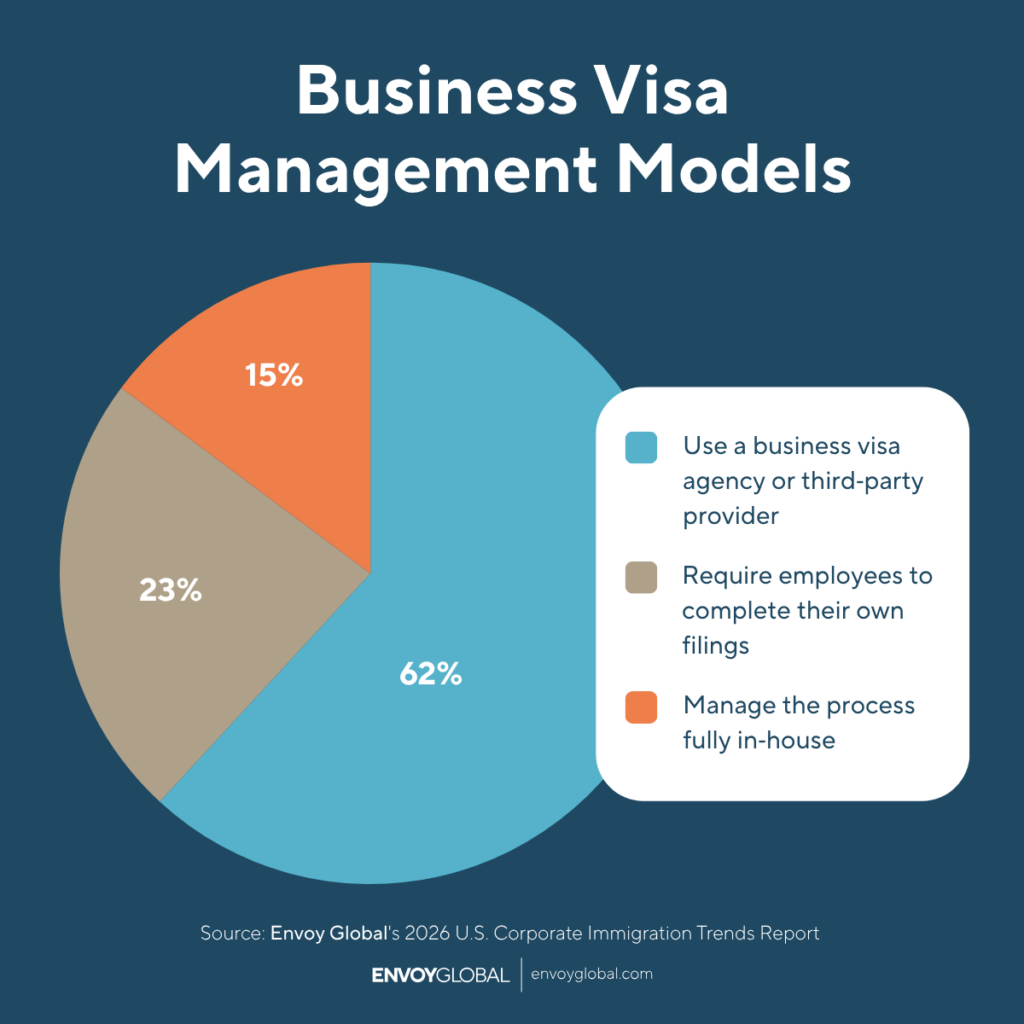
Business visa processing has become another area where employers turn to outside support. Requirements vary widely across countries, shift quickly and require dedicated expertise.
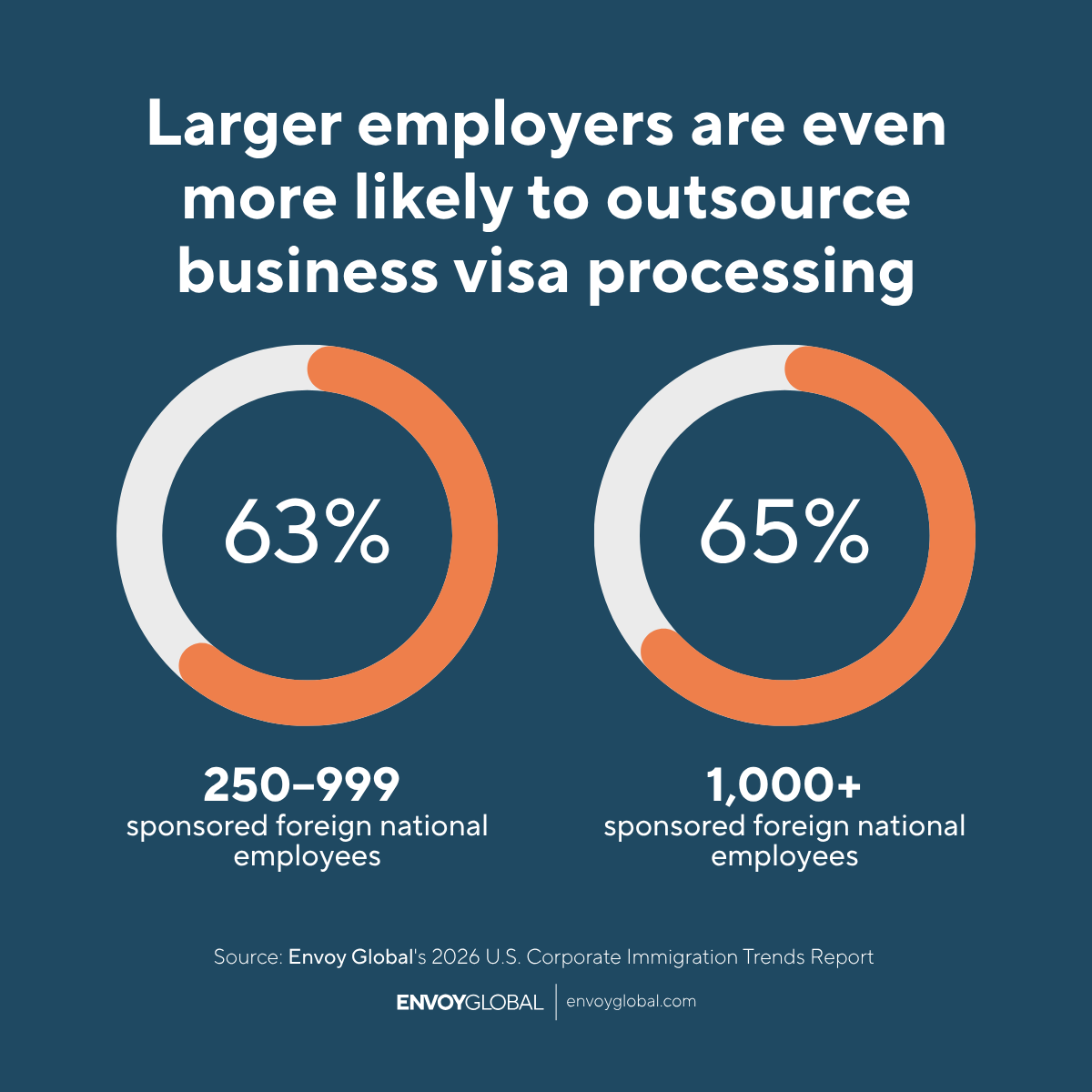
In 2026, nearly two‑thirds of employers rely on a third‑party provider for business visa processing, reflecting the growing scope and variability of business travel requirements.
Employer Size Shapes Business Visa Management Models
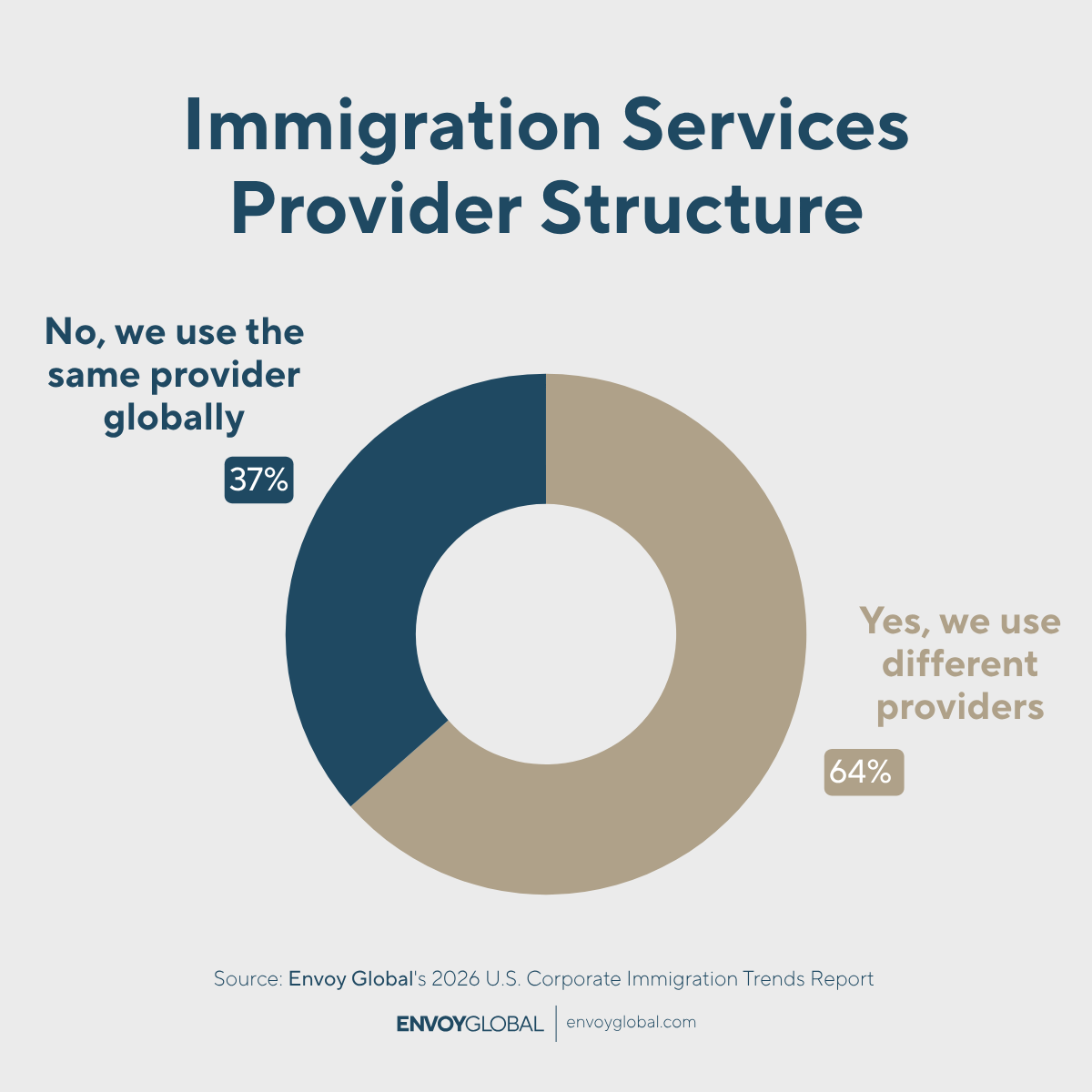
Most Employers Still Use Separate Providers, Creating Fragmentation
In 2026, 64% of organizations report using different providers, indicating that many employers continue to rely on separate models for U.S. and non‑U.S. immigration work.
As immigration programs extend across regions, this structure can make coordination more difficult and limit consistency across cases and teams.
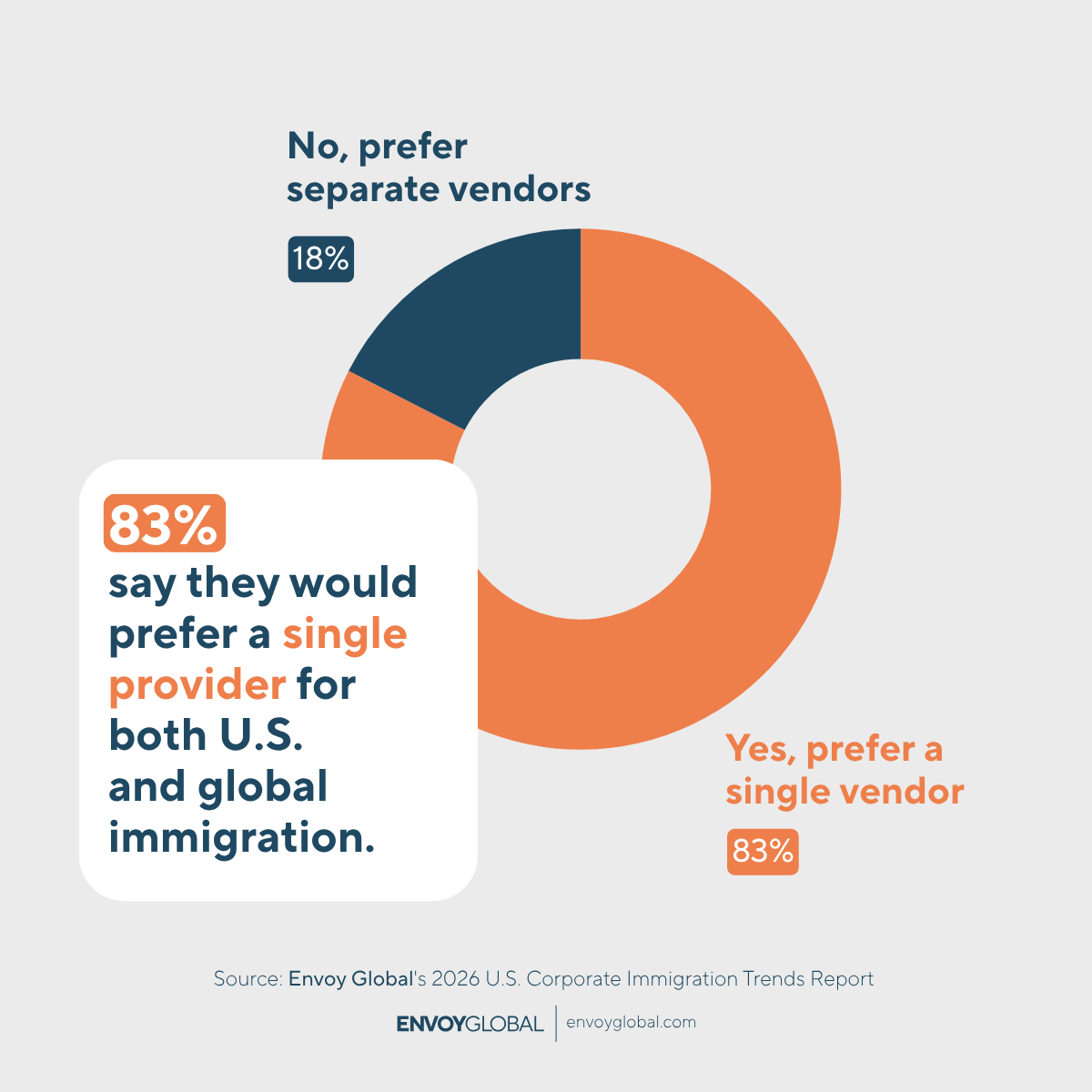
At the same time, many employers indicate a preference for a more unified approach.
A Better Way to Manage Global Immigration
Despite the prevalence of fragmented models today, employers show a clear preference for a more consolidated approach. In 2026, 83% say they would prefer a single provider for both U.S. and global immigration.
Their desire reflects how immigration work is now being managed in practice, spanning regions and requiring consistent coordination, particularly in a policy environment that remains in flux and requires closer alignment across programs.
About Envoy Global
U.S. Employers are navigating a complex and rapidly evolving global talent landscape. Envoy Global helps organizations meet these challenges with the worldwide coverage, in‑country expertise and user‑friendly technology needed to support every stage of the immigration journey.
For more than two decades, we’ve helped companies secure work authorizations, relocate employees and manage global mobility programs across 180+ countries. By bringing together smart, friendly legal teams and smart, friendly technology, we make immigration easier for the organizations and global talent who depend on it.
As attracting and retaining global talent becomes a strategic business imperative, Envoy Global provides the support, visibility and experience employers need to deliver the best immigration experience possible.
Methodology
This survey was conducted from March 20 to April 14, 2026, gathering responses from 519 U.S. employers across industries, company sizes and seniority levels to inform these findings. Learn more about or methodology here.
Authors

Anne Walsh
Partner
Anne Walsh is a Partner at Corporate Immigration Partners, where she advises employers ranging from startups to Fortune 500 companies on employment-based immigration strategy, compliance and corporate mobility matters. She has extensive experience managing complex filings, responding to Requests for Evidence and audits and guiding organizations through evolving immigration policies and adjudication standards.

Rita Ambrosetti
Partner
Rita Ambrosetti is a Partner at Corporate Immigration Partners, specializing in employment-based immigration, including H‑1B and L‑1 visas and immigrant visa processing. She advises employers on sponsorship strategy, cost management and compliance, helping organizations navigate increasing complexity across immigration programs.

Sherry Neal
Partner
Sherry Neal is an experienced immigration attorney with more than 20 years focused exclusively on immigration law. She advises organizations ranging from Fortune 500 companies to healthcare institutions on employment-based immigration strategy, processing and compliance. She is an active member of the American Immigration Lawyers Association (AILA), where she has held multiple leadership roles, and a recognized thought leader who advises employers across industries, with published work and frequent speaking engagements on immigration policy.

Nicole Hartnett
Managing Attorney
Nicole Hartnett is a Managing Attorney at Corporate Immigration Partners, where she advises employers on employment-based immigration strategy, workforce planning and global talent programs. She supports organizations ranging from startups to Fortune 500 companies in navigating evolving immigration policies and building effective sponsorship strategies. She is a member of the American Immigration Lawyers Association (AILA) and is licensed to practice in New York and North Carolina.