- Home
- Insights & Immigration News Alerts
- Insights
- H‑1B Premium Processing in 2026: Why Employers Rely on It More Than Ever
ARTICLE
H‑1B Premium Processing in 2026: Why Employers Rely on It More Than Ever


By Sherry Neal, Partner at Corporate Immigration Partners
The H‑1B landscape in 2026 is defined by unpredictability.
Employers are navigating a system where adjudication times fluctuate, fees continue to rise, policy changes move quickly and Requests for Evidence (RFEs) are becoming more common. Together, these factors have added new layers of complexity to one of the most widely used U.S. employment‑based pathways.
At the same time, U.S. employers face mounting pressure to maintain workforce continuity and avoid disruptions tied to immigration status — all while reducing employee anxiety in an increasingly uncertain environment. These operational realities have pushed organizations to rely on premium processing at unprecedented levels.
According to Envoy Global’s 2026 U.S. Corporate Immigration Trends data, employers continue to rely on premium processing across the entire H‑1B lifecycle.
Partner Sherry Neal offers critical insight into how and why employers are using premium processing for H‑1B petitions in 2026.
Premium Processing Fee Increases Over the Years
Premium processing fees have risen sharply in recent years, most notably through DHS’s 2026 fee adjustments. Despite these increases, employer usage is high across all H-1B petition types.
Why Employers Use H‑1B Premium Processing Across All Petition Types
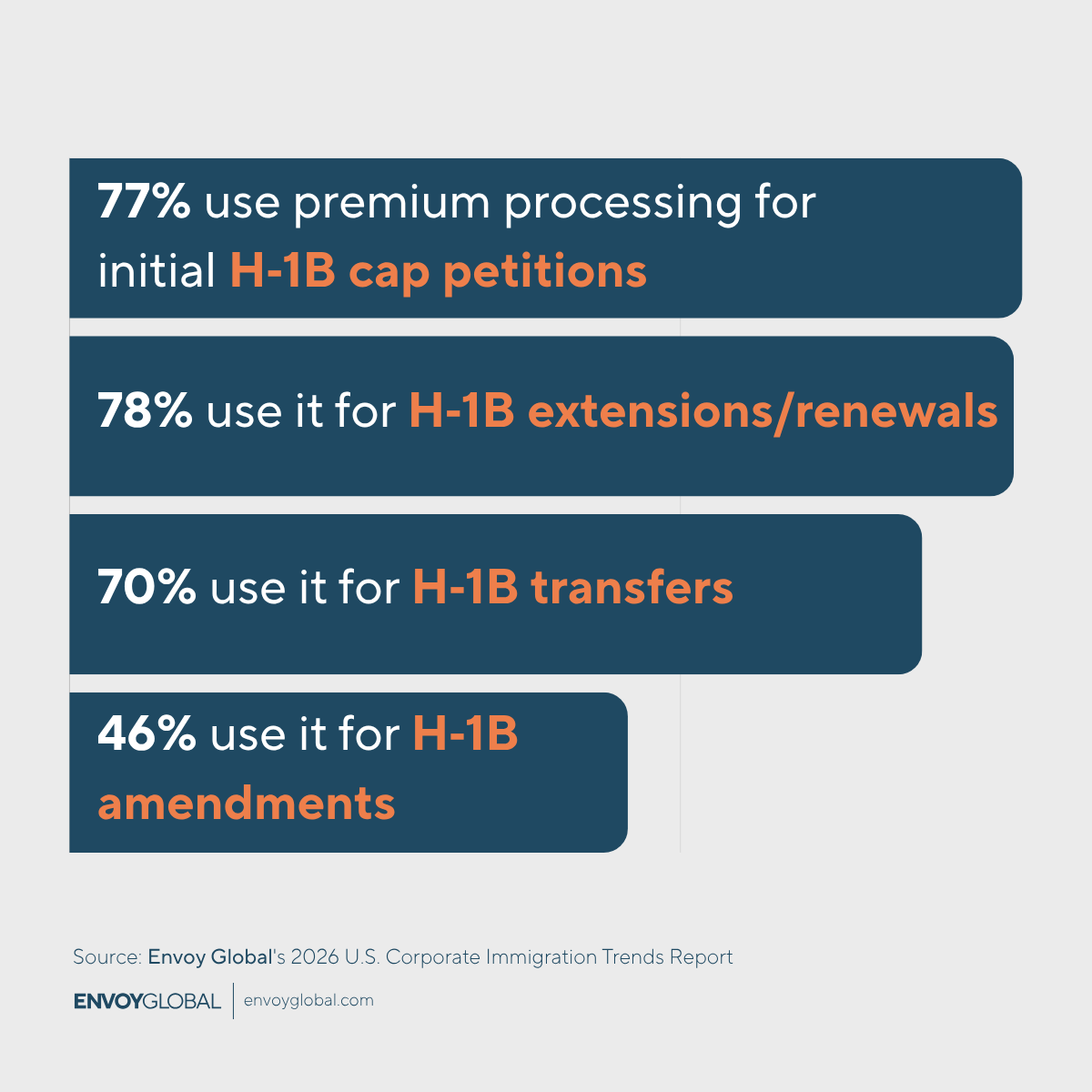
Employers overwhelmingly use premium processing for H-1 B petitions, regardless of whether it is an initial H‑1B cap petition, an H-1 B transfer or an H-1 B extension. And almost half of employers reported using premium processing for H-1B amendments.
High Usage Reflects Rising Uncertainty and Employee Anxiety
High premium processing usage across all H‑1B petition types reflects employers’ efforts to manage growing uncertainty and employee anxiety in the current immigration environment.
Why Employers Use Premium Processing for Cap Cases
Even for cap cases, where premium processing does not accelerate the October 1st effective date, employers use it to secure faster adjudication to avoid the risk of last-minute issues that could delay onboarding.
Premium Processing Reduces Risk for Extensions and Renewals
For extensions and renewals, despite the 240‑day continued work authorization while an extension is pending, employers often opt for premium processing to reduce stress for employees.
While the employee can continue to work while the extension is pending, the approval (rather than a receipt notice) is necessary for an employee to return to the U.S. after international travel and may be necessary for ancillary issues such as renewal of a driver’s license.
Similarly, although H‑1B portability allows employees to begin working upon filing a transfer, employers often factor premium processing into the recruiting costs as many foreign nationals are reluctant to leave their current employment until the H-1B transfer petition is approved.
Premium Processing as an Operational Safeguard
Despite the rising cost of premium processing this year, employers still rely on it as an operational safeguard, providing greater certainty about workforce continuity and supporting employee retention and morale.
Learn More About Premium Processing and the H‑1B Timeline
Premium processing has become a critical safeguard for employers navigating an increasingly unpredictable H‑1B landscape. As organizations work to maintain workforce continuity and reduce employee anxiety, understanding how premium processing fits into the broader H‑1B timeline is more important than ever.
Envoy Global’s 2026 U.S. Corporate Immigration Trends Report brings clarity to an evolving U.S. immigration landscape. Drawing on insights from more than 500 U.S. employers, the report highlights how organizations are adapting to new challenges, where immigration programs are evolving and what strategies look like in today’s environment.
Download the Envoy Global 2026 U.S. Corporate Immigration Trends Report.
Authored By

Sherry Neal
Partner
Sherry Neal is an experienced immigration attorney with more than 20 years focused exclusively on immigration law. She advises organizations ranging from Fortune 500 companies to healthcare institutions on employment-based immigration strategy, processing and compliance. She is an active member of the American Immigration Lawyers Association (AILA), where she has held multiple leadership roles, and a recognized thought leader who advises employers across industries, with published work and frequent speaking engagements on immigration policy.
Content in this publication is for informational purposes only and not intended as legal advice, nor should it be relied on as such. Envoy Global is not a law firm, and does not provide legal advice. If you would like guidance on how this information may impact your particular situation and you are a client of the U.S. Law Firm, consult your attorney. If you are not a client of the U.S. Law Firm working with Envoy, consult another qualified professional. This website does not create an attorney-client relationship with the U.S. Law Firm.