- Home
- Insights & Immigration News Alerts
- Insights
- How Employers Handle U.S. Reentry Delays
ARTICLE
How Employers Handle U.S. Reentry Delays


By Nicole Hartnett, Managing Attorney at Corporate Immigration Partners
As HR and global mobility teams know, foreign nationals may need to leave the U.S. for a variety of routine reasons, ranging from attending a visa stamping appointment to visiting family abroad, completing required consular processing or traveling for business on behalf of their employer. Under normal circumstances, these trips are a predictable and standard part of global mobility.
In 2026, however, these routine departures require more planning and coordination. Consular appointment availability varies by region, additional vetting procedures are more common, and processing times can shift with little notice. As a result, employees who leave the country — even for expected, compliance‑driven reasons — may face delays returning on their planned timeline.
Findings from Envoy Global’s 2026 U.S. Corporate Immigration Trends data suggest that when these situations occur, employers are taking a measured, retention‑focused approach. Rather than defaulting to corrective action, organizations are prioritizing continuity and supporting employees through delays beyond their control.
Managing Attorney Nicole Hartnett offers insight into how employers are navigating these increasingly common reentry challenges.
Why Employers Are Turning to Paid Leave
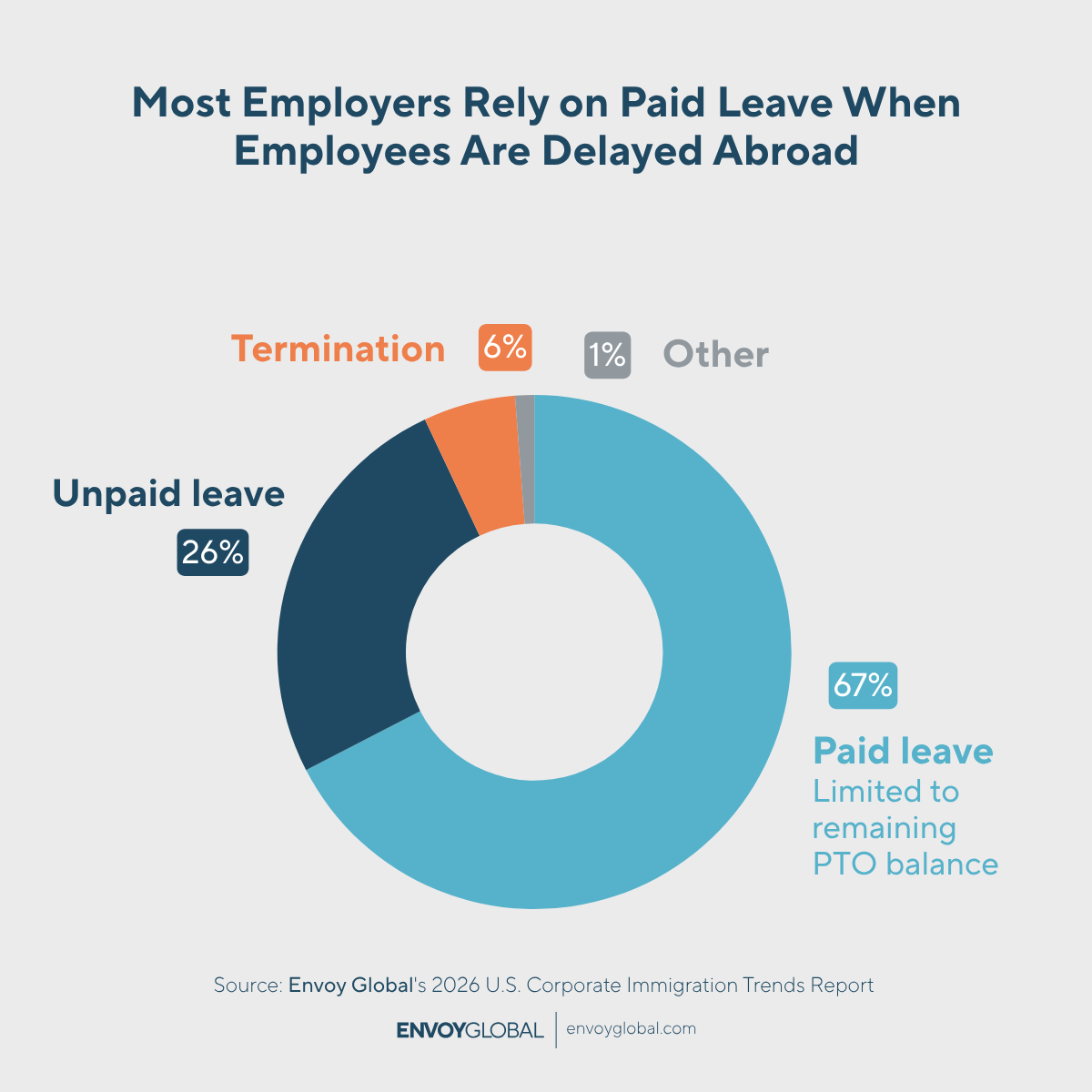
The prevalence of paid leave as the primary response to travel-related reentry disruptions reflects a practical and risk-aware approach by employers navigating increasing immigration uncertainty. When delays arise from visa processing, administrative vetting, or travel restrictions – factors largely outside the employee’s control – employers are incentivized to preserve continuity rather than impose punitive outcomes.
The Business Case for Retention Over Replacement
From a business perspective, allowing employees to utilize accrued paid time off (67.4%) is often the least disruptive and most cost-effective option. Replacing a skilled foreign national employee can trigger a cascade of costs, including recruiting, onboarding, lost productivity, and restarting or transferring the underlying visa process, which may involve additional legal fees, timing delays, and uncertainty. In contrast, temporary paid leave allows employers to retain institutional knowledge and maintain project stability, particularly in roles tied to specialized skills or client deliverables.
Compliance and Work Authorization Considerations
This approach also aligns with compliance considerations and the realities of workforce planning. In many cases, employers must carefully manage work authorization constraints, as employees who are outside the U.S. and delayed in reentry may not be able to continue their U.S.-based employment functions remotely. Paid leave provides a clean, administratively manageable bridge until the employee can lawfully resume work in the U.S.
How Employer Size Shapes Response Strategies
The data further highlights a divergence in how organizations absorb these disruptions. Larger organizations, with more robust global footprints and deeper staffing flexibility, are often better positioned to offer paid leave or temporarily reallocate responsibilities across teams or international offices. In contrast, smaller employers tend to feel the operational impact more acutely, as a single employee’s absence can significantly strain resources, making unpaid leave or, in limited cases, termination more likely outcomes.
A Broader Shift Toward Proactive Workforce Planning
Ultimately, the widespread use of paid leave underscores a broader trend: employers are prioritizing talent retention and continuity in the face of systemic unpredictability. As immigration-related travel disruptions persist, organizations are increasingly treating these events not as isolated incidents, but as foreseeable operational risks, and planning accordingly to minimize disruption while preserving access to critical talent
Looking Ahead
As reentry delays become a more common reality, employers are adapting with pragmatic, employee-centered strategies that balance compliance with business continuity. By prioritizing flexibility—particularly through paid leave and thoughtful workforce planning—organizations can mitigate disruption while reinforcing their commitment to retaining critical talent. In an environment defined by uncertainty, a proactive and supportive approach is quickly becoming the standard.
Learn More in the 2026 Trends Report
Envoy Global’s 2026 U.S. Corporate Immigration Trends Report brings clarity to an evolving U.S. immigration landscape. Drawing on insights from more than 500 U.S. employers, the report highlights how organizations are adapting to new challenges, where immigration programs are evolving and what strategies look like in today’s environment.
Download the Envoy Global 2026 U.S. Corporate Immigration Trends Report.
Authored By

Nicole Hartnett
Managing Attorney
Nicole Hartnett is a Managing Attorney at Corporate Immigration Partners, where she advises employers on employment-based immigration strategy, workforce planning and global talent programs. She supports organizations ranging from startups to Fortune 500 companies in navigating evolving immigration policies and building effective sponsorship strategies. She is a member of the American Immigration Lawyers Association (AILA) and is licensed to practice in New York and North Carolina.
Content in this publication is for informational purposes only and not intended as legal advice, nor should it be relied on as such. Envoy Global is not a law firm, and does not provide legal advice. If you would like guidance on how this information may impact your particular situation and you are a client of the U.S. Law Firm, consult your attorney. If you are not a client of the U.S. Law Firm working with Envoy, consult another qualified professional. This website does not create an attorney-client relationship with the U.S. Law Firm.