- Home
- Insights & Immigration News Alerts
- Insights
- Europe's Schengen Area Visa Countries
GUIDE | Updated August 2026
Europe's Schengen Area Visa Countries
Looking for a list of Schengen countries, information about Schengen visas or details on the 90/180-day rule? This guide explains everything travelers and employers need to know about the Schengen Area in 2026.
Contents


What Is the Schengen Area?
The Schengen Area is a border-free travel zone comprising 29 European countries that have eliminated internal border controls and adopted a common visa policy. Under the Schengen Agreement, travelers can generally move between participating countries without routine passport checks at internal borders.
The Schengen Area supports the free movement of people across Europe, making it easier for business travelers, tourists, students and multinational employers to navigate cross-border travel. More than 400 million people benefit from the agreement, including EU citizens, foreign nationals residing in participating countries and eligible visitors entering the region for short-term travel.
Most Schengen countries are also members of the European Union (EU), but the Schengen Area and the EU serve different purposes.
Cailin McCaffery, Immigration Consultant, EMEA, provides a comprehensive overview of the Schengen Area, including its benefits for international mobility, eligibility requirements and implications for workforce planning.
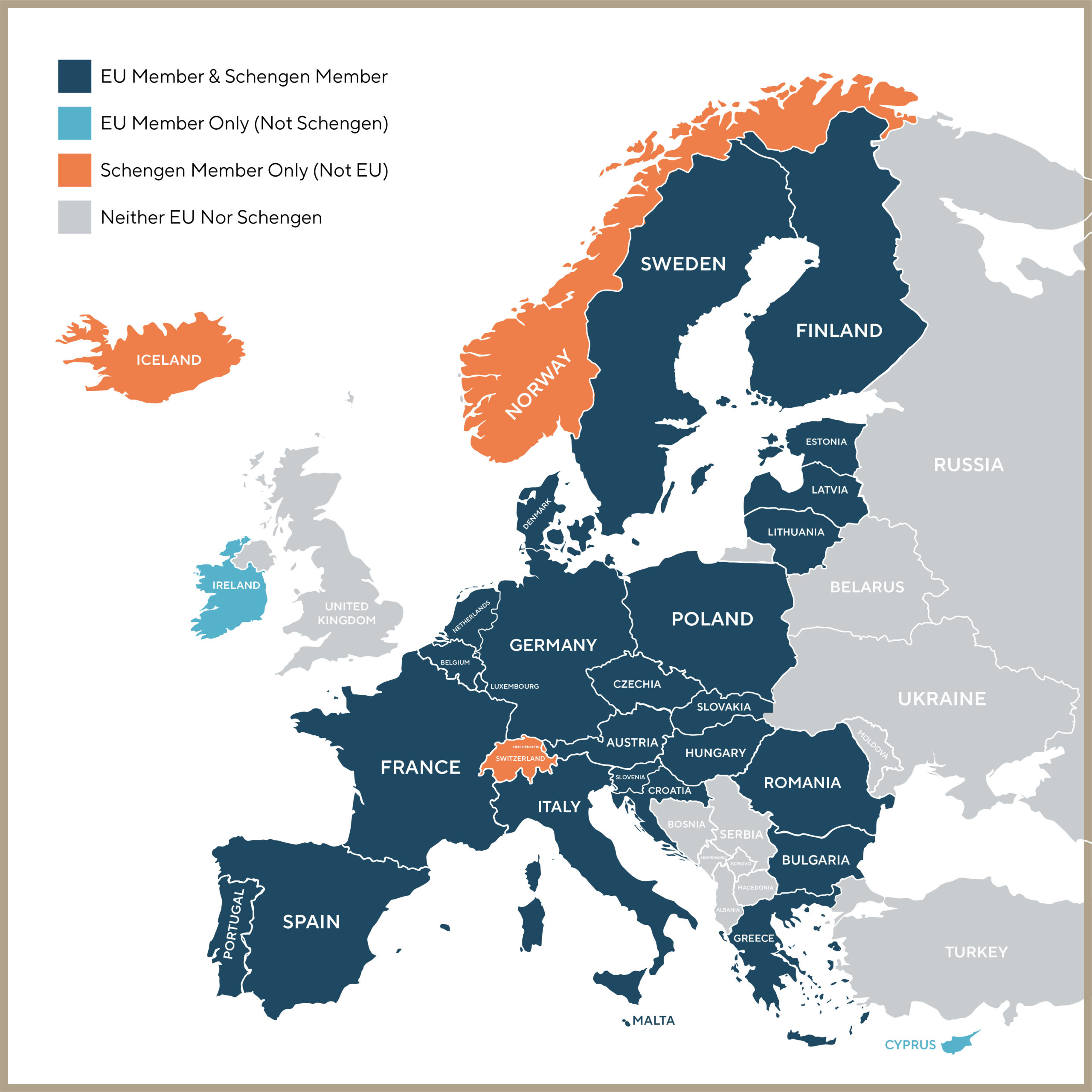

Schengen and EU Membership Overlap and Exceptions
Although the Schengen Area and the European Union (EU) often overlap, they are distinct organizations with different roles.
The Schengen Area
The Schengen Area focuses on border management and travel. Participating countries have removed routine border checks between member states, allowing travelers to move freely throughout the region.
The European Union
The European Union is a political and economic alliance of 27 member states. Its responsibilities extend far beyond border issues, encompassing trade, governance, economic policy and regional cooperation.
Since each organization has a different purpose, membership in one does not automatically mean membership in the other.
Key Exceptions to Know
- Switzerland, Iceland, Norway and Liechtenstein are members of the Schengen Area but are not part of the EU.
- Ireland is a member of the EU but does not participate in the Schengen Area.
- Cyprus applies certain Schengen rules but has not yet achieved full Schengen membership.
What Is a Schengen Visa?
A Schengen Visa allows eligible foreign nationals to travel within the Schengen Area for short-term stays, typically for:
- Business travel
- Tourism
- Family visits
- Short-term training or events
A valid Schengen Visa generally permits travel across all participating Schengen countries without obtaining separate visas for each destination.
Depending on nationality, some travelers may require a Schengen Visa before entering Europe, while others may qualify for visa-free travel.
What Is the Schengen 90/180-Day Rule?
One of the most important compliance requirements for business travelers is the Schengen 90/180-day rule.
Under this rule, eligible non-EU nationals may generally remain in the Schengen Area for up to 90 days within any rolling 180-day period.
The time limit applies across the entire Schengen Area, not to individual countries.
For example, time spent in France, Germany and Spain counts toward the same 90-day allowance.
Employers should monitor employee travel carefully to avoid immigration violations, overstays and future travel complications.
ETIAS and EES Requirements for Europe
Europe has introduced new border management systems aimed at strengthening security and modernizing travel. The Entry/Exit System (EES) digitally records travelers’ entries and exits using biometric data, replacing passport stamping, while the European Travel Information and Authorisation System (ETIAS) will require advance travel authorization for eligible visa-exempt travelers before entering participating European countries.
Schengen Changes Ahead: What Mobility Leaders and Travelers Need to Know
The EU Entry-Exit System (EES) and future ETIAS authorization requirements will change how many travelers enter and exit the Schengen Area. Employers, business travelers and global mobility teams should understand how these systems may impact travel planning and compliance.
Nelli Toth, Envoy Global’s Director of Knowledge Management and Advisory & Compliance Services, breaks down what mobility leaders and travelers need to know about processing times, operational readiness and what to expect at the border.
Upcoming Schengen Area Expansion and What It Means for International Travel
Several European countries are expected to advance toward full accession to the Schengen Area in the coming years. While recent expansions have included countries like Croatia and soon Cyprus, future candidates must meet a range of criteria related to border security, visa policy alignment and infrastructure readiness before joining.
The accession process remains rigorous, ensuring that new members can uphold the standards of Schengen cooperation.
Frequently Asked Questions About the Schengen Area and European Travel
Understand the latest Schengen travel requirements with answers to common questions about member countries, border-free movement and what employers, mobility teams and travelers should know about European travel.
Which countries are in the EU and which countries are Schengen members?
The Schengen Area consists of 29 countries that have abolished internal border controls and apply a common external border and visa policy. Romania and Bulgaria became full Schengen members on Jan. 1, 2025, while Cyprus is expected to join in the future.
| Country | EU Member | Schengen Member |
| Austria | Yes | Yes |
| Belgium | Yes | Yes |
| Bulgaria | Yes | Yes |
| Croatia | Yes | Yes |
| Czech Republic | Yes | Yes |
| Denmark | Yes | Yes |
| Estonia | Yes | Yes |
| Finland | Yes | Yes |
| France | Yes | Yes |
| Germany | Yes | Yes |
| Greece | Yes | Yes |
| Hungary | Yes | Yes |
| Italy | Yes | Yes |
| Latvia | Yes | Yes |
| Lithuania | Yes | Yes |
| Luxembourg | Yes | Yes |
| Malta | Yes | Yes |
| Netherlands | Yes | Yes |
| Poland | Yes | Yes |
| Portugal | Yes | Yes |
| Romania | Yes | Yes |
| Slovakia | Yes | Yes |
| Slovenia | Yes | Yes |
| Spain | Yes | Yes |
| Sweden | Yes | Yes |
| Iceland | No | Yes |
| Liechtenstein | No | Yes |
| Norway | No | Yes |
| Switzerland | No | Yes |
Do All EU Countries Follow Schengen Travel Rules?
No. While many European Union (EU) member states participate in the Schengen Area, not all EU countries follow Schengen travel rules. Likewise, some countries are part of the Schengen Area but are not members of the EU.
- Non-EU Schengen countries: Switzerland, Iceland, Norway and Liechtenstein participate in the Schengen Area but are not members of the EU.
- Non-Schengen EU countries: Ireland is a member of the EU but does not participate in the Schengen Area and maintains its own border controls and entry requirements.
- Temporary border controls: Although the Schengen Area generally allows passport-free travel between member states, countries may temporarily reintroduce internal border checks in response to public health, security or migration concerns.
- Understanding the distinction between the EU and the Schengen Area is important when planning business travel, immigration strategies and cross-border mobility within Europe.
How long does it typically take to get a Schengen visa?
Processing times for Schengen visas typically average around two weeks. However, travelers should consider submitting their applications 30 to 60 days in advance of their planned trip to account for processing delays or requests for additional information. Schengen visa applications may generally be filed up to six months before the intended date of travel.
How Long Is a Schengen Visa Valid?
The Schengen visa framework permits short-term travel of up to 90 days within a rolling 180-day period across participating Schengen countries. Travelers who qualify for a multiple-entry visa may receive validity periods ranging from several months to as long as three or five years, depending on individual circumstances.
How do I Apply for a Schengen Visa?
Discover the key steps to obtaining a Schengen visa and what travelers should know about application requirements, fees, processing timelines and entry rules.
To apply for a Schengen C Visa, foreign nationals must:
Step 1: Determine the correct consulate
- Applicants should submit their visa application to the consulate of their ‘main’ Schengen destination.
- This refers to the country where they plan to spend the most time or where the primary purpose of their trip will take place.
- If no main destination can be identified, the application should be submitted to the consulate of the country whose external border the applicant will cross first—i.e., their initial point of entry into the Schengen Area.
- If visiting multiple countries, apply where you will spend the most time.
- If time is evenly split, apply at the consulate of your first point of entry.
Step 2: Submit an application
- No less than 15 days before travel. However, most consulates prefer that an application be submitted at least three weeks in advance of the planned travel date.
- No more than six months in advance.
Step 3: Meet eligibility requirements, including.
- Valid passport
- Proof of travel purpose and itinerary
- Sufficient financial means to support your stay
- Travel health insurance
- Accommodation details
A Schengen Visa does not guarantee entry. Upon arrival, border officials may still require proof of purpose, financial means or other documentation.
Schengen Visa and 90/180 Rule Calculator
The Schengen 90/180-day rule plays a key role in determining how long non-EU travelers can remain in the region.
How Do I Calculate My Stay Duration in the Schengen Area Using the 90/180-Day Rule?
Most travelers can remain in the Schengen Area for up to 90 days within any rolling 180-day period.
How EES Impacts the 90/180-Day Rule
Beginning in 2026, the EU’s new Entry‑Exit System (EES) will automatically calculate:
- Days already spent in the Schengen Area
- Remaining days available
- Any overstays or re‑entry violations
This replaces manual passport stamps and provides a more accurate, centralized record of travel history.

Do I need a visa to enter a Schengen State?
Envoy Global also provides the agility of a digital travel processor anchored by deep, built-in legal expertise. Travelers can instantly determine their visa requirements, exact government fees and clear service costs using our interactive assessment tool.
Envoy Global: Schengen Travel and Immigration Support
As the Schengen Area evolves with new visa rules and systems like ETIAS and EES, staying informed is essential for employers and travelers navigating cross-border mobility.
At Envoy Global, we combine smart, friendly legal teams with smart, friendly technology to support organizations navigating the complexities of the Schengen Area, from travel requirements and immigration processes to ongoing compliance obligations. Our holistic, proactive services are built for accuracy, efficiency and a people-first experience.
Reach out today to learn how we can support your company’s Schengen travel and immigration needs.
Contributors

Nelli Toth
Director, Knowledge Management and Advisory and Compliance Services
Nelli Toth is Director, Knowledge Management and Advisory and Compliance Services Envoy Global with more than 15 years of experience in global immigration. She advises clients on work authorization and immigration processes across Europe and has extensive expertise in visa and mobility programs covering more than 30 countries.

Cailin McCaffery
Immigration Consultant, EMEA
Cailín McCaffery is an Immigration Consultant, at Envoy Global. In this role, she supports corporate clients and international employees with immigration and mobility matters across Europe, helping navigate work authorization and cross-border compliance requirements.
Related Content



Content in this publication is for informational purposes only and not intended as legal advice, nor should it be relied on as such. Envoy Global is not a law firm, and does not provide legal advice. If you would like guidance on how this information may impact your particular situation and you are a client of the U.S. Law Firm, consult your attorney. If you are not a client of the U.S. Law Firm working with Envoy, consult another qualified professional. This website does not create an attorney-client relationship with the U.S. Law Firm.