


Getting the wage level right is critical for employers of every size. Paying below the prevailing wage is a regulatory violation, while offering a wage above the prevailing wage represents a binding commitment to pay the higher wage.
- Home
- Insights & Immigration News Alerts
- Insights
- 2026 H-1B Strategy: How to Select the Right Wage Level
GUIDE | Updated February 2026
2026 H-1B Strategy: How to Select the Right Wage Level
The wage‑weighted H‑1B lottery makes it essential for employers to understand how to determine the correct H‑1B wage level and how wage levels influence selection odds. This guide explains the wage‑level framework, offers a step‑by‑step walkthrough for determining the H‑1B wage level and includes a real prevailing wage example to show how the analysis works in practice. Developed with attorney insight, this guide gives HR and mobility teams the clarity they need to prepare for the FY 2027 cap season.
Contents
Contents
-
Navigating the Weighted H-1B Lottery for FY 2027
- Why Wage Level Matters
-
Increased Scrutiny Under the Wage-Weighted System
-
Understanding the Wage Levels
- How to Determine the H-1B Wage Level: Step by Step
-
H‑1B Wage Level Example
-
Employer Checklist for Setting and Defending the Wage Level
-
About Envoy Global
Navigating the Weighted H-1B Lottery for FY 2027
The FY 2027 H‑1B cap season marks a major shift for employers. In addition to the new $100,000 consular fee for select cases, the Department of Homeland Security (DHS) has replaced the long‑standing random lottery with a wage‑weighted selection system that prioritizes registrations with higher wage levels. Under the new rule, the wage listed in the H‑1B registration — and the wage level it corresponds to — now directly affects the likelihood that the beneficiary will be selected.

Navigating H-1B Reform in 2026: A 5-Step Guide for Employers
Sweeping reforms are reshaping the H‑1B visa program. Our new guide, “The $100K Question: How Trump’s H-1B Changes Impact Your 2026 Strategy,” walks you through the key 2026 H-1B questions, scenarios and strategic considerations that matter most, so you can assess risk, prioritize roles, allocate your budget and identify the right immigration pathways for your workforce.
Why Wage Level Matters
In the H‑1B program, wage level has always been a central factor because it reflects the education, experience and complexity required for the role. Even outside the lottery, the offered wage must meet or exceed the prevailing wage tied to the job’s requirements.
Under the weighted lottery, wage level now also functions as a strategic differentiator. Employers may commit to paying a higher wage level to increase selection chances, so long as the offered wage is genuine and compliant.
About the New Wage-Weighted Selection
For the FY 2027 cap season (March 4–19, 2026), USCIS will evaluate all H‑1B registrations under the new wage‑weighted framework. Because selection odds now depend on the assigned wage level, employers need a clear understanding of how to determine the correct H‑1B wage level and how that level influences the lottery.
This guide provides the clarity HR and mobility teams need, including:
- A step‑by‑step walkthrough for determining the correct H‑1B wage level using official Department of Labor (DOL) data
- A real prevailing wage example that shows how the analysis works in practice
- An explanation of how wage levels affect selection odds under the wage‑weighted lottery
- Insight into how USCIS evaluates consistency between the registration and the petition
- Strategies to reduce request for evidence (RFEs), denials and compliance risks under the new system

How the Weighted Lottery Uses Wage Levels
Under the new rule, USCIS assigns more chances in the lottery to registrations tied to higher wage levels:
- Level I: 1 chance
- Level II: 2 chances
- Level III: 3 chances
- Level IV: 4 chances
The weighted lottery is based solely on the wage level assigned to the registration; no other factors influence the number of entries.
Higher wage levels receive a higher probability of selection. This makes the wage level selected at registration a direct factor in a beneficiary’s chances of being chosen.
How the Weighted Lottery Handles Multiple Registrations
If a beneficiary has multiple H‑1B registrations from different employers at different wage levels, USCIS assigns the lottery weight based on the lowest wage level across all registrations.
Example:
Three companies submit an H-1B registration for the same beneficiary:
- Company A: Level II
- Company B: Level III
- Company C: Level IV
Result: The beneficiary receives two lottery chances because USCIS uses the lowest wage level across all registrations — in this case, Level II from Company A.
Multiple registrations do not increase the number of chances. The system remains beneficiary‑centric, meaning the beneficiary does not gain any advantage by being registered by multiple employers.
Because the wage levels differ, the beneficiary’s chances default to the lowest wage level submitted on their behalf.
USCIS also expects employers and beneficiaries to communicate about whether other registrations exist and what wage levels were used.
How USCIS Will Capture Wage Level Information
USCIS intends to update the H‑1B registration system to collect additional job‑offer details, including:
- SOC code
- Worksite location
- Wage offered
- Wage level
USCIS also plans to revise Form I‑129 to ensure consistency between the information submitted at registration and the petition filing.
How Wage Level Selection Affects the H‑1B Registration and Lottery
The weighted lottery is based solely on the wage level associated with the offered wage. If a position requires a Level II wage based on the occupation’s normal requirements, an employer may choose to offer a Level III wage and register under the higher level.
The wage level listed on the H‑1B registration must be:
- At least the level supported by the job requirements, and
- No higher than what the employer is genuinely offering and prepared to pay if the H‑1B is selected
This ensures both compliance with prevailing wage rules and accuracy in the wage‑weighted lottery.
Increased Scrutiny Under the Wage-Weighted System
The wage-weighted lottery gives employers more strategic flexibility, but it also increases the likelihood of RFEs and denials. Under this framework, USCIS is expected to scrutinize wage‑level decisions more closely, particularly where the registration and petition must align. Key areas of concern include:
Earlier decision‑making
Employers must finalize the work location and salary at the registration stage, increasing the risk of inconsistencies or changes in business needs between registration and H‑1B filing. These early decisions now carry greater downstream consequences.
SOC code scrutiny
Because wage level directly affects selection probability, USCIS may more closely examine whether the SOC code accurately reflects the job’s actual duties. USCIS may issue RFEs or denials for job misclassification if the duties, required skills, or level of independence do not align with the chosen SOC code or the wage level associated with it.
Offered wage above the required wage level
USCIS explains that if an employer offers a wage above the required level, the registration will be weighted based on that wage—even if the job itself does not require that level. In practice, this means a registration may reflect a higher wage level than what is strictly required. However, the employer must pay the wage listed in the registration if selected.
Wage level changes
Employers must ensure the wage level used in registration is bona fide and consistent with the eventual petition.
DHS warns that any post‑selection wage change may be scrutinized.
While USCIS may accept non-material changes (i.e., an offered wage that is lower than the registered wage but still at the same wage level), USCIS is unlikely to accept a drop in wage level.
“Wage manipulation” concerns
USCIS may review wage histories—such as wages paid during OPT or STEM OPT—to determine whether an employer increased the wage at registration and then reduced it after the H‑1B effective date. Patterns that appear inconsistent or strategic may be flagged for further review.
Why Attorney Insight Matters Under the Weighted System
The shift to a wage‑weighted lottery moves scrutiny to the front end of the process. Wage level, SOC code, worksite and salary must all align at registration, and any inconsistency can create compliance risk or lead to RFEs and denials. Attorney review helps employers:
- Confirm that the SOC code and wage level are defensible
- Ensure the offered wage is compliant and sustainable
- Anticipate how USCIS will interpret the job’s duties and requirements
- Avoid patterns that may appear manipulative or inconsistent
- Reduce the likelihood of RFEs, denials or post‑selection challenges
This is where the value of legal guidance becomes most visible: the weighted system rewards precision, and even small missteps can have outsized consequences.
Understanding the Wage Levels
The maximum number of chances a beneficiary can receive in the lottery is four, corresponding to the four wage levels in the Department of Labor’s wage survey.
Wage levels are assigned by comparing the requirements of the specific job to the typical education and experience needed for the occupation, as defined by the Standard Occupational Classification (SOC) system under the DOL’s Occupational Employment Statistics (OES) survey.
Each occupation includes four wage levels, with wage values varying by geographic location.
How the Department of Labor Defines the Wage Levels
The DOL’s Prevailing Wage Determination Policy Guidance (2009) outlines the four wage levels based on required experience, education, skills, supervision and job complexity within an occupation.
Level I (Entry)
Level I applies to positions that are entry‑level within the occupation, which involve limited complexity and close oversight. According to DOL, this level is used for:
“Beginning level employees who have only a basic understanding of the occupation… perform routine tasks.”
Level II (Qualified)
Level II applies to roles requiring a good understanding of the occupation. According to DOL, this level is used for
“Qualified employees who… have a good understanding of the occupation… perform moderately complex tasks that require limited judgment.”
Level III (Experienced)
Level III applies to job offers for someone experienced in the occupation, with substantial experience and/or advanced. According to DOL, this level is used for:
“Experienced employees… with special skills or knowledge… who exercise judgment and may coordinate the activities of other staff.”
Level IV (Fully Competent)
Level IV applies to roles requiring extensive experience and independent decision‑making. According to DOL, this level is used for:
“Competent employees… who plan and conduct work requiring judgment… and generally have management and/or supervisory responsibilities.”
With the regulatory framework established, the next step is to determine the appropriate wage level for your specific H‑1B position.
How to Determine the H-1B Wage Level: Step by Step
This section walks you through the full process of determining the correct H‑1B wage level and includes an example to show how the analysis works in practice.
The H‑1B program requires employers to meet prevailing wage obligations to ensure that hiring a foreign national does not adversely affect U.S. workers.
DOL governs the prevailing wage framework, and USCIS reviews the wage level selected in each petition. Because wage levels cannot be changed after filing, selecting the correct level at the outset is essential for compliance and petition success.

Partner
Step. 1: Wage Tool
Access the OFLC Wage Search Tool
Use DOL’s official prevailing wage database to begin the analysis.
Step 2: Wage Data
Select the Latest Wage Data
Always choose the most recent wage year available in the OFLC tool.
Step 3: Industry
Choose the Right Industry Category
Ensure that you choose the “all industry” tab.
Exception: The “ACWIA Higher Ed” option is limited to institutions of higher education and related nonprofit or research organizations.
Step 4: Occupation
Identify the Correct Occupation Code
Selecting the correct SOC code is one of the most important steps in determining the wage level. Begin with the SOC system, focus on the job’s actual duties rather than its title, use the Occupational Information Network (O*NET) to compare duties and requirements, and choose the SOC that most accurately reflects the real role.
Always choose the SOC that best reflects the real duties and required qualifications — not the one that seems easiest or most advantageous.
Partner
How to approach selecting the correct occupation code:
1. Start with the SOC system.
The DOL classifies all jobs by SOC. Every H-1B position must align with one of the occupational classifications.
2. Focus on job duties – not job titles.
Job title is not the sole determinative factor: titles can vary widely in the industry and across employers.
It is important to identify the SOC code that best matches the actual job duties, not just the job title.
3. Use O*NET to compare duties and requirements.
Each SOC code links to DOL’s O*NET database, which provides:
- Occupation-specific information, including the normal duties for the position;
- Education and/or experience requirements for the occupation;
- The Specific Vocational Preparation (SVP) provides a range of the duration of time/preparation required to work in the specific occupation.
This information helps you compare the offered job to the SOC and select the closest match.
4. Select the SOC that best matches the real job.
Choose the SOC code that most accurately reflects the day‑to‑day duties and required qualifications — not the most convenient or highest‑paying one.
Step 5: Location
Enter the Worksite Location
Prevailing wages vary significantly by geography. Enter the state and county where the employee will work, as wages may differ even within the same metro area.
Remote Work Consideration
Wage level must be based on the worksite location, not the employer’s headquarters. If the remote worksite is within the same commuting area as the headquarters, the wage level will be the same. But, if an employee works remotely in a different, more distant location, such as a different state, the difference in wage offered may influence (positively or negatively) the wage level.
For example, if a company headquartered in San Francisco, California, allows work to be done remotely from any state, then an employee who lives and works in Jackson, Mississippi, may have an advantage if the company pays wages based on national standards rather than local wages.
Step 6: Duties Match
Match Job Requirements to Wage Level Criteria
To determine the correct H‑1B wage level (Level I–IV), attorneys align three DOL classification tools: the SOC code, the O*NET occupation profile, and the SVP range. The goal is to compare the employer’s job requirements to what is considered “normal” for entry into the occupation.
How These Tools Work Together
- SOC – defines the occupation
- O*NET – defines what is normal for the occupation
- SVP – defines the baseline preparation needed for the occupation
When you pull prevailing wage data, the O*NET profile (including the SVP range) appears directly below the wage chart.
The next section shows how these tools work together in practice using a Software Developer role in Crawford County, Illinois.
How DOL Evaluates Wage Levels
DOL treats the prevailing wage as a core compliance requirement, and wage levels are determined by the job’s actual requirements—not the offered salary.
- Wage levels reflect the role’s duties, skills, experience and level of responsibility.
- The offered salary must meet or exceed the prevailing wage to satisfy compliance.
- Paying above the prevailing wage does not change the assigned wage level.
How USCIS Evaluates Wage Level
USCIS treats the prevailing wage as both a compliance requirement and a key factor in the wage‑weighted H‑1B lottery.
- The agency assumes the employer will pay the offered wage at the stated wage level if selected, beginning on the H‑1B’s effective date.
- The wage level reflects how the job is valued in the labor market based on its actual requirements.
- Paying above the prevailing wage to reach the next wage level can increase selection odds under the weighted system.
Step 7: Wage Worksheet
Complete the DOL Prevailing Wage Worksheet
DOL’s Prevailing Wage Determination Policy Guidance (2009) states that all determinations begin at the entry‑level wage and progress upward only after evaluating the employer’s actual requirements for education, experience, skills and supervisory duties.
The worksheet compares the job offer to the occupation and assigns wage‑level points based on where the job exceeds what is typical for the occupation.
Worksheet for Determining OES Wage Level
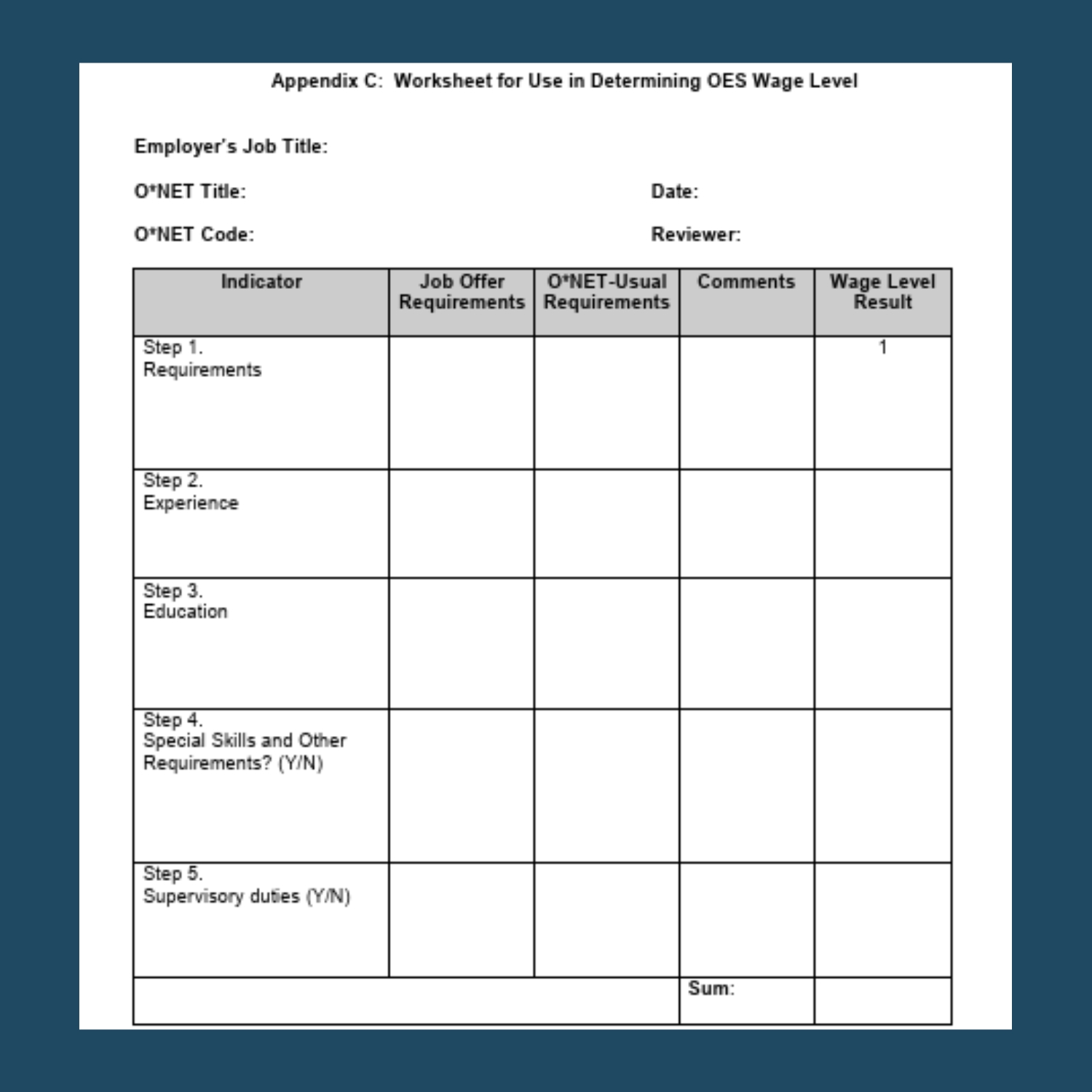
Begin by listing the normal requirements, education and experience required for the job.
H‑1B Wage Level Example
The following example shows how these tools work together in practice.
How to Apply O*NET and SVP to a Real Position
Let’s take a Software Developer role in Crawford County, Illinois, as an example. When you click into the prevailing wage entry, you’ll see the four wage levels for that occupation, including the hourly and annual wage amounts assigned to Levels I–IV.
Prevailing Wage Chart — Software Developer (Crawford County, IL)
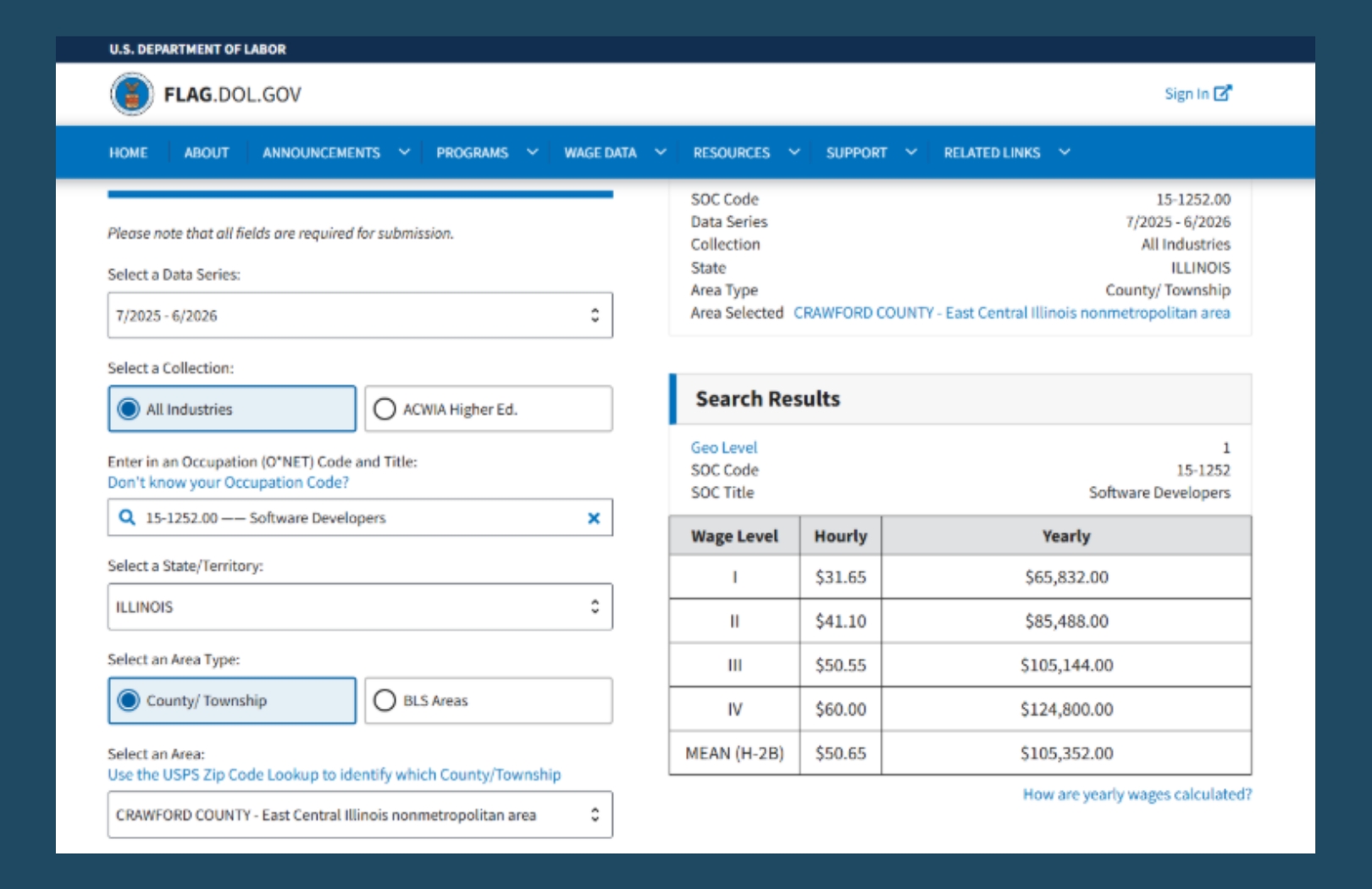
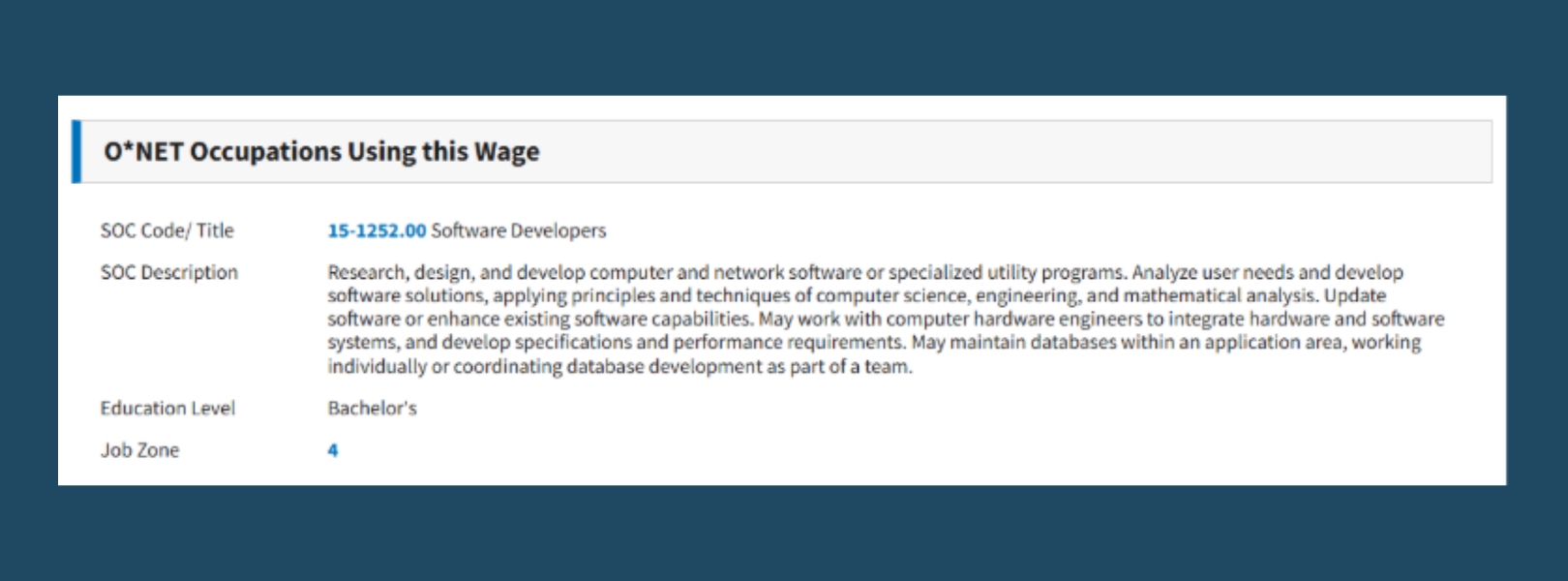
Directly beneath the prevailing wage chart, the hyperlink for SOC 15‑1252.00 opens the O*NET occupation profile. This profile provides the foundational information DOL uses to determine the “normal” requirements for the role.
O*NET Occupation Profile — SOC 15‑1252.00
The O*NET occupation profile includes the official job description, the typical education level, and the Job Zone classification, which reflects the level of preparation normally required for the occupation.
O*NET Job Titles
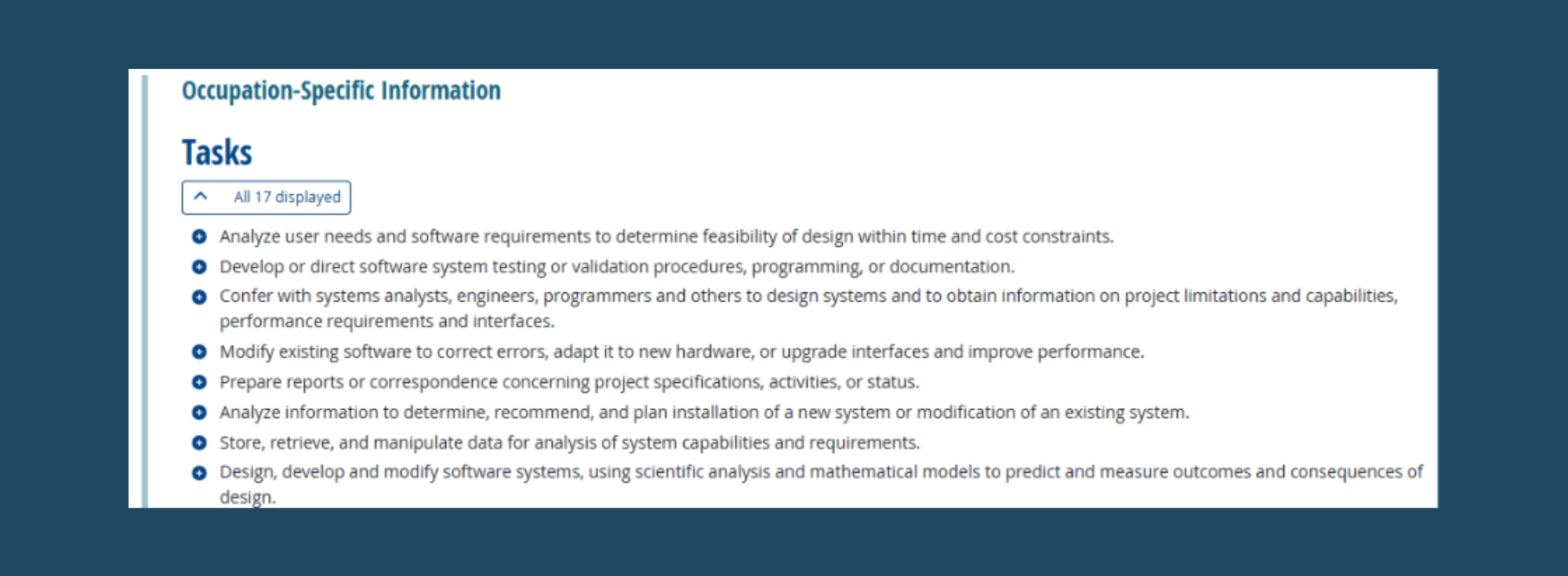
O*NET provides additional detail about the role, including common job titles and the specific tasks associated with the occupation.

O*NET Job Tasks
O*NET also lists the specific tasks associated with the occupation. These details help confirm whether the employer’s job description aligns with the standard expectations for the SOC code and whether the duties match the level of complexity reflected in the wage level.
O*NET Job Zone and SVP Range
O*NET also provides the Job Zone and SVP range for the occupation.
This information explains the level of preparation typically required for the role, including expected education, related experience and training.
The SVP range is especially important because DOL uses it to determine what level of experience is considered “normal” for the occupation.
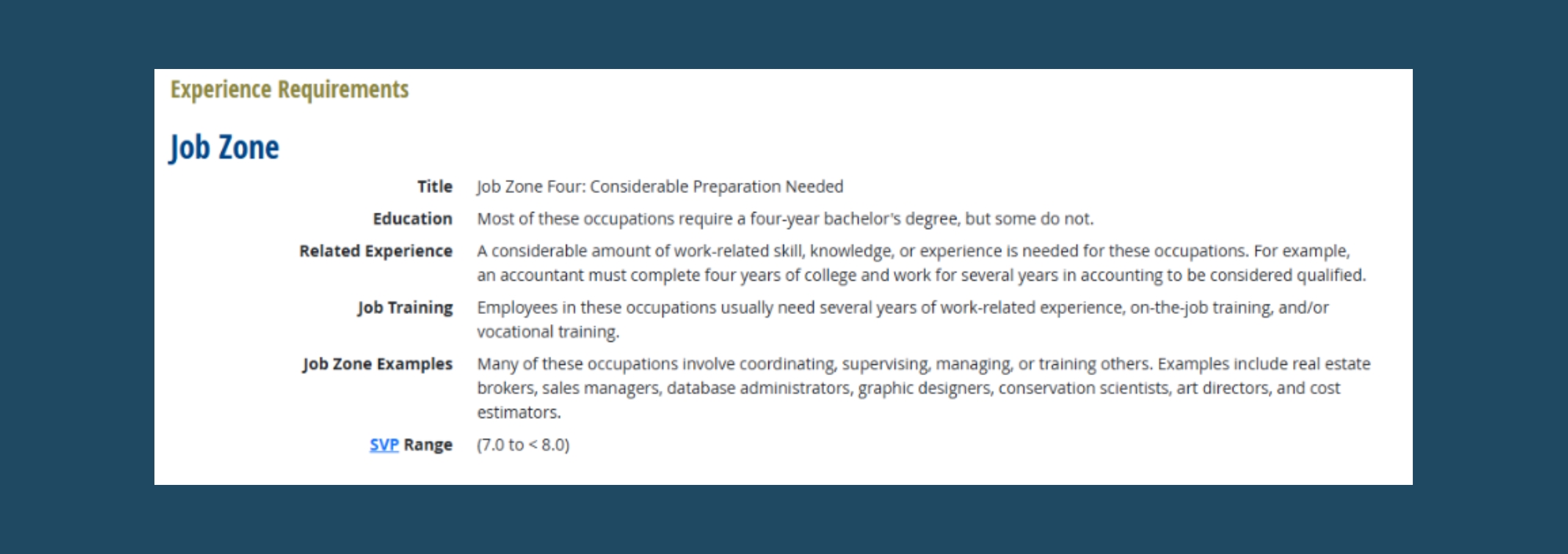
For a Software Developer, O*NET lists an SVP range of 7.0 < 8.0.
DOL SVP Levels and How They Determine H‑1B Wage Level Requirements
DOL's SVP Levels
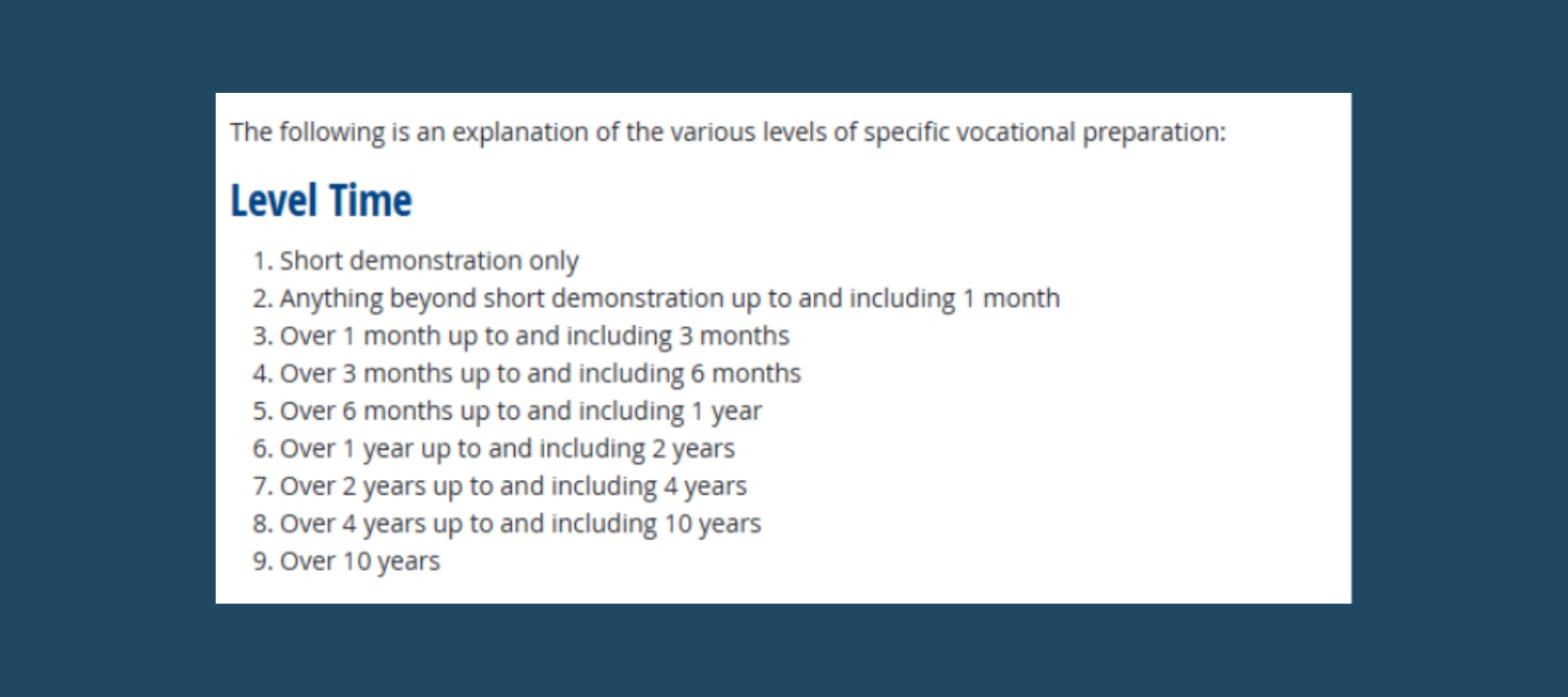
According to DOL’s SVP definitions:
- SVP 7 corresponds to “over 2 years up to and including 4 years” of preparation.
- SVP 8 corresponds to “over 4 years up to and including 10 years” of preparation.
Understanding SVP Through Education
A bachelor’s degree equates to two years of SVP, and a one‑year master’s degree adds one additional year. For Software Developers, the SVP range of 7.0 < 8.0 reflects up to four years of preparation, including the two years automatically credited for a bachelor’s degree.
Applying the Example
O*NET classifies Software Developers as requiring “considerable preparation,” typically a bachelor’s degree and a couple of years of related experience. With those normal requirements established, the next step is to compare them to the employer’s actual H‑1B position.
Add one wage‑level point for each area where the job exceeds what is typical for the occupation—education, experience, special skills and supervisory duties. Finally, total the points in each column to determine the appropriate wage level, up to a maximum of Level IV.
Employer Checklist for Setting and Defending the Wage Level
Before committing to a wage level, employers should evaluate both the compensation context and the regulatory factors that determine whether the level is defensible.
Employers should consider:
- Job title and actual duties
- Most accurate SOC code
- Exact worksite location
- Actual wage paid to similarly situated employees
If increasing the wage for registration, employers should ensure:
- The offered wage is the actual wage that will be paid if the H‑1B is selected.
- The wage complies with all DOL prevailing wage requirements.
- The increase does not create inconsistencies with wages paid to similarly situated employees in the same geographic area.
- The wage does not deviate from wages paid to U.S. workers in a manner that could raise concerns about discrimination.
As employers navigate the first year of the new weighted H‑1B lottery, having immigration counsel that can navigate the wage‑level strategy is key.
This guide is designed to help you stay informed amid an increasingly complex landscape, giving you the clarity and confidence to support your U.S.-based foreign national population and make defensible wage‑level decisions for the FY 2027 cap season.

The Weighted H‑1B Cap Selection Rule
Many employers have questions about the new wage‑weighted H‑1B lottery and what it means for FY 2027 cap season planning. For a deeper dive into the rule, its impact and what employers should expect, explore our detailed FAQ with Sherry Neal.
About Envoy Global
At Envoy Global, we understand that your ability to attract and retain global talent is a business imperative. You need the right talent in the right roles, and you need a partner who can help get you there.
We provide comprehensive corporate immigration services in the U.S. and in 180+ countries worldwide. With deep immigration expertise, proprietary technology and coordinated, responsive support, we help organizations and their employees successfully navigate the complexities of immigration.
If you have questions about the content in this guide or want to talk about how we can help shape your immigration program, please contact us.
Sherry Neal
Partner
Sherry Neal is an immigration attorney with more than 20 years of exclusive experience in U.S. immigration law. She advises Fortune 500 companies, nonprofits and healthcare organizations on employment‑based immigration strategy, compliance, and workforce mobility. A longtime AILA leader, she has served as Chair of the Ohio Chapter, on the Board of Governors and on the Healthcare Committee. Sherry’s work has been widely published, and she is a frequent speaker for bar associations, trade groups and employer organizations.