- Home
- Insights & Immigration News Alerts
- Insights
- The 2026 H‑1B Alternatives and Global Talent Toolkit
GUIDE | Updated July 2026
H‑1B Alternatives and Global Talent Toolkit
This toolkit is designed to help HR and mobility teams evaluate alternatives to the H‑1B visa in 2026. It provides attorney‑informed insights on eligibility, cost, timing and long‑term workforce planning. Use it as a reference when assessing candidates, responding to H‑1B non‑selection or building a more flexible global talent strategy.
Contents
Contents
-
Navigating the H-1B Visa Landscape in 2026
- When H-1B Alternatives Offer a Better Fit
-
What’s Inside the 2026 H-1B Alternatives Guide
-
Step 1: Overview of Key U.S. Visa Categories
-
Step 2: Understanding the Cost Landscape in 2026
-
Step 3: Processing Timelines by Visa Category
- H‑1B Alternatives Decision Toolkit
-
Identifying Your Visa Alternatives
-
How Envoy Global Helps with H-1B Alternatives


The H‑1B visa is one of the most recognized pathways for U.S. employers hiring global talent, but it’s not the only option, and depending on your organization and hiring needs, it may not be the most efficient pathway for employing foreign talent.
Navigating the Guide
To learn more about each visa category, including costs, processing timelines and employer considerations, read onward.
You can also use the table of contents on the left to navigate directly to specific sections.
If you’re ready to evaluate alternative pathways immediately, our H-1B Alternatives Decision Toolkit guides you through a series of questions to identify which non‑H‑1B visa categories may be viable for your organization.
Navigating the H-1B Visa Landscape in 2026
The challenges employers are facing this year make it clear that relying on a single visa category is no longer sustainable. Shifting selection rules, rising program costs and increasing pressure to secure talent quickly have created an environment in which organizations need more predictable and flexible immigration strategies than the annual H‑1B lottery can provide.

Why Employers Need an H-1B Alternative in 2026
Employers are navigating one of the most unpredictable H‑1B environments in recent years, driven by several compounding challenges:
- A very limited filing window, with H‑1B cap petitions accepted only during a short period each fiscal year, typically in March.
- High lottery uncertainty, with non-selection continuing to disrupt hiring plans for critical roles.
- Wage‑weighted selection rules that affect selection odds, leaving some roles in higher‑cost regions at a disadvantage.
- Significantly increased USCIS filing fees—including the new $100,000 consular processing fee—which make the H‑1B financially out of reach for many employers.
- Consular delays and processing backlogs that make start‑date planning difficult and unpredictable.
- Rising retention pressures, pushing employers to seek visa pathways that support long‑term workforce planning rather than relying on a once‑a‑year lottery.
- Tightening budgets, prompting teams to reassess whether the H‑1B remains the most cost‑effective option for each role.
When H-1B Alternatives Offer a Better Fit
For high‑priority roles, urgent hiring needs or candidates with specialized backgrounds, alternative visa pathways may offer faster timelines, more predictable outcomes and better alignment with workforce planning. They give employers the flexibility to choose the immigration strategy that best fits the role, the candidate’s qualifications and the organization’s immediate and long‑term hiring goals.

How Employers Are Diversifying Their Visa Alternatives
As employers continue to diversify their sponsorship strategies, the H‑1B is no longer the sole pathway used across many organizations.
Findings from our 2026 U.S. Corporate Immigration Trends Report show that employers are increasingly relying on a broader mix of visa categories to meet hiring needs and reduce dependence on a single option.
The breakdown below reflects visa usage across U.S. employers, based on Envoy Global’s 2026 U.S. Corporate Immigration Trends Report:
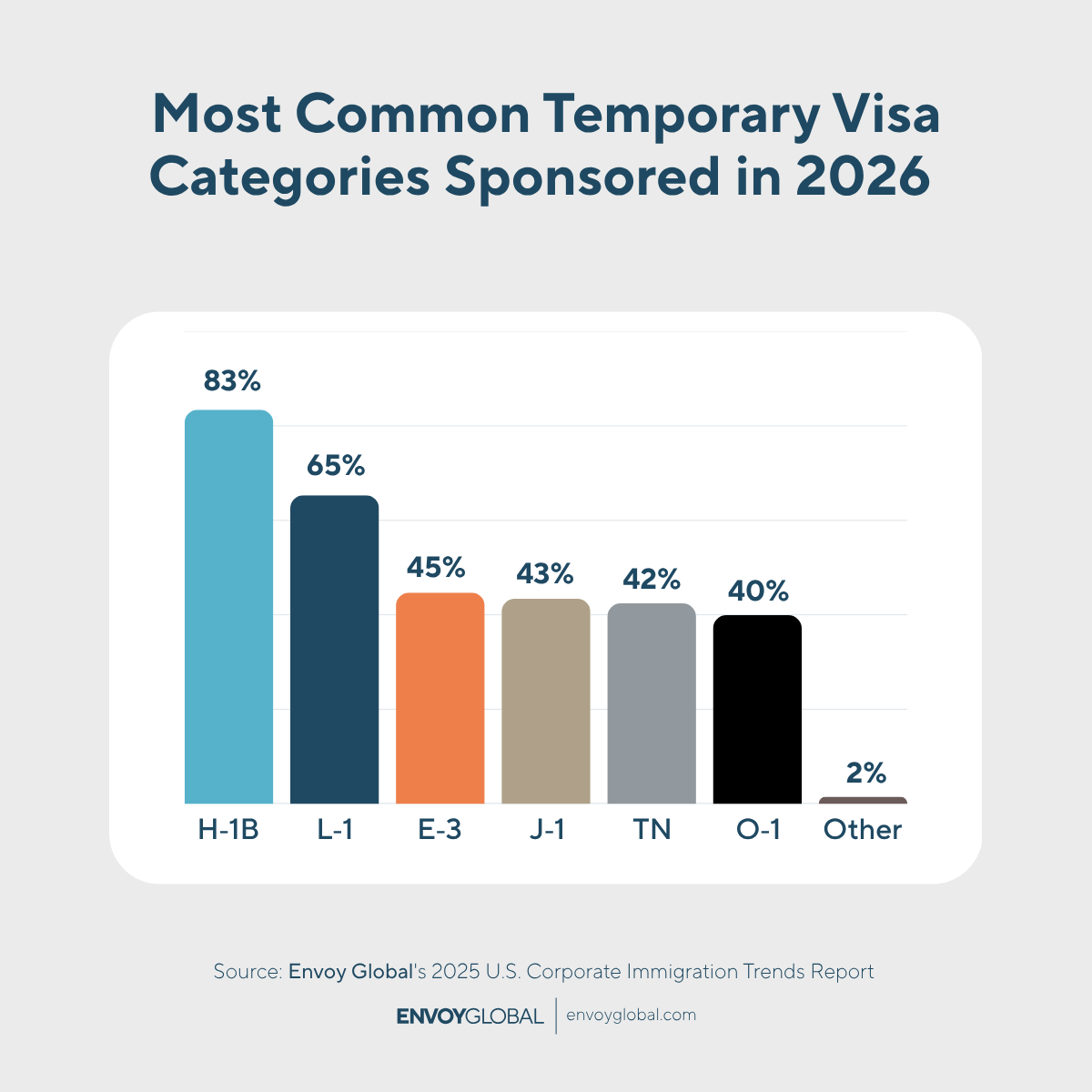
This shift highlights a broader trend: employers are expanding their visa portfolios to improve predictability, reduce risk and support a wider range of hiring scenarios.
Evolving Business Needs Require Evolving U.S. Work Visa Strategies
At the same time, organizations themselves are changing. The visa category that once felt like the best fit for a team or function may no longer align with new business priorities, workforce models or long‑term planning. As companies grow, restructure or expand globally, their talent pathways need to evolve with them and relying on a single visa category becomes increasingly limiting.
What’s Inside the 2026 H-1B Alternatives Guide
To help employers navigate these challenges and build a more flexible, predictable immigration strategy, we created this guide as a practical resource for exploring alternatives to the H-1B visa. It’s designed to give U.S.-based HR and mobility teams a clear, accessible overview of visa categories that may better support your hiring goals and the needs of the foreign national employees who rely on you.
Inside, you’ll find an overview of each pathway:
- Eligibility requirements
- Typical costs
- General hiring timelines
You’ll also see the scenarios in which each visa category may be the strongest fit for your organization’s talent goals — whether you’re responding to an H‑1B non‑selection, dealing with urgent hiring needs or building a long‑term global mobility strategy.
To begin, it’s important to understand the eligibility landscape across the most commonly used alternatives.
Step 1: Overview of Key U.S. Visa Categories
Beyond the H‑1B, there are numerous U.S. visa categories that employers rely on to hire and retain global talent. Each category was designed by the U.S. government to meet different workforce needs across industries, seniority levels and organizational structures.
To run a successful immigration program in 2026, it’s essential for employers to understand the eligibility requirements, qualification criteria and practical use cases for each pathway.
Many organizations discover that a visa category they haven’t previously used may be a stronger fit for certain roles for various reasons, including faster timelines, more predictable outcomes or greater flexibility than the H‑1B.
Below is an overview of the most-commonly-used U.S. visa categories employers rely on when evaluating alternatives to the H‑1B.
O‑1 Visa: Extraordinary Ability
Overview of the O‑1 Visa Categories
The O-1 category is for individuals at the top of their field in sciences, business, education, arts, athletics or the motion picture/television industry. It includes the following subcategories:
- O‑1A: Science, business, education, athletics
- O‑1B: Arts, film, television
- O‑2: Essential support personnel for O‑1 talent
- O‑3: Dependents of O‑1/O‑2 holders
To learn more about the specifics of this visa category, visit our O-1 visa overview.
Examples of Approved O‑1 Visa Cases
Several examples of approved O‑1 cases include a film producer with network television credits, an athlete competing for a major rugby team, an organ‑transplant physician with significant research publications, a machine‑learning engineer developing autonomous vehicle features or a director of biotechnology operations leading innovative technology initiatives.
TN Visa: Canadian & Mexican Professionals
Overview of the TN Visa Category
The TN category is for Canadian and Mexican citizens working in professions listed under the United States–Mexico–Canada Agreement (USMCA). The key requirements include:
- Citizenship in Canada or Mexico (permanent residence is not sufficient)
- A job offer that falls under one of the professional occupations listed under the USMCA
- Candidate must meet the profession’s minimum qualifications
Common fields include IT, engineering, healthcare, science, business and education.
To learn more about the specifics of this visa category, visit our TN visa overview.
Examples of Approved TN Visa Cases
Common examples of approved TN cases include registered nurse, professor, statistician, accountant and engineer (including mechanical, software, electrical and machine learning engineers).
L‑1 Visa: Intracompany Transfers
Overview of the L-1 Visa Categories
The L-1 category is for employees transferring from a foreign office to a related U.S. entity. The subcategories include:
- L‑1A: Executives and managers
- L‑1B: Specialized knowledge employees
The key requirements include:
- Qualifying corporate relationship (parent, subsidiary, affiliate or branch) between the U.S. company and the foreign company
- Employment with the foreign entity for at least 12 months during the last three years
- Employment during the required period in a role that was either manager, executive or involved specialized knowledge
- A job offer with the U.S. entity in a position that is either manager, executive or specialized knowledge
To learn more about the specifics of this visa category, visit our L-1 visa overview.
Examples of Approved L-1 Visa Cases
Common examples of approved L‑1 cases include vice president, manager of production engineering and product specialist.
E Visa Categories: Treaty Traders & Investors
Overview of the E Visa Categories
The E visa category for nationals of treaty countries engaging in substantial trade or investment with the U.S. The subcategories include:
- E‑1: Treaty Traders
- E‑2: Treaty Investors and Essential Employees
- E‑3: Australian Specialty Occupation Workers
To learn more about the specifics of this visa category, visit our E visa insight.
Examples of Approved E‑1 and E‑2 Visa Cases
Common examples of approved E‑1 or E‑2 cases include engineers, managers and other essential employees supporting trade or investment activities.
Examples of Approved E‑3 Visa Cases
Common examples of approved E‑3 cases include engineers, software developers, teachers, marketing managers, graphic designers and other professional occupations.
P Visa Categories: Athletes & Entertainers
Overview of the P Visa Categories
The P visa category is for internationally recognized athletes, artists and entertainment groups. Subcategories include:
- P‑1: Athletes and Entertainment Groups
- P‑2: Artists/Entertainers in reciprocal exchange programs
- P‑3: Culturally Unique Performers
- P‑4: Dependents
To learn more about the specifics of this visa category, visit our P visa insight.
Examples of Approved P Visa Cases
Common examples include soccer players, tennis players and recording artists.
J‑1 Exchange Visitor Program
Overview of the J-1 Visa Category
The J‑1 category is for individuals participating in approved cultural, educational or professional exchange programs.
However, it has limited applicability—not only because it is restricted to certain role types (such as interns, trainees, researchers and professors), but also because employers cannot directly petition for a J‑1 unless they operate an approved J‑1 program approved by the Department of Homeland Security. Companies without their own program must work through a designated sponsor organization.
Most international physicians use the J‑1 for U.S. medical residency or fellowship programs sponsored exclusively by the Educational Commission for Foreign Medical Graduates (ECFMG). Some universities also maintain approved J‑1 programs and use them for professors and researchers. Other common J‑1 categories include research interns in engineering and other internship roles.
To learn more about the specifics of this visa category, visit our J visa insight.
Examples of Approved J-1 Visa Cases
Common categories under the J‑1 program include interns, trainees, researchers, professors and physicians.
F‑1 Students & OPT/STEM OPT
Overview of the F-1 Visa Categories
The F-1 category is for international students studying in the U.S. Work authorizations (besides on-campus employment or employment based upon unforeseen economic necessity) include:
- OPT: Up to 12 months of post‑completion work (per academic level – bachelor’s, master’s or PhD)
- STEM OPT: Additional 24‑month extension beyond regular OPT for employment with an E-Verify employer if the student has a degree in a STEM field
- Curricular practical training: Employment/internship while a student is attending school (which may be after OPT and STEM OPT if a student returns to school for a higher degree)
To learn more about the specifics of this visa category, visit F visa insight.
B‑1 Business Visitors
Overview of the B-1 Visa Category
The B-1 is for short‑term business travel such as meetings, conferences, or negotiations. It is not a work visa but may be used for preliminary or exploratory business activity.
Citizens of certain countries may enter as a visitor under the ESTA program, which bypasses the need for a “visa” from a US consulate.
To learn more about the specifics of this visa category, visit our B visa insight.
H‑2A & H‑2B Temporary Workers
Overview of the H-2 Visa Categories
The H-2A and H-2B category is for temporary or seasonal labor needs. The subcategories include:
- H‑2A: Agricultural roles
- H‑2B: Non‑agricultural seasonal roles
However, like the H-1B, both the H-2A and H-2B are subject to annual limits and a lottery. To learn more about the specifics of this visa category, visit our H-2 visa insight.
Examples of Approved H-2A Visa Cases
Common examples of H‑2A workers include crop harvesters and poultry workers.
Examples of Approved H-2B Visa Cases
Common examples of H‑2B workers include landscapers, resort maintenance workers, amusement park workers and seafood processors.
Employment‑Based Green Cards
Overview of the Green Card
There are various permanent residence pathways for long‑term workforce planning, each with its own criteria. The categories include:
- EB‑1: Priority workers (extraordinary ability, outstanding professors/researchers, multinational managers)
- EB‑2: Advanced degree professionals or exceptional ability
- EB‑3: Skilled workers, professionals and other workers
- EB‑4: Special immigrants
- EB‑5: Investors
To learn more about the specifics of this visa category, visit our green card overview.
Step 2: Understanding the Cost Landscape in 2026
In 2026, an organization’s visa strategy isn’t just about eligibility—it’s also about cost. With H‑1B filing fees rising, wage‑based selection rules reshaping budgets and consular delays adding new layers of expense, it’s increasingly important for employers to compare the cost differences across visa categories.
The following section breaks down the typical cost ranges, government fees and long‑term financial considerations associated with the most-commonly-used alternatives to the H‑1B.
Employers can use this information to forecast budgets, evaluate cost‑effective pathways and identify options that align with both immediate hiring needs and long‑term workforce planning.

Visa Cost Factors in 2026
In 2026, employers are facing a more complex cost environment than in previous years. Several factors are driving this shift:
- Rising H‑1B filing fees have increased the total cost of pursuing the category, especially for high‑volume or high‑wage employers.
- Wage‑weighted selection rules mean some employers may need to budget for higher wages to remain competitive in the lottery.
- Consular delays and administrative processing can add unexpected expenses, including travel changes, extended onboarding timelines and additional legal support.
- Premium processing reliance has increased across categories as employers seek predictable start dates, but the cost of premium processing has risen as well.
Understanding these cost drivers helps employers evaluate whether the H‑1B is the most strategic investment for a given role or whether an alternative pathway may offer a more cost‑efficient and predictable solution.
The ranges below provide a general estimate of employer costs for the most common H‑1B alternatives.
Actual government filing fees vary based on the individual petition type, required documentation and whether premium processing is used. These amounts also do not include attorney or immigration service fees.
| Visa Category | Typical Employer Cost Range | What Drives Cost | Premium Processing Available? |
| TN | ~$1,000–$2,500 | Border vs. USCIS filing, attorney support, consular fees | Yes (if filing with USCIS) |
| E‑3 / H‑1B1 | ~$1,500–$3,000 | Consular fees, LCA prep, attorney support | Yes (for E‑3/E‑3D/E‑3R with USCIS; H‑1B1 is not eligible) |
| B‑1 | ~$185–$1,000 | Consular fee, limited attorney involvement | No |
| F‑1 OPT / STEM OPT | ~$500–$3,000 | SEVIS fees, E‑Verify compliance, and attorney support for STEM OPT | No |
| J‑1 | ~$1,500–$5,000+ | Sponsor fees, SEVIS, consular fees, program category | No |
| L‑1 | ~$4,000–$10,000+ | Fraud fee, corporate documentation and premium processing | Yes |
| O‑1 | ~$5,000–$12,000+ | Evidence-heavy filings, expert letters and premium processing | Yes |
| P Visas | ~$4,000–$10,000+ | Union consultations, itineraries and premium processing | Yes |
| E‑1 / E‑2 | ~$3,000–$12,000+ | Business plans, corporate documentation, consular prep | No (consular-based) |
| H‑2A / H‑2B | ~$3,000–$8,000+ | DOL recruitment, seasonal renewals, consular fees | No |
| Green Card (EB‑1/2/3) | ~$8,000–$20,000+ | Multi‑stage filings, PERM recruitment and I‑485 fees | Yes (for I‑140 stage only) |
Government Filing Fees
Government filing fees vary widely by visa type and employer size. Some categories (TN, E‑3) have minimal government fees, while others (H‑1B, L‑1, O‑1, P, green cards) involve multiple stages and higher filing costs.

How Employers Allocate Their Immigration Budgets
According to our 2025 U.S. Corporate Immigration Trends Report, most employers dedicate the largest share of their immigration budgets to government filing fees — particularly for nonimmigrant visas like H‑1B, L‑1 and O‑1.
Additional major spend areas include green card government fees, PERM‑related legal costs (including testing the U.S. labor market) and attorney fees for non‑immigrant sponsorship.
Notably, 27% of employers reported that their budgets are spread across all of these categories, underscoring how complex and multi‑layered immigration costs have become.
This trend highlights why understanding cost ranges across visa categories is essential for building a predictable, sustainable immigration strategy in 2026.
Premium Processing
Many employers use premium processing to secure predictable start dates, which adds $1,780 to $2,965 to the total filing cost, depending on the type of petition.
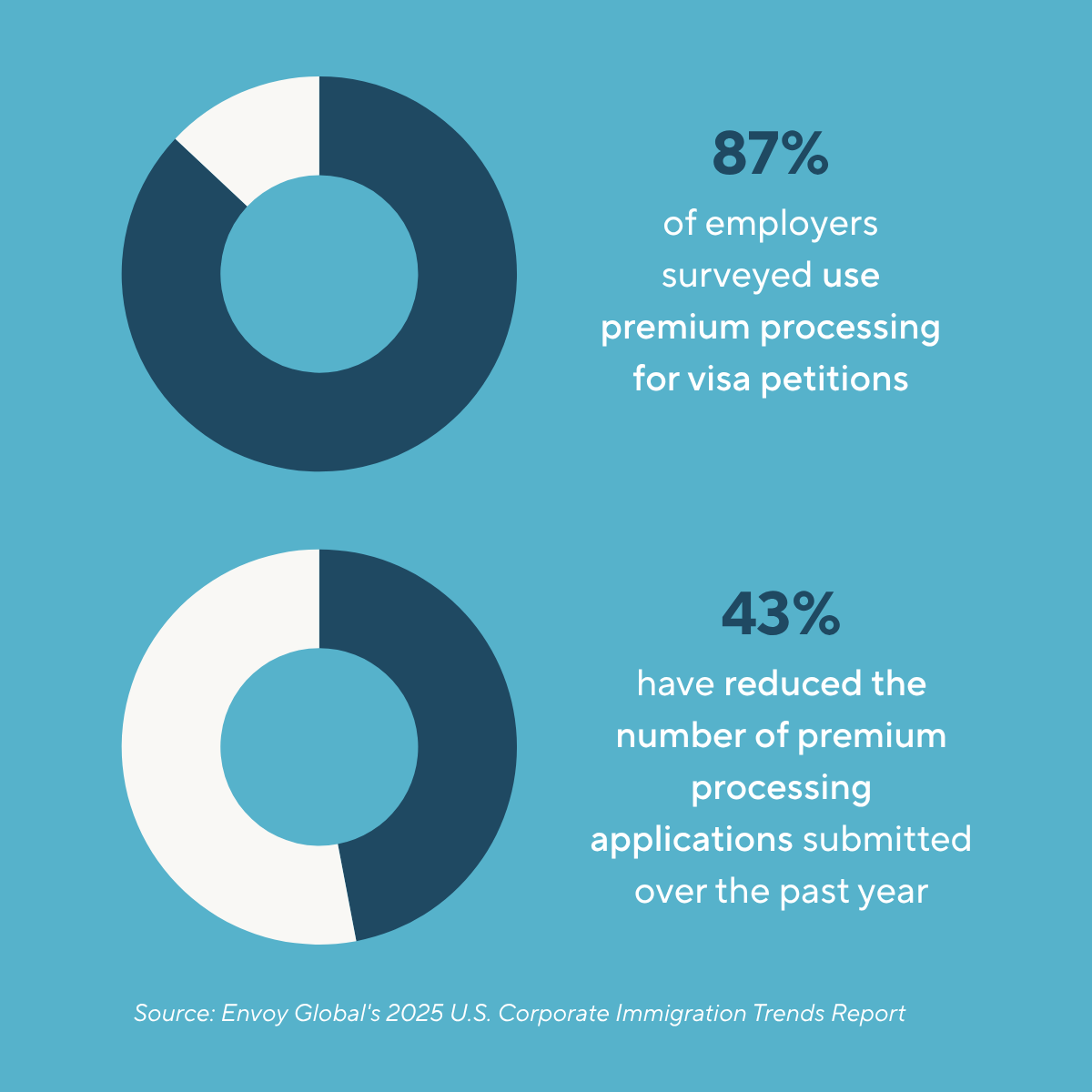

The most frequent reason for not using premium processing is the filing fee. USCIS has increased the premium processing fee significantly over the last few years. As a result, some clients have chosen not to include premium processing unless there is a specific business reason to do so.
Additionally, because premium processing is one of the few fees an employee may cover, some clients allow the employee to decide whether to use it. If so, the employee may pay the fee without a specific business justification.
A typical example of a business necessity might be when an employee needs case approval before traveling abroad for business.
Managing Attorney
Consular Fees & Travel
Consular appointments, Machine Readable Visa (MRV) fees and travel expenses can add unexpected costs, especially during periods of consular backlog.

Some visa categories have higher up‑front costs (such as O‑1 or L‑1), while others have lower initial fees but higher long‑term expenses due to frequent renewals (such as TN or P visas).
Understanding both the immediate and ongoing financial impact helps employers choose the most cost‑effective pathway for their workforce strategy.
Partner
Step 3: Processing Timelines by Visa Category
The next factor employers should consider when evaluating their visa‑alternative strategy is the overall hiring timeline. Unlike the H‑1B, most alternatives aren’t tied to a once‑a‑year lottery, giving employers far more flexibility to file year‑round. However, timelines can vary significantly by visa category, and understanding those differences is essential for planning in 2026–2027.
The following section breaks down the typical processing times, key steps and factors that can speed up or slow down each visa pathway.
The chart below provides some current processing estimates.
| Visa Category | Typical Document Preparation | Average Government Processing | Notes |
| L‑1 (Intracompany Transferee) | 1 to 4 weeks | USCIS: ~6.5 months under regular processing, but 15-business-days for premium processing
Consular: Varies by post |
Timelines vary based on corporate structure documentation, qualifying relationship evidence and consular appointment availability.
If the employer has a Blanket L approval, the employee can apply directly at the consulate without an individual petition approval from USCIS, except for L-1 B without a degree. |
| TN (USMCA – Canada/Mexico) | 1 to 2 weeks | Border/POE: Same day
USCIS: ~2.5 months under regular processing, but 15-business-days for premium processing
Consular: (for Mexican citizens): ~1 –3 months (varies by consulate) |
Timelines vary based on whether the job description aligns with the TN professions list and whether the case is filed at the border or through USCIS.
A Canadian citizen can apply directly at the port of entry without USCIS approval; a Mexican citizen can proceed directly at the consulate without USCIS approval. |
| H‑1B1 (Chile/Singapore Specialty Occupation) | 1 to 2 weeks | Consular: ~2–4 weeks (varies by post).
USCIS (extensions / changes of status): ~5 months under regular processing, but 15-business-days for premium processing |
Timelines vary based on consular appointment availability, LCA processing, documentation quality and whether the case is filed abroad or through USCIS.
A person may apply directly at the consulate without a petition approval from USCIS. |
| O‑1 (Extraordinary Ability) | 1 to 2 months | USCIS: ~10.5 months under regular processing, but 15 business days under premium processing
Consular: Varies by post |
Timelines vary based on the volume and complexity of evidence, expert letters, and the availability of consular appointments.
A petition approval from USCIS is required before a person can obtain a visa at a U.S. consulate |
| J‑1 (Exchange Visitor) | Can vary depending on the program sponsor | Consular: Varies by post | Processing depends heavily on program sponsor timelines. |
| F‑1 (Student) | Can vary depending upon registration and acceptance at school, and issuance of Form I-20 from the university | Consular: Varies by post | School responsiveness and SEVIS updates affect timing.
The student can apply for a visa directly at U.S. consulate, and a Canadian citizen can apply directly at the port of entry with a passport, Form I-20 and supporting documents. |
| F‑1 OPT / STEM OPT | 1 to 2 weeks after the I-20 is issued by the university | OPT: ~2.5–5 months (USCIS)
STEM OPT: ~2–4 months (USCIS) |
Timelines vary based on school responsiveness, SEVIS updates, E‑Verify compliance and USCIS workload. |
| P Visa (Athletes/Entertainers) | 1 to 4 weeks | USCIS: ~10 months under regular processing, but 15-business days under premium processing
Consular: Varies by post |
Timelines vary based on union consultation requirements, itinerary documentation, case complexity and consular appointment availability. |
| Employment‑Based Green Card (EB‑1/2/3) | (varies by stage) | PERM: 14 –18 months after filing
I‑140: 8-12 months under regular processing, but 15-business days under premium processing
I‑485: 8–18+ months, but can vary if priority date retrogresses while I-485 is pending |
Multi‑stage process with the longest overall timeline. |
| H‑2A/H‑2B (Temporary Workers) | Varied depending upon lottery filing time-period | H‑2A: ~15 days
H‑2B: ~5 months
Consular: Varies by post |
Timelines vary based on seasonal demand, cap limits, DOL recruitment requirements and consular appointment availability. |
| B‑1 (Business Visitor) | 1 to 2 weeks for preparation | Consular: Varies by post.
Citizens of countries that qualify under ESTA can bypass the consulate and apply directly online before departure (1 to 2 days) |
Appointment availability varies widely by location, with some consulates taking as long as one year to process visitor visa requests.
However, sometimes an expedited appointment can be issued. |
| E‑1/E‑2 (Treaty Trader/Investor) | 2 to 4 weeks | Consular: ~2–4 months
USCIS: ~2–5 months (USCIS currently reports that some I‑129 E‑filings may take up to ~11 months under Service Center Operations) |
Timelines vary based on consular appointment availability, the quality of the business plan and corporate documentation, and whether the case is filed abroad or through USCIS. |
| E-3 (Australian Specialty Occupation) | 2 to 3 weeks | Consular: ~2–4 weeks (varies by post)
USCIS (for extensions or changes of status): ~2–5 months |
Timelines vary based on consular appointment availability, LCA processing, documentation quality and whether the case is filed abroad or through USCIS.
A person may apply directly to the consulate without a USCIS petition. |
USCIS estimates processing times using its online Processing Times tool.
Why U.S. Work Visa Timelines Vary
While USCIS provides estimated processing timelines, these timeframes can vary significantly due to factors such as:
- Consular appointment availability, which varies by country and season. In recent months, the U.S. government has canceled or rescheduled some consular appointments for various reasons.
- USCIS workload and backlogs, especially during peak filing periods.
- Security checks or administrative processing, which can add weeks or months.
- Third‑party dependencies, such as unions (P visas), program sponsors (J‑1) or academic institutions (F‑1).
- Presidential proclamations, including those that restrict or limit the entry of certain foreign nationals.
Because of these variables, timelines should be treated as planning ranges—not guaranteed dates.

Working with an experienced immigration provider helps ensure:
- An accurate, complete petition
- Accurate job descriptions and eligibility assessments to avoid RFEs
- Strategic planning around consular wait times and premium processing
- Proactive issue spotting before filing
- Consistent communication between HR, managers and foreign nationals
This reduces the risk of delays after filing and helps employers move talent more efficiently through the process.
Once you understand eligibility, cost and timing, the next step is determining which pathways best align with your specific hiring scenario. The following decision tool walks you through that process.
H‑1B Alternatives Decision Toolkit
Now that you’ve reviewed the key factors that influence visa selection—eligibility, timing, predictability, cost, worksite flexibility and long‑term planning—it’s helpful to bring those pieces together. With so many pathways available, HR and global mobility teams often need a structured way to determine which options best align with a specific role, candidate profile or business need.
This decision tool is designed to simplify that process. By walking through a series of guided questions, you’ll get a sense of which visa categories may be a strong fit for your situation. Whether you’re responding to an H‑1B non‑selection, planning for urgent hiring needs or building a long‑term global talent strategy, this tool provides a structured way to identify potential pathways that may fit your organization’s goals.
Key Questions to Consider Before Exploring Alternatives
Before exploring the potential H-1B visa alternatives, consider the following questions. Your answers will help narrow down the most relevant pathways:
- How quickly do you need the employee to start?
- Does your organization have offices outside the U.S.?
- What is the candidate’s citizenship?
- Does the candidate have notable achievements (publications, patents, awards, leadership roles)?
- Is the role seasonal, specialized, managerial, creative or early‑career?
- Are you planning to retain this employee long‑term?
Once you have these answers in mind, move through the steps below.
Disclaimer: This tool is for informational purposes only and does not constitute legal advice. Visa eligibility is highly fact‑specific, and the only way to determine whether a candidate qualifies for a particular category is through a detailed assessment with a qualified immigration attorney.
STEP 1 — Hiring Timeline: What’s Your Immediate Need?
When timing is the primary driver, the fastest options are those that allow same‑day adjudication, premium processing, consular‑based filings or visa transfers for individuals already in the U.S. The categories below reflect realistic onboarding windows based on current USCIS and consular processing trends.
Fastest Start (within 4 weeks)
Potential Options:
- TN (Canada citizen— same‑day at border/point-of-entry)
- B‑1 (short‑term business needs) with an existing B-1 “visa” or eligible under the ESTA program
- Visa transfer options for candidates already in the U.S. in another work‑authorized status (case‑specific), with premium processing (15-day business-day processing)
Moderate Timeline (1–3 months)
Best for roles where onboarding is important but not immediate.
Potential Options:
- E‑1 / E‑2 / E‑3 (consular timelines often fall in this range)
- J‑1 (DS‑2019 issuance + consular scheduling)
- L‑1 (with premium processing: 15 days)
- O-1 (with premium processing: 15 days)
- TN (if filing through USCIS or a Mexican citizen applying at a consulate)
- F‑1 OPT / STEM OPT (for students transitioning to employment)
Longer‑Term Workforce Planning
For long-term retention, employers need to consider sponsoring permanent residence for foreign national employees to transition from non-immigrant (temporary) status to permanent residence.
Potential Options:
- EB‑1, EB‑2, EB‑3
- L‑1A → EB‑1C
- O‑1 → EB‑1A
- PERM‑based pathways (multi‑stage, longest overall timeline)
STEP 2 — Does Your Organization Have a Foreign Office?
Your company’s global footprint plays a major role in which visa pathways are available.
If you have a qualifying foreign entity, the L‑1 category may be a good option, assuming the candidate has worked for the foreign entity at least 12 months within the past three years in a role that is either manager, executive or involves specialized knowledge, and the position in the U.S. will be either manager, executive or specialized knowledge.
Yes — We Have a Qualifying Foreign Entity
Potential Pathways:
- L‑1A (executives/managers)
- L‑1B (specialized knowledge employees)
Best For:
- Executive or manager roles (people manager or functional manager)
- Employees with “specialized knowledge” (advanced knowledge or unique knowledge about the company’s product or process)
Not Possible For:
- New hires with no prior employment abroad
If Not This, Consider:
- O‑1
- TN (if Canada/Mexico)
- E‑3 (Australia)
No — We Do Not Have a Foreign Office
Move to Step 3.
STEP 3 — Candidate Citizenship
Several visa categories are nationality‑specific. Confirming the candidate’s citizenship early helps you identify pathways that may be uniquely available to them.
Canada or Mexico
Potential Pathway: TN
Best For:
- Fast onboarding
- Low‑cost, predictable adjudication
- STEM, business, healthcare and education roles – must be one of the professional occupations listed on the USMCA
Australia
Potential Pathway: E‑3
Treaty Country (E‑1/E‑2 Eligible)
Potential Pathways:
- E‑1 (trade)
- E‑2 (investment)
To find out if your foreign national employee is from a Treaty Country, visit here.
Other Countries
Move to Step 4.
STEP 4 — Extraordinary Ability or Achievement
Some visa categories are designed specifically for individuals with notable achievements or industry recognition. This step helps you determine whether the candidate may qualify for an extraordinary‑ability pathway, even if they are early in their career.
Yes — The Candidate Has Notable Achievements
Potential Pathways:
- O‑1A / O‑1B
- EB‑1A (for long‑term planning)
Substantial evidence of multiple accomplishments, such as:
- Publications in professional journals
- Patents
- Original research contributions
- Awards by industry organizations
- Presentations at major industry conferences
- Work cited by others in the field
- Working in a critical role with an organization that has a distinguished reputation
- A high salary compared relative to the occupation
Not Sure
Ask yourself if they have multiple accomplishments, such as:
- Has the candidate published research?
- Do they have patents or notable projects?
- Have they won awards or recognitions?
- Have they presented at major industry conferences?
If yes to any → O‑1 may be viable.
STEP 5 — Type of Role
The nature of the position is one of the strongest indicators of which visa pathways may fit. Certain categories are tailored to specialized STEM roles, leadership positions, creative fields, seasonal work or early‑career talent.
This step helps you align the role with the visa types most commonly used for that job profile.
Highly Specialized STEM Role
Potential Pathways:
- O‑1
- TN (if Canada/Mexico)
- E‑3 (Australia)
- H‑1B1 (Chile/Singapore)
- F‑1 STEM OPT
Manager or Executive
Potential Pathway:
- L‑1A
Creative or Entertainment Role
Potential Pathways:
- O‑1B
- P‑1 / P‑2 / P‑3
Seasonal or Project‑Based Role
Potential Pathways:
- H‑2A (agricultural)
- H‑2B (non‑agricultural)
- P visas (for performers/athletes)
Early‑Career or Student
Potential Pathways:
- F‑1 OPT
- STEM OPT
- J‑1 Intern/Trainee
Other Roles
Move to Step 6.
STEP 6 — Long‑Term Retention Goals
Employment‑based sponsorship for permanent residence is a significant retention tool. Because permanent residence offers long‑term stability and flexibility, employees may consider other opportunities if their current employer is not willing to support this process.
Permanent residence can also provide additional benefits, including easier international travel, eligibility to apply for U.S. citizenship, the ability to sponsor certain family members and, for dependent children, potential access to more favorable university tuition rates.
As a result, green card sponsorship can play an important role in an employee’s long‑term satisfaction and commitment to an organization.
Securing permanent residence can be a major factor in an employee’s long‑term stability and decision to remain with an employer.
Partner
Yes — We Want to Retain This Employee Long‑Term
Potential Pathways:
- EB‑1A
- EB‑2
- EB‑3
No — Short‑Term Need Only
Potential Pathways:
- B‑1
- J‑1
- Short‑term O‑1 or TN
Not Sure
Planning Note: If you may want to retain the employee later, choose a visa that transitions cleanly to a green card (O‑1, L‑1A, TN, E‑3).
Identifying Your Visa Alternatives
The pathways highlighted in this tool can help you quickly narrow down your options, but they’re only the starting point. Each visa category has unique requirements, documentation needs and long‑term implications for both the employee and your organization.
If you’ve identified one or more visas that may fit your situation, the next step is a detailed eligibility review with an immigration professional. An attorney can help confirm whether the candidate meets the criteria, assess timing and cost considerations, and map out a strategy that aligns with your broader workforce plans.
A strong immigration program is built on clarity, predictability and proactive planning. This toolkit provides the framework, and with the right support, you can turn these insights into a streamlined, effective global talent strategy.
How Envoy Global Helps with H-1B Alternatives
At Envoy Global, we believe a lottery shouldn’t dictate your talent strategy. While the H-1B cap presents an annual challenge, our approach is defined by proactive intervention rather than reactive filing. By combining the strategic foresight of elite legal teams with the predictive power of our technology, we help you look beyond the obvious.
This synergy of human expertise and intuitive technology ensures that your organization is never left without a “Plan B.” We don’t just help you navigate the visa landscape; we help you architect it, ensuring that your most critical team members have a secure path to stay and grow within your organization.
With Envoy Global as your partner, you gain the visibility to see around corners and the agility to secure your global workforce. Connect with us to learn more.
Sherry Neal
Partner
Sherry Neal is an immigration attorney with more than 20 years of exclusive experience in U.S. immigration law. She advises Fortune 500 companies, nonprofits and healthcare organizations on employment‑based immigration strategy, compliance, and workforce mobility. A longtime AILA leader, she has served as Chair of the Ohio Chapter, on the Board of Governors and on the Healthcare Committee. Sherry’s work has been widely published, and she is a frequent speaker for bar associations, trade groups and employer organizations.