- Home
- Insights & Immigration News Alerts
- Insights
- FAQ: Understanding the Weighted H‑1B Cap Selection Rule
GUIDE | Updated January 2026
The Weighted H‑1B Cap Selection Rule
The FAQ below outlines the latest details on the new weighted lottery model and identify key questions for you and your employees.
Contents
Contents
-
The Weighted H‑1B Cap Selection Rule
-
Overview of the New Weighted H‑1B Lottery System
-
How the Weighted Lottery Works
-
H‑1B Beneficiary‑Centric Rules and Multiple Registrations
-
Wage Levels, Worksites and Remote Work Under the Weighted Lottery
-
Interaction With the $100,000 H‑1B Fee
-
H-1B Registration Requirements and System Changes
-
Wage Changes, Job Changes and Compliance Risks
-
Employer Considerations and H-1B Strategic Planning
-
About Envoy Global


The Weighted H‑1B Cap Selection Rule
On December 23, 2025, the Department of Homeland Security (DHS) published a Final Rule to Change the Selection Process for H-1B Cap Cases from a “random” selection process to a “weighted” selection process. The new process will take effect on February 27, 2026, just in time for the upcoming H-1B cap filing season in March 2026.
The FAQ below outlines the latest details on the new weighted lottery model and identifies key questions for you and your employees.
Please note that these updates and recommendations are based on information provided by government agencies and may be subject to change as new guidance and practices emerge. We will continue to make every effort to share any updates or changes as they become available.

Navigating H-1B Reform in 2026: A 5-Step Guide for Employers
Sweeping reforms are reshaping the H‑1B visa program. Our new guide, “The $100K Question: How Trump’s H-1B Changes Impact Your 2026 Strategy,” walks you through the key 2026 H-1B questions, scenarios and strategic considerations that matter most, so you can assess risk, prioritize roles, allocate your budget and identify the right immigration pathways for your workforce.
Overview of the New Weighted H‑1B Lottery System
What is the new weighted H-1B selection system?
The new “weighted” lottery is a change from the “random” lottery for H-1B cap registrations. DHS has replaced the random H-1B lottery with a lottery system that is based on the wage levels for the applications registered in the H-1B cap. Registrations associated with higher Occupational Employment Statistics (OES) wage levels receive higher selection weight (i.e., more chances at the lottery), although all wage levels remain eligible.
Why did DHS make this change?
DHS wants to favor the allocation of H-1B cap petitions to the “higher-paid” beneficiaries because it believes wages are a proxy for “higher-skilled.” DHS states that the rule is consistent with the September 19, 2025, presidential proclamation, “Restriction on Entry of Certain Nonimmigrant Workers,” which directed Homeland Security to initiate rulemaking to prioritize the admission of high-skilled and high-paid nonimmigrant foreign nationals.
When does the new system take effect?
The rule takes effect February 27, 2026, which means it will apply to the upcoming H-1B cap registration season in March 2026.
Is there a chance the rule will be delayed?
It is unlikely that the rule will be delayed. USCIS will need to update its electronic system to capture the new job classification and wage-level information; however, the agency has stated it “is fully prepared to implement the weighted selection process from an operational and technical perspective in time for the upcoming H-1B cap season.”
Will there be an increased filing fee due to this new weighted system?
No, not on this upcoming H-1B cap season. However, DHS noted that “the new weighted selection process will require updates to USCIS IT systems for registration and additional time by USCIS adjudicators to review newly required information during the adjudication of the petition,” and stated that a fee adjustment may be determined during the next biennial fee review.
Does the rule change the annual H-1B cap numbers?
No. Federal law sets the H‑1B cap numbers, and only Congress can change them. The numbers remain 65,000 for the regular cap and 20,000 for the U.S. advanced degree exemption (“master’s cap”).
Does this weighted system apply to the master’s cap?
Yes. The weighted selection system will apply to both the regular cap and the master’s cap.
Will USCIS continue to do the lottery in two systems, starting with the master’s cap and then the bachelor’s cap?
Yes, USCIS will continue to do the Master’s cap selection first and then the regular cap selection, thereby giving beneficiaries under the master’s cap chances in both the master’s cap selection and the regular cap selection.
How the Weighted Lottery Works
How will the registrations be weighted and selected?
USCIS will assign a higher probability of selection to registrations based on the wage level offered. The chances of lottery selection will depend on the wage level, with wage offers at Level IV receiving four chances at the lottery, wages at Level III receiving three chances, wages at Level II receiving two chances, and wages at Level I receiving only one chance.
Does this mean that the lottery selections will go to the applications with the highest annual salary?
Not necessarily. The system does not use total annual salary, unlike a 2021 DHS proposal that would have ranked selections by the highest offered wages.
Instead, DHS adopted the approach it proposed in fall 2025, which bases selection odds on the wage level per occupation and area of intended employment. This method ranks the odds of selection based on wage level within the specific occupation and geographic area, rather than by absolute salary alone.
Notably, despite receiving 2,731 public comments, DHS issued the final rule without any changes from the proposed version.
How will the wage levels be determined?
The wage levels will be based on the occupation, specifically the Standard Occupational Classification (SOC) under the Department of Labor’s OES wage system. As a result, selecting the correct SOC code remains important because it determines the OES wage level used for weighting. The SOC code must accurately reflect the position.
Does the weighted system eliminate Level 1 workers?
No. DHS explicitly states that entry-level workers remain eligible, but their selection probability is lower than for higher wage levels. The agency estimates a “marked decrease in registrations selected for workers who will be paid a Level I corresponding wage” and projects that Level 1 positions will drop by more than 10,000 annually.
Will this rule decrease the chances for entry-level, yet highly skilled, employment, including new graduates?
Some commenters warned that the weighted system could undermine the “education‑to‑employment pipeline” and reduce selection chances for students on OPT and STEM OPT. DHS acknowledges that lower‑paid workers may face reduced odds but maintains that employers will offer higher wages when a beneficiary is truly in demand.
Are healthcare and/or other shortage occupations given special priority? Or are STEM occupations given priority?
No. There is no exemption or priority based on occupation. In public comments, some stakeholders, including the American Hospital Association, requested special weighting for healthcare roles, but DHS did not adopt that recommendation.
How does the weighted system affect non-profit entities?
If a nonprofit qualifies to file a cap‑exempt petition, it should continue using the normal cap‑exempt process. However, if the nonprofit does not qualify as H‑1B cap exempt, it must enter the H‑1B lottery and will be subject to the same weighted selection system as all other employers.
Are there any considerations for small employers or startups?
No. DHS is treating all employers the same, stating that “all employers have the option to pay any highly sought‑after beneficiary a higher wage.”
The H-1B Visa Explained: Everything You Need to Know
Want to understand the full H‑1B visa process? Envoy Global’s in‑depth guide explains eligibility, timelines, filing steps and compliance considerations to help employers and foreign nationals navigate each stage with confidence.
H‑1B Beneficiary‑Centric Rules and Multiple Registrations
Does the new weighted system eliminate the beneficiary-centric model?
No. The beneficiary-centric registration model, adapted in 2024, remains in place. It was designed to prevent a beneficiary from having multiple chances at the lottery by submitting multiple/numerous applications by different companies/petitioners.
Under the new system, there is still no advantage to having multiple employers register the same beneficiary – each beneficiary counts only once, regardless of how many employers submit the registration.
However, a beneficiary may receive between one and four “chances” depending upon their wage level, with four being the maximum.
The beneficiary-centric model continues to block duplicate filings from inflating a candidate’s odds, while the weighted system adds additional “weight” based on wage level.
How will a registration be weighted if a beneficiary has multiple registrations with different employers at different wage levels?
DHS will assign the lottery chance based on the “lowest applicable wage level” across all registrations submitted for a beneficiary, regardless of how many employers file.
Thus, because the lottery is beneficiary-centric, the maximum weight any beneficiary can receive is four entries for a Level IV wage.
For example, if a beneficiary has three job offers at wage levels III, II and I, the beneficiary will receive one chance in the lottery because of the lowest wage level controls.
DHS notes that “registrants will communicate with beneficiaries to make informed decisions regarding whether other companies have submitted registrations on their behalf, and under which corresponding wage level,” since the lowest wage level determines the beneficiary’s lottery chances.
How will USCIS weigh a registration when a beneficiary works in different positions for the same petitioner at different wage levels?
DHS will assign the lottery chance based on the “lowest applicable wage level” for all the positions in which the beneficiary will work.
Wage Levels, Worksites and Remote Work Under the Weighted Lottery
How does remote work affect wage level assignments?
Wage level must be based on the worksite location, not the employer’s headquarters. If the remote worksite is within the same commuting area as the headquarters, the wage level will be the same. But, if an employee works remotely in a different, more distant location, such as a different state, the difference in wage offered may influence (positively or negatively) the wage level.
For example, if a company headquartered in San Francisco, California, allows work to be done remotely from any state, then an employee who lives and works in Jackson, Mississippi, may have an advantage if the company pays wages based on national standards rather than local wages.
Does DHS know how many petitions were filed at each level in years past?
Yes. DHS reported that, over the past five years, the average distribution of H‑1B cap petitions by wage level was 28% at Level I, 55% at Level II, 12% at Level III and 5% at Level IV.
The breakdown varies slightly between the regular cap and the master’s cap.
For the regular cap, the five‑year averages were 20% at Level I, 61% at Level II, 13% at Level III and 6% at Level IV. For the master’s cap, the averages were 36% at Level I, 50% at Level II, 11% at Level III and 4% at Level IV.
What are the chances of selection under the new weighted system?
It’s impossible to predict exact selection odds because they depend on two variables that aren’t known until after the registration period closes: the total number of beneficiaries registered and how those registrations are distributed across wage levels.
However, DHS provided estimates based on the numbers from last year. If the weighted system had been in place last year, the odds of selection would have been significantly lower for level 1 and nearly the same for level 2. Specifically, the comparison is as follows:
| Level I | Level II | Level III | Level IV | Total | |
| Estimated number of beneficiaries with eligible registrations by wage level | 89,911 | 177,216 | 37,928 | 15,667 | 320,711 |
| Probability of being selected last year under the random selection process | 29.59% | 29.59% | 29.59% | 29.59% | N/A |
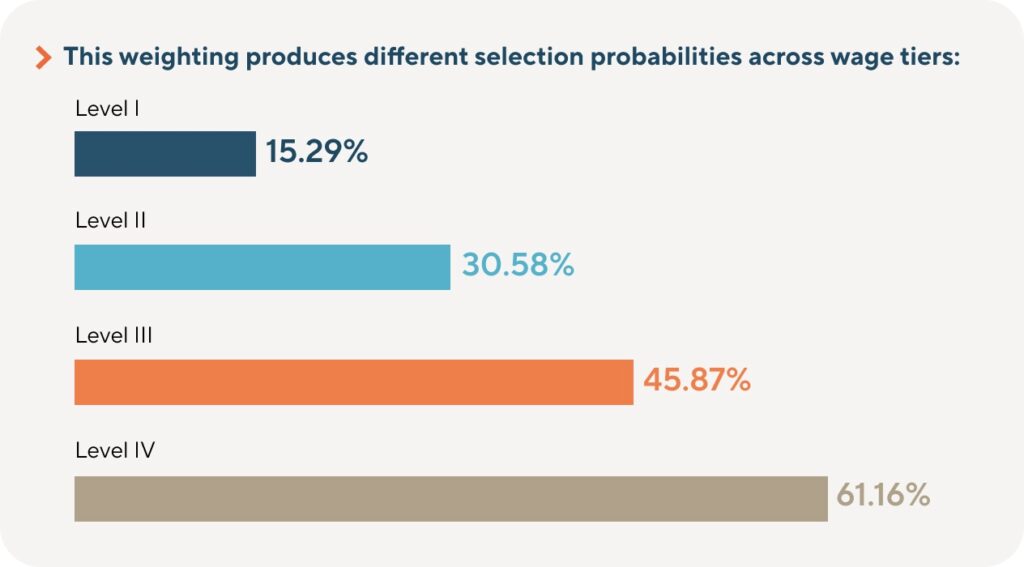
| Probability of being selected under the weighted selection process, based upon last year’s filings | 15.29% | 30.58% | 45.87% | 61.16% | N/A |
The chart below illustrates how the weighted system changes selection odds across wage levels. Higher wage tiers receive proportionally higher chances of selection, based on last year’s filing distribution.
Interaction With the $100,000 H‑1B Fee
On September 19, 2025, President Donald Trump issued a proclamation titled “Restriction on Entry of Certain Nonimmigrant Workers,” introducing a new $100,000 supplemental fee for certain new H‑1B petitions. The fee primarily applies to offshore cases and aims to prioritize higher‑paid, higher‑skilled workers. Federal agencies have begun releasing preliminary guidance, but several implementation questions remain, and USCIS states that it will grant exceptions only in “extraordinarily rare circumstances.”
How will this weighted system correlate to the $100k fee for H-1B?
The weighted lottery system is separate from the $100,000 fee; however, the two policies interact because the fee is likely to influence the number of H-1B petitions filed. DHS notes that “the combined effect of the two policies could further disadvantage businesses that lack the resources to pay the $100,000 fee and higher wages”.
Since the $100,000 fee applies to offshore (consular processing) cases, there is likely to be a drop (perhaps significantly) in the total number of H-1B registrations. While USCIS has not released historical data on the percentage of H-1B cap cases that are change of status vs. consular processing, in the 2023 proposed rules to Modernize H-1B Requirements, DHS noted a “significant percentage of H–1B beneficiaries do not enter the U.S. within six months of the requested employment start date or H-1B petition”.
Between FY2017 and FY2022, the data shows that an average of 42% of consular‑processing cases involved beneficiaries who did not enter the U.S. within six months of the validity date. The $100,000 fee discourages employers from sponsoring foreign nationals, even when they need the individual in the U.S. at the beginning of the H-1 B validity period.
If the executive action establishing the $100,000 fee withstands the court challenges and if USCIS grants exceptions only in “extraordinarily rare circumstances” as USCIS guidance has indicated, it is reasonable that the overall number of H-1B cap filings will drop.
If so, this could offset some of the impact of the weighted lottery system since the odds of selection will be based upon three factors:
- The overall number of H-1B beneficiary registrations;
- The wage level offered relative to the occupation and geographic area; and
- The number of registrations under each wage.
H-1B Registration Requirements and System Changes
How will USCIS capture additional information on wage levels in the registration process?
DHS is revamping the electronic registration system to collect additional information about the job–offer details needed for the weighted lottery. The agency also intends to revise Form I-129 to capture the information and compare the consistency (SOC code, worksite location, wage offered and wage level) between the registration and the H-1B petition filing.
Will this new weighted system complicate the H-1B registration and/or H-1B petition filings?
Yes. Employers must provide additional information and analysis at the registration stage—including the SOC code, wage offered and wage level—and ensure that these details match the H‑1B petition for each selected registration.
This change requires employers to finalize job details—such as location, wage and wage level—at the time of registration rather than after H‑1B selection, and it locks in the wage level as of the registration date.
DHS estimates an additional cost burden of $15 million for petitioners during the registration process and an additional cost burden of $15 million for petitioners on the H-1B petition filing.
Does the rule change the LCA process?
No. The LCA process remains the same. However, the wage level now directly ties to selection probability, which makes accurate classification even more important.
Wage Changes, Job Changes and Compliance Risks
Can employers change wage levels after selection?
DHS cautions that USCIS may scrutinize any post‑selection wage changes. Employers must ensure the wage level used in registration is bona fide and consistent with the eventual petition.
While USCIS may accept non-material changes (i.e., an offered wage that is lower than the registered wage but still at the same wage level), USCIS will not accept a drop in wage level.
Does this rule require employers to pay the beneficiary at the wage level listed in the registration, even after future job changes?
The new rule allows USCIS to deny a subsequent new or amended petition filed by the petitioner, or a related entity, on behalf of the same beneficiary if USCIS were to determine that there was an attempt to “unfairly increase the odds of selection during the registration” process such as by “reducing the wage to an amount that would be equivalent to a lower wage level than that indicated on the original registration.”
While this rule mentions subsequent petitions filed “by the petitioner or a related entity”, the USCIS may consider changes in wage levels on any subsequent petition to determine whether the original offer was a bona fide job and/or whether unrelated companies colluded with one another for a beneficiary’s benefit.
Could there be more Requests for Evidence and/or denials on H-1B cap petitions based upon this weighted system?
Yes. It is possible, and perhaps likely, that the weighted system will lead to more Requests for Evidence (RFEs) and/or denials.
First, petitioners will need to choose their work location and salary earlier in the process, at the time of registration rather than filing. This necessarily means there is greater chance of errors and/or changes in business plans from registration to H-1B filing.
Second, DHS warns that the new system may increase scrutiny of SOC code selection because wage level now affects selection probability.
Therefore, it will be even more important for employers to ensure the SOC code:
- Accurately reflects the job duties;
- Aligns with the Labor Condition Application (LCA);
- Matches the offered wage and required skills. A misclassification may risk an RFE, if selected in the lottery, and could result in denial if it is not the appropriate SOC for the position.
Third, a reduction in the wage level in a subsequent new or amended petition by the same petitioner or related entity for the same beneficiary may incur extra scrutiny to determine if the initial petition was to “unfairly increase the odds of selection”.
In addition, USCIS may look for what it calls “wage manipulation” (i.e., manipulating the timing of wages by decreasing beneficiary wages while on OPT or STEM OPT to apply those unpaid wages to H-1B registration and H-1B employment period).
Impacts of RFEs on H-1B Petitions
When a petition receives an RFE, employers should expect:
- Longer processing times: USCIS responses often take 60+ days, with delays possible during peak periods
- Higher costs: Preparing additional documentation increases both internal workload and external legal fees
- Employee uncertainty: RFEs can create anxiety for foreign nationals awaiting approval to begin or continue work
Employer Considerations and H-1B Strategic Planning
What are the factors employers should consider in each H-1B cap registration?
Employers will need to give careful consideration to:
- The job title and job duties;
- The most accurate SOC code for the position;
- The exact worksite location;
- The actual wage paid to other employees in the same position with similar duties and skills, including not only current employees but also other H-1B workers being registered for the H-1B cap.
From a policy perspective, won’t this new rule result in some companies offshoring more work overseas, rather than participating in the H-1B lottery system?
DHS does not believe the rule will push companies to offshore more work or move operations overseas. Instead, the agency states that U.S. employers “are more likely to change their hiring practices in the U.S.”
Can an employer raise the wage offered to an H-1B registrant to improve the odds of selection?
The decision to increase the wage offered in an H-1B registration is a multi-factored decision. First, if an employer decides to raise the wage offered, it must be the actual wage the employer will pay the employee if selected in the lottery. DHS noted that “Rational employers will not offer wages exceeding the expected value of the employee’s work.”
Second, the wage must comply with Department of Labor regulations, including the requirement that wages be free from other obligations. For example, an employer cannot shift H‑1B filing costs to the employee or reclassify those employer‑paid costs as part of the employee’s “compensation.”
Third, employers need to consider the impact a wage increase may have on other employees, H-1B workers, as well as other workers. An employer must pay H-1B workers the higher of the prevailing wage and actual wage paid to other employees with the same experience and qualifications in the same place of employment.
Thus, increasing the wage for one H-1B registrant may result in an employer having to increase the wage of other H-1B employees if those other employees have the same experience and qualifications and are working in the same area as the H-1B registrant.
Moreover, if an employer increases the wage for an H-1B registrant, the company may face discrimination charges if U.S. workers similarly employed are paid less than the H-1B registrant.
Can an employer change the work location of a beneficiary where a wage offered to the beneficiary would result in a higher wage level?
DHS said, “this rule does not prevent employers from making business decisions about the location or relocation of their operations and terms of employment for their employees. If an employer chooses to move a position to a low-cost area while retaining a salary commensurate with a high-cost location…this is in the purview of the business.” But, of course, this is permissible only “if the employer is offering a bona fide position at that location and the beneficiary will in fact work in that location” and “attempts to then move the beneficiary back to a high-cost location would be heavily scrutinized”.
About Envoy Global
We understand that your ability to attract and retain global talent is a business imperative. You need the right talent in the right roles, and you need a partner who can help get you there.
We provide comprehensive corporate immigration services in the U.S. as well as 180+ countries worldwide. Our deep immigration expertise, highly connected, coordinated and responsive support and proprietary technology help organizations and their employees successfully navigate the complexities of global immigration.
Reach out today to learn how Envoy Global can support your company’s immigration needs.

Sherry Neal
Partner
Sherry Neal is an immigration attorney with more than 20 years of exclusive experience in U.S. immigration law. She advises Fortune 500 companies, nonprofits and healthcare organizations on employment‑based immigration strategy, compliance and workforce mobility. A longtime AILA leader, she has served as Chair of the Ohio Chapter, on the Board of Governors and on the Healthcare Committee. Sherry’s work has been widely published, and she is a frequent speaker for bar associations, trade groups and employer organizations.
Smarter H-1B Planning for a Changing World.
The immigration landscape has shifted under the current administration, from new wage-based selection rules to heightened scrutiny. Connect with Envoy Global to build a cap plan that navigates the new complexities with confidence and compliance.